
Recently I’ve had a few conversations about the possibility of combining NFTs with science museums, including people in blockchain circles and in the VR industry. I’m recording my thoughts here:
The digitization of museums is nothing new; it’s been underway for many years, especially in many overseas museums, which long ago digitized most of their collections and made them public on the internet. Of course, digital exhibition halls and the like have also already been built in great numbers. Our own Tsinghua Science Museum is not behind the times either: every exhibition is turned into a “3D Digital Exhibition Hall”.
But the current kind of digitization is basically still rather thin: it amounts to taking a number of photographs and turning physical exhibits or physical museums into digital versions. The basic logic still cannot break out of so-called “virtual reality” — in my previous articles I’ve repeatedly emphasized that the metaverse is not virtual reality, not a “close approximation” measured against reality, not a simulation or copy of reality, but a transcendence of reality and a redefinition of reality. In this sense, the current physical museum has not yet truly entered the “metaverse.”
Some overseas art museums have also noticed the potential of NFTs and have begun trying to combine them with NFTs. But I think that if one wants museums to combine the virtual and the real and enter the metaverse, the best path may not be to start with art museums, but with science museums.
The great works of art that already exist are still mainly flat pictures; even sculptures and installations are generally relatively static and not very interactive. Performance art, by contrast, moves toward the other extreme: it is entirely contextualized and dynamic, and lacks reproducibility.
So the digitization of art museums is often rather clunky as well. Flat paintings remain flat in digital space; exhibits without interactivity remain non-interactive in digital space. If one really wants to design three-dimensionality and interactivity, then a great deal of re-creation is actually required, but then such an exhibition becomes something new of its own.
Of course, I believe that in the metaverse era, new artistic forms will keep emerging, and in the future there will be more and more “native digital artworks,” meaning works that are born first in digital form rather than being measured against a real-world original. All kinds of NFTs beginning with crypto punks are in fact things of this sort, and this new generation of artworks will also have new forms of exhibition in the future. But digital museums emerging in this sense can no longer draw on historical depth. At least for now, emerging digital art has not yet formed a weighty historical foundation.
What I’m imagining here, however, is a digital museum that on the one hand still takes root in the physical world and draws meaning from thick layers of culture and history, while on the other hand stepping into the “metaverse” and redefining exhibition through new forms. The most suitable kind of museum for this is a science museum.
The exhibits in a science museum are the exact opposite of the static, flat, non-reproducible collections in the art museums mentioned above: they are interactive, three-dimensional, and reproducible. I discussed the characteristics of scientific instruments and their educational significance in “The Biography of Things,” so I won’t repeat myself here. What can be added is this: the digital version of a scientific instrument is very likely to be more educationally meaningful than its physical version or model version.
As for the significance of the restoration research on scientific artifacts and the exhibition of restored replicas, I don’t need to say much more; Wang Zheran and others have plenty of experience and arguments. Compared with precious originals, which are often damaged, lost, or at least difficult to interact with, restored replicas sometimes make it easier to bring visitors closer to the history of science. Compared with flat instruments on drawings, those remade restoration models are easier to interact with. But if the material of so-called restored replicas is not wood or plastic, but digital? The effect that can be achieved is actually the same, or even better.
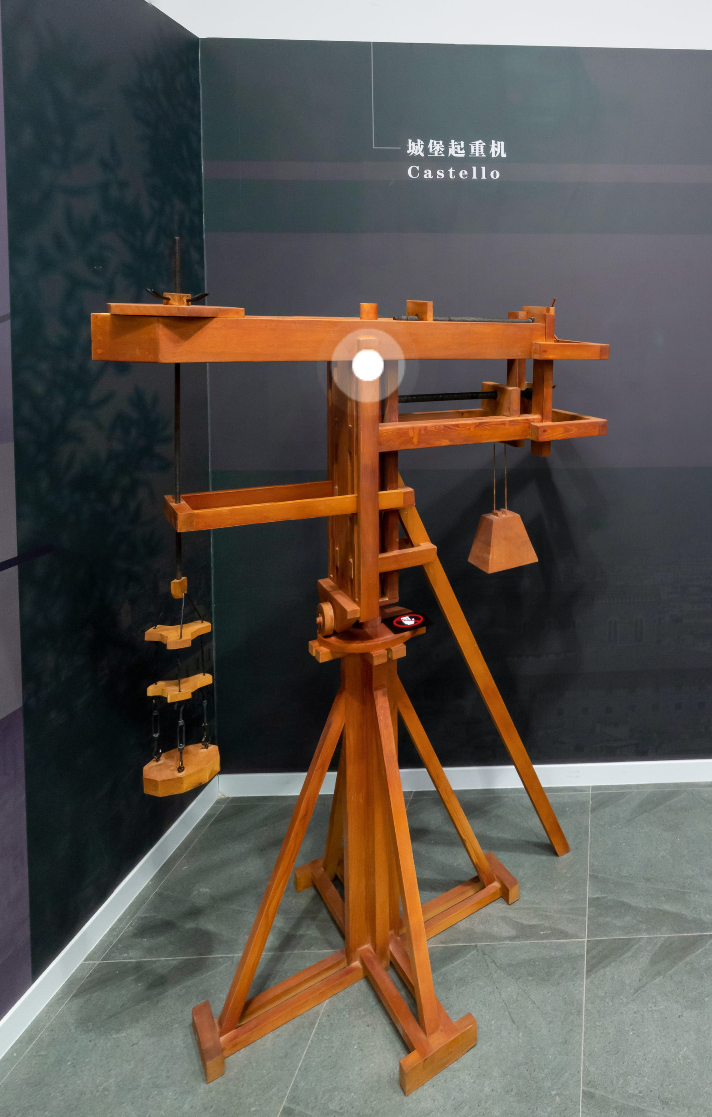
Take, for example, this “castle crane,” designed by Brunelleschi for the construction of Santa Maria del Fiore. It stands 17 meters high and requires three people to operate. Its engineering details were fully recorded by Leonardo da Vinci, and Wang Zheran’s team therefore reconstructed this crane on the basis of Leonardo’s manuscript. But the model in the exhibition hall is only a little over a meter tall; although it is much more spectacular than looking at a drawing, it is still far from the original experience.
In virtual space, by means of VR technology (the metaverse is not VR, but VR is one of the key technical components of the metaverse), we can very easily view a crane that is more true to life than any physical model: if it is 17 meters, then it is 17 meters. Visitors can even take part in operating the machine, or experience the ascent and descent in the hoisting basket. Of course, the entire experience can be set against a digital version of Santa Maria del Fiore or of its construction site. Visitors can play Leonardo da Vinci, who at the time, as an apprentice, toured Santa Maria del Fiore and learned from Brunelleschi and other pioneers.
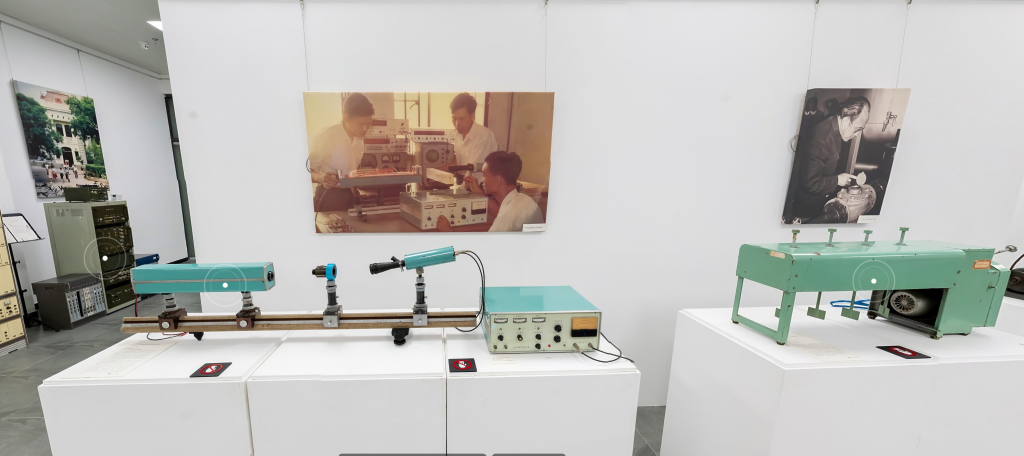
Many artifacts in the history of science and the history of technology need to be placed in scenes and situations in order to better convey scientific knowledge, scientific spirit, and so on. For example, Tsinghua’s own scientific instruments were not necessarily all that special in their day, but what matters is the story behind them. Our current exhibition method is to pair them with an old photograph, presenting the arduous struggle of Tsinghua researchers in those years. But if one could restore the VR historical scene, the effect should be even better.
Speaking of which, what I’ve really been talking about is still the potential for virtual-reality-ization of digital museums; NFTs haven’t really entered the picture yet. So what role can NFTs play? Quite obviously, one very direct function is to serve as an incentive of name and profit.
The pursuit of reputation need not be taboo in museum work. The collection of museum holdings has always depended on donations, and although donors do not seek profit, they always hope to leave a reputation behind. For example, if an exhibit is donated, the donor’s name is always indicated in the display. The convenience of NFT technology lies first of all in its ability to mark out the contributors (not limited to donors), and to preserve every record of transfer after a digital collectible has circulated or been distributed. In addition to donors, researchers, investors, exhibition designers, and so on can all continually record their contributions in the blockchain ledger for all future viewers to consult.
The existing NFT copyright rules include the traditional copyright approach and the completely open CC0 approach, but it seems that not many people have yet tried the CC-BY or, to put it another way, copyleft model. Non-profit digital collectibles might try licensing in a copyleft manner, which is to say that anyone may view, use, or improve them, but all original attributions must be preserved, and any new version published after one’s own improvements must likewise be licensed openly in the same way. Wikipedia has already proved that copyleft is an effective protocol for knowledge dissemination, capable of incentivizing communities to create together.
Besides reputation, the second benefit is assurance in terms of interest. Of course, museum exhibition itself should be non-profit; I do not think that this basic attribute of the museum needs to change in the digital age. But museums also have revenue-generating methods beyond exhibition. For example, if the exhibition models I have researched and designed are used to develop toys, souvenirs, and the like, then I still have the right to earn royalties.
In disseminating knowledge and providing public exhibition, museums must maintain openness and public benefit, but interest-based incentives beyond that are also beneficial. In particular, conducting research, writing stories, organizing explanations, making models, developing VR scenes, and so on all require large and sustained financial input, and it is very hard to keep going on public-spirited enthusiasm alone. This may also be one reason why the application of VR technology in museums has progressed relatively slowly.
NFTs may provide substantial and lasting financial income. Every digitized collectible can enter the market as an NFT and be freely bought and sold. As with existing NFTs, the initial creator of an NFT can collect a large sum from the first issuance, and can even issue it in unreveal form to raise funds; thereafter, the creator can collect royalties from every future transaction.
What authorization the person who buys the NFT receives is something that can be negotiated and discussed. In fact, even if no authorization is granted at all, people still willingly pay for it; for example, the mfer below is an NFT issued under CC0, and it is also extremely popular. Among its total of more than ten thousand pieces, even the cheapest one is worth at least tens of thousands of dollars. The motivations of collectors may be to seek reputation, dignity, or bragging rights, and the most important thing is that NFT holders can join self-organized communities centered on a particular culture. “Displaying taste” and “qualifying for group membership” are also valuable for circles related to science museums. Of course, while ensuring free exhibition, one can also grant holders of digital collectibles more permissions, such as rights for secondary development of toys, gifts, and so on, or a share of sales from these derivative products.

Of course, at present the policy environment and other external conditions in China are still unclear; the ideas above are merely fantasies. I hope they can bring some inspiration to the relevant academic and industrial circles, and perhaps help some fields begin to explore and experiment first.
Translated from the Chinese original with AI assistance. The original text is authoritative.