
This piece was submitted to the article by the new media outlet “歪脖三观,” founded and hosted by Jiang Gungun, and I was honored that it became the inaugural founding text of that media platform. When it was published, it was shortened and polished, and the title was changed to “The Ambition of Blockchain: Anti-Keynesianism, Public Life, and Transhumanism.” Everyone is welcome to repost and follow it. I am posting here the unedited original draft:
EDCON2023 in Montenegro has come to a close. In addition to the usual topics of the crypto community, this year’s grand gathering also had a substantial block of topics related to transhumanism/longevity. The earlier “A Conversation on Transhumanism at SeeDAO” also counted as a warm-up for SeeDAO’s Montenegro activities. Then, during the Montenegro event, on May 21 I also took part in a small gathering invited by SeeDAO and gave an online talk, with the theme: “The Human Condition in the Digital Age—A Void Real World vs. a Real Virtual World,” which was also arranged within the “transhumanist” segment of the program (because of equipment failure on site, it was actually moved to the “public goods” segment afterward).
Why does the crypto community care about “transhumanism”? The simplest explanation is: “the leader likes it.” Vitalik (Vitalik Buterin, commonly known as V God) is the founder of Ethereum and the undisputed leader of the Ethereum community. He himself has long been interested in longevity, and has provided funding to relevant research institutions. He advocates the “Parable of the Dragon Tyrant,” and believes that letting people age without striving to eliminate aging and death is immoral.
Of course, Vitalik is not an exception. We can indeed feel that, compared with other industries, blockchain pioneers and the crypto community seem more enthusiastic about transhumanism or longevity. This preference can be traced back to Hal Finney, Bitcoin’s “number two” — as a transhumanist, when he was dying of ALS, he chose cryonic preservation, hoping that future technology would bring him back to life.
As Kelsie Nabben’s article says, the “overlap between transhumanism and cryptocurrency” lies first in the idea of “longtermism” — “the immutability of blockchain makes it the perfect long-term infrastructure.”
Below, I will try to further expand on this overlap and complete my brief talk at the time, “The Human Condition in the Digital Age.”
“In the long run we are all dead”
This is Keynes’s famous remark. Keynes advocated active economic policy (especially monetary stimulus) to regulate the market and save society from crises such as depression or unemployment. Keynes’s opponents, by contrast, argued that one should believe in the market’s own capacity for self-regulation; they believed that so-called market imbalances, inflation or deflation and the like, were only temporary, and that “in the long run” the market could repair itself. In response to these objections, Keynes uttered this famous line: “In the long run we are all dead.”
Setting aside the mocking or ironic tone, Keynes’s point was this: the key issue is not whether the market can regulate itself automatically, but rather the question of time scale. Spontaneous market repair may take decades before its effects become clear, whereas the crucial point is that violent fluctuations on a three-to-five-year time scale can already cause severe social problems. Therefore, the government should step in to stabilize things and keep market fluctuations as smooth as possible.
After Keynes, it became a worldwide convention for governments to use various monetary tools such as interest-rate hikes and reserve-requirement cuts, as well as policy instruments like taxation and welfare, to regulate the market in order to achieve stabilization goals such as “2% inflation.” The legitimacy of “fiat credit money,” regulated and issued by the central bank, is also to a large extent built on Keynesianism — if the money supply is limited, then the central bank will lose many monetary tools on which it relies to regulate the market; the value of money in the market will lose stability and may fluctuate sharply. Therefore, the power of coinage should be firmly held in the hands of the central bank, so that the government can coordinate regulation and protect market order so that it remains as smooth and stable as possible.
Keynes’s theory makes sense. He shattered the “God’s-eye view” of some market omnipotentists (though on the other hand, he also tempted the government to play the role of God). When I discussed the unemployment crisis brought about by artificial intelligence, I also expressed a similar position: for example, when you face a group of unemployed people caught in a technological wave, you casually say, “Don’t worry, in the long run new technologies will bring new jobs, or improve the conditions of human survival; the unemployment crisis is only temporary…” But this temporary pain may last decades, and the unemployed people now in distress may not live to see the day when they enjoy the good life brought by new technologies. Nor can those heavily indebted wage earners say to the bank, “In the long run I’ll pay it back, so don’t make me repay my mortgage in the short term.”
The Dilemma of Keynesianism
Keynesianism rose to fame during the Great Depression. It was born in response to an urgent market crisis, and perhaps at the time it did in fact play a role — though this is also disputed, so let us set that aside and tentatively assume that Keynesianism contributed to saving the social crisis of the Great Depression. But the problem is that, as a central regulatory mechanism for “emergency relief,” the monetary-stimulus measures that were meant to avoid crises later became the norm.
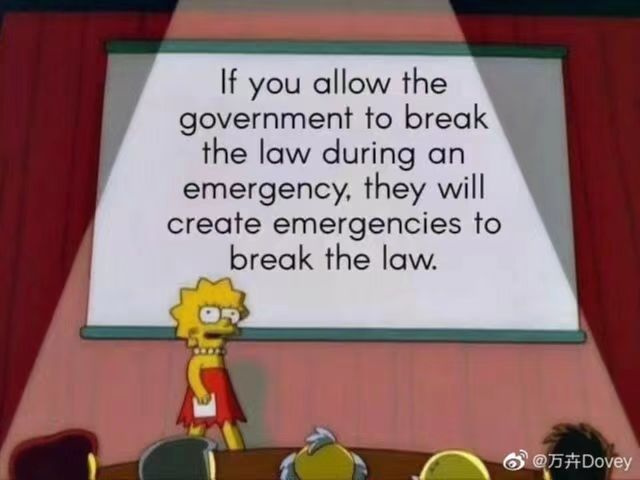
Especially after the collapse of the Bretton Woods system in the 1970s, credit money turned into a runaway horse and was issued without limit. Although credit money claims to be backed by bonds to prevent abuse, facts have shown that the “debt ceiling” can be broken again and again.
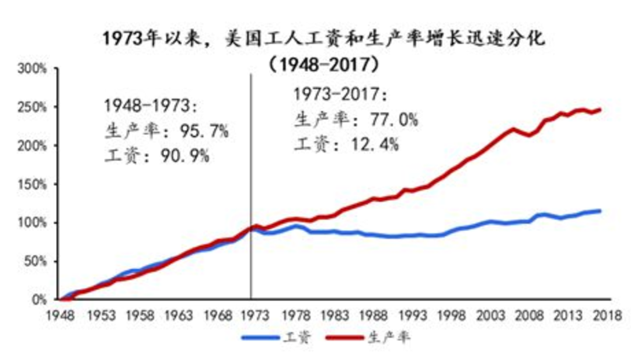
The meaning of inflation also seems to have drifted beyond the scope of stimulating the market. More often than not, inflation seems to serve only to promote the nominal wage growth of bottom-layer laborers, thereby masking the stagnation of real income. Precisely after the 1970s, the real wages of American workers fell into stagnation, and the wealth gap gradually widened.
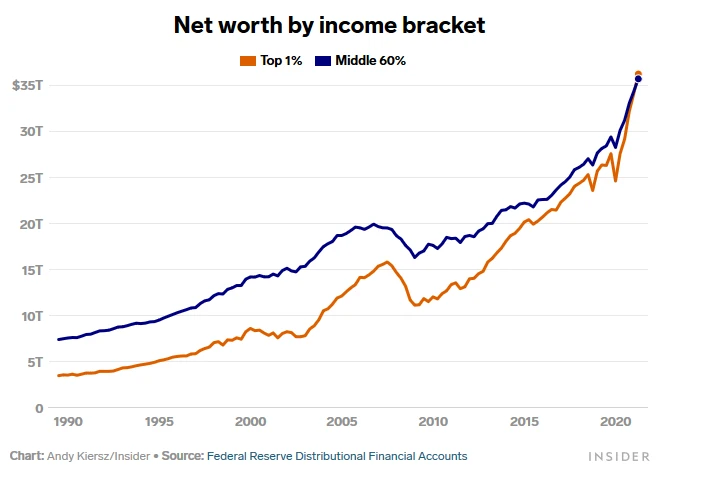
Thanks to all sorts of flashy monetary policies, the United States also safely weathered the 2008 financial crisis, allowing many people to continue praising this monetary system regulated by the central bank. But others grew increasingly dissatisfied. They believed that, on the one hand, the crisis itself was the result of these monetary policies — just like saying that “withdrawal symptoms” can be relieved by taking more drugs, yet the reason withdrawal symptoms occur in the first place is entirely due to the credit for taking drugs, so treating monetary stimulus as an effective market-regulation tool is as absurd as treating drug use as an effective therapy. On the other hand, the central regulators are not moral paragons. In fact, all kinds of crisis-rescue measures, including welfare policies that appear on the surface to benefit the poor, end up continually widening the wealth gap. People discovered that most financial tycoons were not only unpunished by the financial crisis, but instead made a killing from it. The widening wealth gap has turned the “80/20 rule” into a joke; now in the United States, the wealth of the richest 1% already exceeds the total wealth of the middle class (60% of the population).
The Legitimacy of “Eating One Year’s Grain Before Another Year’s Harvest”
In a certain sense, the dilemma of Keynesianism is inevitable, and it is not the result of individual politicians mistakenly leaning hawkish or dovish. At root, the paradox of Keynesianism lies in its taking the basic idea that “overspending the future to rescue the present” is a matter of course.
There are a few sharp-tongued scholars who criticize Keynes for being homosexual and having no descendants, and therefore for not accepting the idea of longtermism. Such personal attacks are certainly inappropriate, but how to think about the issue of “descendants” is indeed crucial. When we take descendants into account, Keynes’s famous line becomes: “In the long run we are all dead, but our descendants live on.”
Thus, the struggle between the long term and the short term is, in essence, a struggle between descendants and the present generation. Many of the relief and stimulus measures of Keynesianism boil down to nothing more than “eating one year’s grain before another year’s harvest” — obtaining money through borrowing (the central bank can even borrow out of thin air), and then injecting stimulus into the market at any time in order to maintain the stability of the present order.
Literally speaking, the strategy of “eating one year’s grain before another year’s harvest” is perfectly legitimate — if I have no food this year, I’m going to starve to death. If I have the chance to eat next year’s grain in advance, of course I will eat it without hesitation. As for what happens next year, I’ll deal with that next year; if I have no food now, then I won’t have a next year at all.
But the legitimacy above only applies when the two sides weighing the matter between the year of yin and the year of mao are both “me”: I overspend my own grain for next year and leave the problem for my future self to solve. That is my freedom. But what if yin and mao are two different people? Zhang San is about to starve to death, so he eats Li Si’s grain; as for what Li Si should do, let Li Si solve it himself — is such behavior still legitimate? Sometimes Zhang San would not even starve to death if he ate a little less; he simply feels that his bodily condition is not stable enough, so he snatches Li Si’s grain to eat, while Zhang San is not even sure whether Li Si’s grain is sufficient. Zhang San may defend himself by saying that Li Si surely has enough and that what he took was only Li Si’s surplus grain; does that make Zhang San’s behavior reasonable? Not necessarily. Zhang San taking Li Si’s grain without asking is clearly a kind of theft, even a kind of murder. Even if Zhang San later returns more than he took, that still cannot confer legitimacy on the act of taking without asking.
Now the question is: if yin and mao are neither the present and future of the same person, nor two people at the same time, but instead “this generation” and “the next generation” at the level of human society, then what happens? We are very familiar with such conflicts: the previous generation consumed in advance and thereby acquired appreciating real estate, at the cost of the next generation being unable to afford housing; the previous generation obtained a comfortable retirement life through pensions, at the cost of the next generation having to grind themselves constantly just to pay taxes; the previous generation did not hesitate to pollute the environment in exchange for expanding wealth, at the cost of the next generation being busy cleaning up the pollution…
The “eat next year’s grain” trick was widely and unproblematically practiced throughout the twentieth century, thanks to several broad background conditions: first, continuous population growth ensured that there would be enough descendants to support their predecessors; second, the accelerating advance of technology meant that descendants had more and more ways to clean up after their elders; third, economic and social structures remained broadly stable, so that the condition of the next generation could, on the whole, be anticipated. To put it simply, Zhang San could take grain from Li Si, Wang Wu, and a few others, while Li Si and the rest were far more productive than Zhang San, and their lives were relatively stable, with no unforeseeable catastrophes or upheavals. Under the above premises, Zhang San’s taking grain without notice and prepaying himself out of Li Si’s store seemed like an innocuous matter. Indeed, Li Si would have been perfectly happy with such behavior, because once this behavior was legal, Li Si also had the right to obtain even greater benefits from Wang Wu, Ma Liu, and others who came later.
But this environment changed rapidly in the twenty-first century: first, population is shrinking, and there are no longer more and more descendants; second, the limits of technology have become increasingly exposed, and people have discovered that although technology continues to advance, the speed of pollution control can never keep up with the speed of pollution production; third, the setbacks of globalization and the revolutionary development of information technology are shaking the old social structures. In this environment, the struggle between the long term and the short term has once again become acute.
It should be noted that I am not opposed to “borrowing” as such; whether used for emergencies or to promote entrepreneurship, borrowing itself is an important financial practice. But the key question is: who is the party responsible for the borrowing? In ordinary lending, the subject is either an individual or a corporate legal person. On the one hand, within the same subject, if you borrow and you repay, the debt that your future self will bear is something you fully foresee; there is no behavior of “taking without notice.” Shares, legal representatives, and the like in a company can be transferred, but the successor has the duty to learn in advance about the company’s debt relations, so if one voluntarily assumes the post, one of course also has the obligation to handle the company’s liabilities. On the other hand, both individuals and companies have “limited liability”: individuals die, companies go bankrupt, and bad debts that remain unpaid after liquidation are properly written off, rather than leaving endless harm behind. The trespass of Keynesianism lies in the fact that it transplanted behaviors and mechanisms that originally applied only to individuals with finite boundaries onto total structures such as the state and society.
The contradiction is that human individuals are finite and mortal, whereas taken as a whole, “society” is immortal: without birth or death, without end. Keynes confused the individual with the totality: when considering urgent matters of interest, he stood from the standpoint of the individual and emphasized human mortality; but when considering overall coordination and the behavior of preemptive overspending, he stood from the standpoint of the social total interest and allowed the government to act on behalf of “society,” and for the sake of “society.”
As Arendt said, the rise of “society” means the blurring of the boundary between the public and the private; it means that human animality encroaches upon human politicality. “Society” is never full; a society can never rise above “urgent needs.”
The Original Intention of the Crypto Movement
In any case, many people wanted to resist Keynesianism, and the intellectual resources of others were not necessarily Arendt but Marx, or more people chose to return to intellectual traditions such as the Austrian School, reemphasizing the spontaneous force of the market and opposing government regulation and reckless money printing… and that was precisely the common position of Bitcoin’s early supporters; indeed, one could even say that Bitcoin itself was born for this. Satoshi Nakamoto happened to publish the Bitcoin white paper during the financial crisis in 2008, and then launched the Bitcoin network in early 2009. In Bitcoin’s “genesis block,” Satoshi left the title of that day’s Times article: “Chancellor on brink of second bailout for banks,” which is generally taken to mark a satire of, and resistance to, the traditional central banking system.
As the saying goes, “The criticism of weapons cannot replace the weapon of criticism.” Satoshi Nakamoto was a tough, no-nonsense man of few words, and he invented an unprecedentedly powerful “weapon”: blockchain technology. Blockchain technology aims to build a global, frictionless digital currency system without central banks.
Previously I already said that blockchain technology has only two basic features: first, decentralization; second, immutability. The meaning of decentralization, on the one hand, is opposition to central banks playing God and manipulating the market from above; on the other hand, it emphasizes centering everything on each person’s “self,” keeping both the control over property and the power to define identity in one’s own hands. Immutability also has a double meaning: first, the immutability of the public ledger as a historical record; second, the immutability of the money supply and issuance rate (anti-intervention, anti-inflation).
We find that the core feature of blockchain—“self—immortality”—is precisely the core demand of transhumanism. This is no coincidence, because if we are to oppose Keynesianism at the level of ideas rather than merely at the level of instrumental efficiency, then we will naturally have to touch upon Keynes’s idea of “anti-long-termism”: “In the long run we are all dead.”
The Crisis of Nihilism
Critiquing Keynesianism from the perspective of economics is not my specialty, so let me return to Arendt, return to the philosophical dimension of “the human condition,” and use it to rebut Keynes’s central argument that “in the long run we are all dead.”
“After I die, let the floodwaters rage” is a typical nihilistic attitude, because people are finding it increasingly difficult to entrust the meaning of life to the “long term” (whether to others or to the future), and so egoism and hedonism prevail. Even among some people who seem collectivist or altruistic, it is increasingly hard to find a place for meaning beyond “mere survival.”
Nihilism, or a crisis of meaning, is the basic condition of human beings in the industrial age. In the previous dialogue, I already pointed out that what causes the crisis of meaning is not only “God is dead,” that is, the demise of religious life, but more importantly the loss of the space that traditionally allowed people to entrust themselves to immortality. In China, I think this is the disappearance of “history-culture” (史文化). In the West, it is the alienation of the public sphere (Arendt believed that the public sphere was replaced by the mass “society”).
Every person’s words and deeds will stir ripples in the public sphere, giving rise to endless reverberations and thereby extending one’s existence beyond individual life. At the same time, feedback obtained from the public sphere continually reinforces each person’s sense of the reality of life. A dream is illusory because the experience in a dream cannot be shared with others, whereas the real world is real because others witness it together with me. Arendt said: “The presence of others who see what we see and hear what we hear assures us of the reality of the world and ourselves. … Our sense of reality is entirely dependent on appearance and therefore on the existence of a public realm into which things can emerge from the darkness of hiddenness and take on shape…” (translation by Wang Yinli, second Chinese edition).
Arendt said: “The public realm, as the common world, brings us together and yet prevents our falling over each other. What makes mass society so hard to bear is not the number of people involved, but the fact that the world between them has lost its power to gather them together, to relate and separate them at the same time.”
According to Arendt’s distinction, the meaning of the “public realm” is to make the individual stand out within the group—each person displays the self and pursues excellence through public speech and action; “society,” by contrast, is just the opposite. It is a totalizing concept in which individuals with distinctive characteristics are sorted and classified as statistical data, eventually forming some kind of unified, continuous, objective, mathematical model.
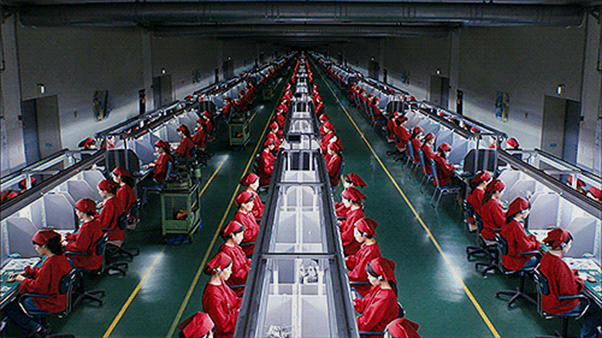
The factory workshop is a miniature of modern mass society. Modern people live in uniform concrete jungles and work in orderly factory workshops; these spaces merely gather human beings together as bare animals, in which people lack both connection and the ability to separate from one another. Everyone is a “replaceable part,” everyone is a “company slave” — a beast in society.
Resisting Alienation
This modern condition was already profoundly criticized by the young Marx—alienated labor in the modern factory causes not only the physical exploitation of workers, but also spiritual emptiness and distortion. Marx believed that the meaning of labor should be to help human beings affirm themselves in the world: “The object of labor is, therefore, the objectification of man’s species-life: for he duplicates himself not only, as in consciousness, intellectually, but also actively, in reality, and thus he contemplates himself in a world he has created.” (“Economic and Philosophic Manuscripts of 1844”)
“Duplication” can be understood as “mirroring,” or “the extension of the human being.” My action leaves traces in the external world, and these traces bear a stamp that belongs uniquely to me; this is “duplication,” that is, intuitively sensing my own existence in the world. For example, an artist can project their skill, experience, taste, and intention into their “work,” and from the real work and the ripples it creates in others, see the existence of “the self.” Originally, this kind of projection was not the preserve of artists alone; an ordinary craftsperson could do it too. But in a modern assembly-line factory, workers cannot do this; they do not own their own “work”—an electronics engineer on a Foxconn assembly line will not regard an iPhone as his own work, and the sweat and blood he pours into it are converted into neutral labor power and paid out in wages. Beyond that, he cannot pour into the product anything that belongs to himself.
Marx pointed out that labor has been alienated: “First, labour is external to the worker, i.e., it does not belong to his essential being; that in his work, therefore, he does not affirm himself but denies himself… The worker therefore only feels himself outside his work, and in his work feels outside himself. … It follows therefore that man (the worker) feels himself to be freely active only in his animal functions—eating, drinking, procreating, or at most also in his dwelling and in dressing-up, etc., and in his human functions he feels himself to be nothing more than an animal. The animal becomes human and the human becomes animal.”
This alienation has already become a common idea among modern people: “The point of going to work is to not go to work” — people naturally think this way. But when one really does not go to work, what is one pursuing? Nothing more than eating well, drinking well, and enjoying various nearly primitive sexual stimuli. The greatest act of creation in a modern person’s life may be decorating one’s own home, but even this activity becomes a luxury for the itinerant laborer without a fixed dwelling.
Marx’s theory of alienated labor was criticized, or rather amended, by Arendt: Arendt believed that Marx confused “labor” and “work.” “Labor” exists to solve the necessity-based needs of human beings as animals—eating and drinking enough, warmth and safety, shelter and reproduction, and so on. Every animal also pursues these things, and these things are eternal; they can never be completely resolved: if you have eaten enough today, you still have to forage tomorrow; if you can live in peace today, you may still have to clean tomorrow. These endless animal needs cannot make a person “affirm himself.” “Work,” on the other hand, is what belongs specifically to human beings; its purpose is not to cope with nature’s necessities but to do things that transcend and defy nature, namely to create a world of artifacts. Beyond labor and work, “action,” that is, expressing the self in the public sphere, is what truly manifests human nature; the world of artifacts is meaningful because it sustains a public realm.
The Real Digital World
The world of artifacts created by “work,” and the “public space” sustained by “action,” do not necessarily have to be spatial entities in the physical sense; the digital world may also provide such space. In particular, when the industrial age caused traditional public space to shrink to the brink of extinction, many people instead found a spiritual home in the digital world.
Even a single-player game can sometimes provide a greater source of meaning. In Arendt’s sense, when you are a corporate cog at work, that does not count as “work” but as “labor,” whereas playing games at home may well be the real “work.” Of course, some people play games merely for “recreation,” to relax their minds so that they can better face their life as a corporate cog. But there are also many people who truly “create” within games; the works they produce in games bear more of my own imprint than the products turned out by a company’s factory, and are a more direct projection of my personal will and taste, and thus more likely to give me a sense of fulfillment. Beyond single-player creation, social games and even more networked social platforms are also wildly popular; “action” in cyberspace and its ripples are entirely real.
Before blockchain, property, wealth, and personal identity in the digital world all had to attach themselves to some company or platform; these data could be tampered with at any time, or even wiped out altogether, and so they always gave people the feeling of castles in the air. The significance of blockchain lies in further endowing the entire digital world with solidity, and in returning to each individual the power to govern personal identity and property, as well as the power that both “connects and separates” people.
Three Kinds of Immortality
In short, the digital world has opened up some possibilities that make it possible for us to recover, out of industrialized tendencies, a world of meaning or public sphere that had been on the verge of extinction. Blockchain provides a robust durability, and cryptocurrency provides a stable measure, making people more inclined to think in long-term terms.
Seen this way, the transhumanist pursuit of “immortality” is merely one way of resonating with the whole underlying trend embodied by blockchain, and in my view it is a relatively superficial response. It simply concentrates “long-termism” on the animal body.
And yet, just like “labor,” the extension of life is endless: it is always the “most urgent” problem. Once life has been extended to 120 years, how to extend it to 150 becomes the urgent problem; once one reaches 150, how to live to 200 becomes the urgent problem. But if longevity is always the most urgent issue looming overhead, then such a life is nothing more than a replay of the ancient notion that “better a lousy life than a good death.”
Of course, I am not denying the transhumanist pursuit; I am only saying that it is a superficial undertaking, and the more crucial question has always been this: how can human beings transcend their ever-unavoidable “mortal condition” and still find a place to lodge meaning?
From ancient times to the present, there have been three dimensions of immortality running in parallel: the animal, the divine, and the human. Whether one entrusts immortality to the reproduction of offspring or simply extends one’s own bodily life, at bottom one is still living as an animal. And to place one’s hopes in the other shore or in the afterlife—that is the theological path. Only those who work and act in the public realm, leaving an immortal influence on the world, achieve the kind of “immortality” that belongs uniquely to humans. These three kinds of immortality are not necessarily mutually exclusive; a person can fully be at once a begetter, a life-keeper, a believer, a creator, and an actor. But in any case, when we speak of creation and action, the dimension of creation and action is always the highest.
The following undertakings all follow the trend embodied by blockchain: at the level of the monetary system or economics, opposing Keynesianism; at the level of individual survival, pursuing longevity; at the level of collective life, pursuing the reconstruction of the public sphere; at the level of artistic creation, helping creators achieve immortality; at the level of cultural belief, reviving historical culture in order to provide a lodging place for undying significance… These seemingly unrelated fields are linked together, sharing the same “spirit of the age,” and this is precisely the hallmark of great historical transformations such as the Renaissance, the Scientific Revolution, and the Enlightenment.
Translated from the Chinese original with AI assistance. The original text is authoritative.