
This piece, along with the earlier The Liberation of People in the Digital Age, was written as copy for PTADAO. The final text was excerpted to form A One-Page Clear White; if you’re interested, you can go take a look there. Here I’m posting the original version of the book review.
Lately I’ve joined some Web3 chat groups and occasionally put out a few views.
For example, a few days ago I was discussing the significance of stablecoins with someone, and I said that cryptocurrency was from the very beginning meant to upend the old system of central banks and fiat money. If the entire blockchain market turns around and still has to operate with USDT as its yardstick, then what exactly has become of our revolution? In my view, the significance of dollar stablecoins is at most that, during a transitional period, they can attract some wavering onlookers who have not yet undergone intellectual liberation. In the long run they cannot become the foundation of the crypto market. If the crypto market ultimately still rests on the dollar regulated by the Federal Reserve, then the entire crypto movement has failed.
Or take yesterday, when I was discussing whether Bitcoin’s POW mechanism is beneficial to fairness or instead exacerbates the gap between rich and poor. Some peacemakers held that the issue of fairness is not the main problem blockchain is meant to solve, and that it should be left to other social mechanisms. I also expressed serious opposition: when I first started paying attention to Bitcoin ten years ago, the elders I followed were all discussing freedom and equality. If not for freedom and equality, why bother with decentralization? And why were we drawn to Bitcoin, and thus plunged into cryptocurrency at a time when crypto had by no means yet revealed a vast money-making future?
(One more remark: these past two days, with the SEC suing Binance and Coinbase, my comment was: “All day long they’re talking about compliance and noncompliance, losing independence in the process and still not ending up in compliance in the end. Cryptocurrency was meant from the start to kill the Federal Reserve, but now it keeps wagging its tail and begging for mercy at the American regulators’ feet. Better to tear off the mask sooner, and return to the proper path of the crypto movement’s original aspiration.”)
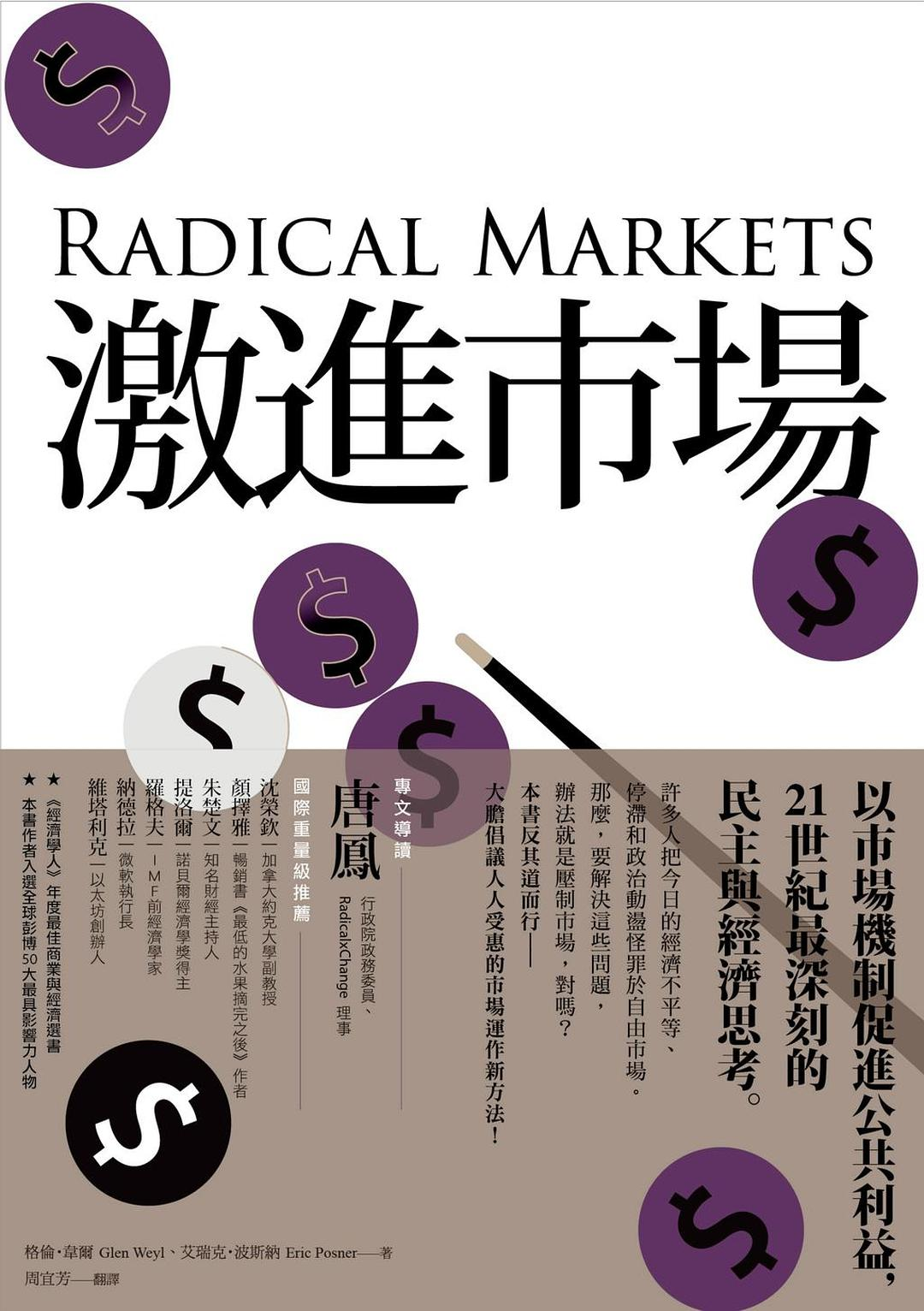
Satoshi Nakamoto’s message in the genesis block points the spear at central banks. The early Bitcoin evangelists were mostly believers in the Austrian School or anarchism; all of them were committed to using cryptocurrency to reform certain existing economic systems and even social institutions. Ethereum’s founder Vitalik was no exception. In 2018, he wrote a book review for that year’s publication of Radical Markets, laying bare the original intention of the crypto movement:
Like most people inspired by Satoshi Nakamoto, Vitalik took the genesis block message as a satire of the existing banking system, and believed that the consensus of the crypto movement was: “Whatever the best way to organize society may be, it certainly is not the current institutional arrangement of politics and finance.” Of course Vitalik also noted that as the blockchain circle’s influence grew, the participants became more mixed and diverse, and many people joined merely with the motive of getting rich. Still, Vitalik believed that “although cryptocurrencies have been weighed down by the theft and fraud of rapid enrichment, their original motivation—that is, finding better ways for things to work in the real world—still exists.” (The Chinese translation is quoted from the Traditional Chinese translation of Radical Markets.)
As for this Radical Markets, I saw someone say it ought to be translated as “Fundamental Markets,” because the English word Radical has the sense of both “radical” and “new,” as well as “fundamental” and “basic.” In fact, these two meanings are not contradictory. For example, in today’s crypto community—especially in the various circles in China—those of us who insist on the crypto movement’s original, fundamental motivation actually come across as very “radical.”
Whether you call it “radical” or “fundamental,” the key is that what we are pursuing is not merely food and money, but meaning and ideals. This idealistic attitude differs from the opportunistic attitude of those fence-sitters who just follow the crowd to make a bit of money, from the compromising attitude that says reform is too hard and we might as well do a few small things within the existing system, and from the numb attitude that doesn’t care a bit about humanity’s fate and only wants to eat a couple more mouthfuls of pig trotter rice. But a radical attitude does not necessarily always appear passionate or impulsive and the like.
Hoping to make this society or this world better is actually not such a rare desire; in fact, everyone more or less has the ideal of changing the world. Just look at all the different “keyboard warriors” prowling the internet these days. Of course, perhaps some people are doing it to earn fifty cents or a few cents from the Americans, and the like, but there are indeed a vast number of netizens who, when taking various actions, are not seeking any concrete private gain. Those who swarm to the pages of people they dislike to debate, abuse, and report them—what are they after? I think, to one degree or another, they are also hoping to root out the tumor and make the world better.
The fundamental motive behind my entry into the cryptocurrency world, and my recent increasing participation in all kinds of DAO activities, has always been: “prove myself, change the world.” But I do not think I am some especially singular, especially noble, especially outlandish person. My pursuit is actually the same as that of those internet trolls who at times chase after me and hurl abuse: “prove myself, change the world.” The difference is that I believe I have found a better breakthrough point, while my actions are also more decent. Devoting oneself to the work of transforming the world and social change does not require you or me to possess any special qualities; the issue is simply that everyone acts, each in their own different way, whether consciously or unconsciously.
Of course, “radical” does not just refer to the desire to improve society; more often it specifically refers to the proposition of reform through a method that, at a fundamental level, overturns the old paradigm and old rules of the game. To give a simple example: one group of people advocates eating sweet zongzi at the Dragon Boat Festival—that’s the sweet faction; another group advocates eating savory zongzi at the Dragon Boat Festival—that’s the savory faction; still another group eats both sweet and savory—that’s the neutral faction. If the sweet faction advocates banning savory zongzi and allowing only cloyingly sweet zongzi, that’s the extremist faction. None of the above is the radical faction. Who is the radical faction? For example, suppose yet another person comes along and says: why must we eat zongzi at the Dragon Boat Festival? We should eat dumplings instead—that would be the radical faction.
In economics, there has long been a struggle between the sweet faction and the savory faction—oh, that is, between the left and the right. The left tends more toward egalitarianism, emphasizes social welfare, and believes that reducing the wealth gap is the top priority; the right tends toward (classical) liberalism, promotes the free market, and opposes excessive government intervention.
And Radical Markets, right from the outset, aims to break the basic paradigm of the traditional left-right divide: “The positions of the right and the left made their contribution in the nineteenth and early twentieth centuries, when they first arose, but by now they have exhausted their tricks. They are no longer bold reforms, but boundaries that bind us. In order to open up society’s possibilities, we must liberate our minds and focus on radical redesign. To find the roots of the problem, we must understand how our economic and political systems operate, use what we know to devise countermeasures, and that is exactly what we do in this book.” (Slightly adapted from the Traditional Chinese translation.)
Their radicalism is not wild speculation, but a return to origins. The basic paradigm of today’s left-right divide is old, but not especially old; as the authors say, it was born in the nineteenth century and broadly developed against the backdrop of the industrial age. Insofar as it broke with the ancient order of kingship and empire, it was progressive and indeed effective. But more than a hundred years later, as humanity has entered the new environment of the information age, the conceptual lineage of the industrial age may no longer be progressive or innovative; instead, it has become a shackle binding our minds and hands and feet.
Of course, we hope human society will continue to progress, rather than start entirely from scratch or simply return to antiquity. So we need to distinguish, among the various ideas and orders formed since the industrial age, which ones are our fundamental pursuits and which ones are merely compromises adapted to the constraints of a particular historical environment. If we take those methods that were originally adopted only because of the limitations of the times as if they were natural conventions, then they are not the fruits of progress; instead, they become fetters obstructing progress.
Radical Markets argues that the left’s egalitarian ideal is entirely correct, but its weakness lies in relying too heavily on government bureaucratic systems and central regulation to realize the ideal of fairness. Certainly, a modern bureaucratic system is definitely more enlightened and progressive than the rulers of ancient feudal kingdoms, but it still is not the final solution to social fairness. On the other hand, the right’s reverence for the free market is not wrong either, but its weakness is that this reverence still falls far short; it deceives itself into believing that the perfect free market has already been achieved, or is unwilling to seriously consider the possibility of further reforming market mechanisms. So the right is “conservative,” and often lacks the “courage or imagination” for more thoroughgoing change.
One key inspiration for Radical Markets, or rather one minimalist model of “radical markets” — as Vitalik captured it — is an ordinary allocation case: the cake-cutting problem between two people. When both people acknowledge the principle of fair division and both believe in their own ability to judge value accurately, the simplest method is: “let one person do the cutting, and let the other choose.” Since the first person believes their cut is fair, they will not object no matter which piece the second person takes; and since the second person trusts their own judgment, they can choose the piece they believe is larger. The result is that neither person has any objection to the outcome. As a math problem, this method of allocation can in fact be extended to the case of any number N of people, with the proviso that the act of cutting the cake itself does not cause any loss.
This ideal method of distribution, of “absolute fairness,” is of course very hard to implement in the actual situations of real life, but it is indeed suggestive for allocating property that is not entirely homogeneous—for example, real estate. The principle is nothing more than making everyone actively participate in valuation, and then using some sufficiently competitive auction rule to give everyone a chance to choose.
“Radical markets” tries to bring all property into the market, rather than limiting itself to commodities in circulation that the owner has proactively put up with a price tag for sale. In particular, the valuation of any property is also fully marketized.
Radical Markets introduces the mechanism of the “Harberger tax” to realize comprehensive marketization. Simply put, all property—especially productive resources like land and minerals—must be put on the market and priced for sale, so as to avoid idle or closed-off resources. At the same time, the holders of property need to pay tax at a certain rate according to the price they themselves set, in order to prevent them from arbitrarily inflating prices and thereby in effect refusing to enter the market. In this way, all resources can be circulated and utilized as fully as possible, and the valuations of all property will also tend toward accuracy and fairness.
Recently, there happened to be a case in China that, in an extreme way, showed how the right to determine the value of certain things is monopolized by a tiny group of people. The story is that a company under CYTS allegedly bought a garden in Suzhou, then appraised the strange rocks in the garden at a value of several hundred million yuan, and then colluded with a bank to obtain huge loans. The problem the Harberger tax seeks to solve is the problem of “big talk not being taxed” — the act of valuation does not need to appeal to any specific institution at all (for any concrete institution may well be prone to collusion), but is entirely decentralized: you can appraise your own stone yourself, but the price of that is that you have to pay tax based on the appraisal. Of course, this may cut off many mortgage-lending activities, but at the very least it makes the market more transparent and fair.
Of course, I do not completely agree with the specific design of Radical Markets, and I also remain reserved about the “Harberger tax” itself, but I must admit that this is a path worth exploring and worth testing.
Radical Markets may not be suitable for the traditional world dominated by industrial production, but in cyberspace—especially in the blockchain world, which is itself founded on decentralization—it may hold great promise. In fact, since Vitalik, explorers in the Web3 field have already made some attempts. But the attempts already made still do not seem successful, perhaps because the design of “radical markets” is only possible in a relatively integrated environment; to explore and improve the relevant designs, one needs a relatively closed yet relatively complete economic system in which to experiment. Perhaps we could start by creating a “radical game world”?
Translated from the Chinese original with AI assistance. The original text is authoritative.