

In June I gave a long lecture for Ji-shi Capital, and recently they finished the transcription and released it in three installments. The text was transcribed by them; I went through it, but there may still be a few scattered errors. I’m posting the complete collected version here for the record. The original texts of the three installments can be found here: Why is our education devoted to producing copies?; Where does technology come from? Looking at Watt’s steam engine to see our misunderstanding of technology; If the AI revolution is similar to the Industrial Revolution, we will face a very terrifying situation. In fact, the three installments correspond to my three questions: Who is technology? Where does technology come from? Where is technology going?
Hu Yilin: What Is Technology
Editor’s Note:
On June 15–16, the 25th Ji-shi Lecture Series was successfully held in Wuxi. This lecture series was jointly hosted by the Wuxi Municipal Local Financial Supervision and Administration Bureau, Wuxi Radio and Television Group (Station), and Ji-shi Capital. With “Science and Technology” as its theme, the summit focused on the origins and development of science and technology, as well as frontier technological fields such as artificial intelligence and semiconductors. Many heavyweight entrepreneurs, scientists, scholars, and investors shared brilliant insights.
Associate Professor Hu Yilin of the Department of History of Science at Tsinghua University gave a speech titled “What Is Technology.” We have divided it into three installments for publication.
Part One:
Hu Yilin: Why is our education devoted to producing copies?
Thank you, everyone. I’m very honored to share with you all. I’m serving as a prelude to Professor Wu’s lecture tomorrow. Professor Wu was my teacher when I was a student, and is now also my colleague. He teaches the history of science at Tsinghua, while I teach the history of technology and philosophy of technology at Tsinghua. The theme I’m sharing today is also a move from philosophy of technology to the history of technology.
Professor Wu will talk about what science is, while I’ll start by talking about what technology is. As philosophers, we have a few classic soul-searching questions: Who are you? Where do you come from? Where are you going? — this is our reflection on “know yourself.” Likewise, with respect to what technology is, we can pose the same kinds of questions.
Today’s lecture will also unfold mainly around these three questions. First, who is technology? What we need to discuss is the definition of technology and the relationship between technology and human beings. Second, where does technology come from? We will explore the sources of technology, with freedom and innovation as the key terms, and I will introduce this through some cases from the history of technology. Third, where is technology going? That is, the future direction of technological development. What goals is our technological development meant to achieve? Our ultimate goal is not development for its own sake, much less having people become slaves to technology, but to use technology to promote a good human life. Especially now, with artificial intelligence developing at a breakneck pace, these topics have become all the more important.
1. Who is technology? — The extension of human beings
1. Which is more important as a technology: a chair or an iPhone?
When we talk about the word “technology,” we often think of people like Jobs and Musk, and of products like the iPhone and Tesla; of course, these are representatives of technology. But at the same time, in other contexts, we also use the word “technology,” even if we may not be aware of it—for example, “Go to Lanzhou to learn technology,” right? Is excavator technique a technology? Of course it is also a technology. Skilled workers, such as the Foxconn workers who produce the iPhone for Jobs—do they also represent technology? And when we play games, we often ask whether a game is a skill-based game, a pay-to-win game, or a game of luck. I would say this is a skill-based game—so that too is technology. And when we go to a technician to have our feet cared for, pedicure technique is also technology, right?
So what I want to say at the outset is that the concept of “technology” actually has a very broad meaning. The word “technology” is used by all of us, from high to low, from top to bottom.
That raises a question: when we talk about technology, what exactly are we talking about? Who is more “technological,” really? When we ask who possesses technology, are we talking about Jobs, an excavator mechanic, or a pedicure technician? When we talk about where to go to learn technology, are we talking about going to Tsinghua, to Lanzhou, or to an internet cafe?
So we find that there is a problem here—one that is especially prominent in Chinese discourse: in fact, we talk about the concept of “technology” simultaneously on many different levels and in many different senses. And the strangest thing is that all these usages sound perfectly natural. Whether we are discussing gaming skills, excavator-driving skills, or so-called high and new technology, we are using the same word. We feel that their meanings are very different, but when we use them, everything still feels extremely smooth and natural.
From the examples above, we can see that the word “technology” contains at least three layers of meaning. The first is high and new technology, things very profound such as technological innovation. The second is vocational technology, possessing a specialized skill. When we talk about vocational technology, it does not mean going to Tsinghua, but going to a vocational and technical school, which sounds far less lofty than high and new technology. There is also bodily technology, abilities and skills at the bodily level, including pedicure technique and game skills, and so on. Therefore, the word “technology” contains at least these three meanings: science and technology, arts and techniques, and skills.
Why can these three layers of meaning be unified? Why do we feel that they are consistent? I’ll state my conclusion directly; this is also the definition I give in my own writings: technology is something that can be learned.

There’s no need to consult a dictionary when discussing the definition of “technology.” In fact, I haven’t seen any dictionary definition of technology that can simultaneously encompass the practical usages we just mentioned.
Technology is something that can be learned. Learning is an activity that is uniquely human, and the activity of learning precisely involves the three layers we just discussed. The first is the internal level, which refers to a personal skill that is embodied in the body and in one’s capabilities; the second is the learning process level, a process through which one can, by learning, internalize something from outside to inside, and this usually takes place in schools or in some specialized fields; the third is the external level, that is, artifacts and environments, such as chips, iPhones, VR, and so on, which we also call technology. So in the process of learning, what we are actually doing is communicating between inside and outside, from outside to inside and from inside to outside.
So technology contains three characteristics, namely externality, internality, and mediation; the activities of learning andmaking connect these three levels. Externality means that we are not born with it and must learn from the outside world; internality means that through training and adaptation it is internalized as our own ability; mediation means that technology mediates between inside and outside.
Therefore, when we talk about using technology, in a certain sense, it is a movement from inside to outside: we project our intentions, thoughts, and needs into the external world, use technology to transform the world, and shape external things into ourselves. And when we learn technology, we are engaged in a process of internalization, shaping ourselves through external objects.
There is an important figure in the technology world, Kevin Kelly. In his book What Technology Wants, he defines technology as everything that doesn’t work yet. My translation of this definition is “everything that has not yet begun to function / take effect”. He once cited a remark by the writer Adams about technology:
1) At the time you are born, everything that already exists in the world is merely normal.
2) Before you are 30, anything invented is incredibly exciting and creative.
3) After you are 30, anything invented is, as far as we know, a violation of the natural order and the beginning of the end of civilization. Only after it has existed for about 10 years does it gradually become truly satisfying.
This example actually touches on the familiar generation gap in technology. Young people are more willing to accept the emergence of new things and new technologies, whereas for people in middle age and above, and for older people, new things and new technologies often seem to them like moral decay and the collapse of rites and music, civilization is going downhill, “look at how these young people nowadays don’t concentrate on work and are obsessed with their phones all day,” and so on. These different levels of acceptance of technology are, in fact, also a matter of learning.
From the human perspective, all technologies were once exciting new things. But for you, the environments that already existed when you were born are merely normal things, not some new technology.
The example Kevin Kelly gives is the chair. He says: “We no longer think of chairs as technology. We just see them as chairs… But it won’t be long before computers, too, become like chairs: negligible and ubiquitous things.”
For the things we are using now, such as chairs, or the PPT and microphone I am using right now, none of them are regarded as technology anymore. At forums where we talk about science, technology, and innovation, we won’t discuss these things, because they already exist and have become part of everyday life. A microphone is just a microphone; a screen is just a screen.
Only those things that change the old environment, and that people over 30 find somewhat hard to accept, do we regard as new technology.
However, Kelly’s statement actually reveals the important power hidden in familiar things. Familiar things are precisely the most effective things. Kelly’s definition of technology is “not yet work,” for example, when we talk about AI chips and so on now, these things have not yet arrived, have not yet taken effect. That is to say, these things have not truly become integrated into the life we are familiar with, so they are regarded as technology. And those things that have already taken effect and have profoundly changed our way of life, we no longer regard them as technology.
Therefore, it is precisely when we no longer regard something as technology that it is exerting its greatest influence.
Frontier technologies have not yet fully come into play; they are now having an impact on everyday life-worlds. Meanwhile, some obsolete technologies are already no longer able to function fully; they often seem utterly out of place in the everyday life-world, and are placed in museums, treated as artifacts. Only those things that have become utterly commonplace and familiar in our daily lives are truly completed technologies.
And those things in which technology has been realized, those things that constitute the way we live here and now, are precisely the most inconspicuous forms of existence. For instance, in this photo of Jobs at a product launch, what we see is the iPhone. The iPhone is very important, but are the clothes on Jobs’s body also technology? They are technology too; in a sense, these clothes are even more important than the iPhone.
To give an example: suppose a person at a product launch were not holding a phone, we would not find that strange; we might guess he was unveiling something else. However, if he walked out without any clothes on, we would be extremely shocked, because wearing clothes is something utterly taken for granted.
As a technological invention, clothing has already fully played its role and has thoroughly become embedded in each and every one of our daily lives. Therefore, when it functions normally, we often do not feel its presence at all. Yet once we lose it, we will feel more shocked, and find it more unacceptable, than losing an iPhone. It is only at such moments that the importance of clothing fully comes into view.
Likewise, eyeglasses and other technological products, such as electricity and lighting, are not placed at center stage under the gaze of all not because they are useless; quite the opposite, it is because they have already fully displayed and exercised their function.
Therefore, when we study the history of technology, we often reawaken our astonishment and admiration for technologies of the past. We can look back on history and re-experience those technologies that are now so commonplace to us, such as the chair mentioned by Kevin Kelly. When the chair first appeared, the shock and impact it brought may have been no less than that of the iPhone or any other new technology.
For example, looking back on history, we can see that chairs in China gradually spread from about the Tang dynasty onward, becoming common items in people’s daily lives. During the Southern Song dynasty, Lu You recorded people’s view of chairs; at that time, chairs had not yet been widely accepted and had not yet become taken-for-granted objects. How, then, did people at that time view the impact of chairs?
Lu You wrote in his Notes from the Cottage of Old Learning: “In the households of scholar-officials in former times, if women sat on chairs or stools, everyone would ridicule them as lacking proper decorum.” This sentence condenses many elements. “In former times” points to historicity: technology is historical. “Households of scholar-officials” shows that technology has a class dimension; when a new technology appears, its impact on different classes is not the same, and some classes are affected first. “Women” indicates that there are also differences in the acceptance of technology by gender. “Everyone would ridicule them as lacking proper decorum” reflects that social, psychological, and ethical factors are all concentrated in the process by which this technological object, the chair, exerts its effect.
So when technology truly begins to work, it exerts an impact on every aspect of society, including social strata, gender, social relations, psychological conditions, and so on. And when technology becomes widespread and familiar, people often overlook these effects and treat them as matters of course. Only by looking back at history can we truly recognize these effects again.
Thus, through this case, we can see the importance of the history of technology: it can help us reactivate “astonishment.” Things we now take for granted once shocked the lives of the ancients; things that now strike us as strange and perplexing were once taken for granted by the ancients;
This stepping out and reactivation may not have any direct effect, but at the very least it can help liberate our minds. It means we can break through prejudice and step outside “what is taken for granted.” The more we understand history, the deeper our understanding of reality becomes. The things we are familiar with now, the things we regard as matters of course, were not matters of course in the past, and they certainly will not be matters of course in the future. Only in the present are they what we regard as normal, taken-for-granted things. Under the inspiration of history, we can rethink the different possibilities of the future world.
All right, let us return to the earlier example: Kelly mentions that people under 30 are more likely to accept new technologies, while after 30 it becomes harder. Why should this be so?
This example actually reflects the influence of learning. Because the working of technology is, in essence, technology constructing a life-world that is familiar to us. In this familiar and stable life-world, we feel that everything is normal, familiar, and secure; that is the result of technology at work.
For children, their life-world has by no means yet stabilized. Their process of growing up and learning is precisely a process of trying to create a life-world they know well. Therefore, children are more likely to accept new technologies, because to them all technologies are the same; each technology is shaping their life-world.
For older people, however, their life-world has already been formed; they have already entered a safe and stable way of life. So for the elderly, technology is not merely technology, but part of the life-world that constitutes their existence. If we try to replace the old technologies they are used to with new ones, that is not really replacement but destruction, because you must first break the original stable chain of meaning and make it adapt to a new structure. For an older person, this means they must learn all over again.
2、Technology is an extension of the human being
From the examples mentioned above, everyone should be able to feel that each person accepts technology through the process of growing from childhood to adulthood, and these views also have plenty of echoes among philosophers and thinkers of technology.
I quoted the media theorist McLuhan, who argued that media are extensions of man; borrowing this definition, technology is an extension of the human being. While technology shapes our living environment, it also, in a sense, defines who we are. Human beings are not merely objective objects wrapped in a skin; they are defined by certain things in the external environment. That is why McLuhan said, “The human technic is the most human thing about the human being.”
What does that mean? It means that when you say who you are, you will not strip yourself naked and cut the flesh into slice after slice, saying that this one piece is you; human beings are not to be understood like pork. When you ask who I am, you see the clothes I am wearing and may say that someone dressed like this could be a modern person; then you look at the PowerPoint and microphone I use and may guess that I am a teacher. But if you strip away the external technologies of clothes and tools and see only my flesh, then you cannot tell who I am at all.
So this sentence means that the human being is determined by the external technologies through which he or she constructs the life-world: “Whether this extension takes the form of shoes, a cane, a zipper, or a bulldozer, every form of extension has the structure of language; they are all the exteriorization or outward expression of human existence. Like all forms of language, they each have their own sentence patterns and grammar.”
McLuhan quoted and developed Churchill’s famous saying, “We shape our tools, and thereafter our tools shape us.” Humans and tools are in a relationship of mutual shaping and mutual definition. He pointed out that technology can change our habits of perception.
McLuhan used his media philosophy to concretely analyze how certain technologies in turn shape us. He said: “People are often skeptical that the wheel, printing, or the airplane can change our habits of perception. Even so, once they come into contact with electric lighting, their doubts are all at once dispelled. In this domain, the medium is the message. Once the electric light is on, a world of perception appears. Once the electric light is off, that perceptual world vanishes altogether.”
All kinds of technology can change our habits of perception. To give a simple example: “the medium is the message” is perhaps most vividly embodied by electric light as an external technology. Once the electric light is on, a world of perception appears; once the electric light is off, that world of perception vanishes altogether. With electric light and without electric light, the world you perceive is completely different. The reason we can give a lecture here is that without lights it would be impossible. But without lights there can still be other ways of communicating and perceiving.
Let me give a more typical example: the shaping of ways of life by timekeeping technology and clocks. McLuhan and historians of technology such as Mumford all emphasized the crucial role of the clock. Mumford proposed an interesting proposition: the key machine of the modern industrial age was not the steam engine, but the clock. The steam engine is only a symbolic thing; the steam engine’s power really came into play in the factory, and what made the factory possible? A factory can only exist with unified time. Factories have to unify everyone’s working hours—nine to five, or nine to nine, and so on—there must be a public, objective time standard in place, and that objective time standard is detached from natural time. No matter whether it is windy or rainy, you still have to work nine to five.
Today, when we say a lecture starts at 3 p.m., you can arrive right on time at 3, and I can begin right on time at 3; this is taken for granted by us. But in ancient times, it was not like this. In ancient times, once the sun was three poles high, you should get out of bed; once the sun went down, you should go home. That is a natural time standard, not especially objective. At most, you might keep a rooster, and when the rooster crowed you would do whatever was needed; that was not especially precise either. So ancient people did not have an objective conception of time.
Only a very small group of people in antiquity had such a need for a rigid, objective temporal standard: the monks in monasteries. In a monastery, even if the rooster does not crow and the sun does not rise, the monks still need to pray at fixed times. Therefore they need an objective, standardized measure to match this non-natural, rigid way of life, and cannot rely on the sun or the rooster.
So the mechanical clock originated earliest in monasteries. In fact, Chinese temples also have a saying: “Be a monk for one day, strike the bell for one day,” because the bell plays an important role in temples. It requires monks to live according to a rigid regularity, with morning lessons and evening lessons.
Living regularly and rigidly according to objective time is not something taken for granted. In ancient times, this was only a way of life for a small number of monks, but through the spread of clocks, this way of life gradually spread. Monasteries were often located beside churches, and the hanging bell was seen by others. Although they were not monks, they were nonetheless continually affected by time. Thus their lives too were disciplined within an objective temporal environment.
The expansion of the clock was first the expansion of monastic life, and afterward the expansion of the factory system of the industrial age. Beyond guiding the rhythm of time, clocks also have other features that are likewise consistent with the basic spirit of the industrial age. For example, the clock tames natural energy and converts it into an even mechanical rhythm; it is a standardized product; it is an automatically operating machine; it is a machine that pursues precision. These features are all metaphors for, or origins of, the basic way of life of the industrial age.
McLuhan corrected or supplemented Mumford’s view. Mumford only emphasized the clock as a tool for rigid, regular time measurement, but did not stress that this clock was in fact the Western mechanical clock, and that it actually transformed the way time was perceived from one dominated by hearing to one dominated by vision. In both East and West, the traditional way of perceiving time was through sound and ringing, conveyed through hearing; whereas mechanical clocks convey time visually. This transformation also had a transitional phase in human habits of perception. At first, mechanical clocks would chime every hour, but later this function was gradually eliminated. At the beginning, people were more willing to accept auditory time, believing that the clock should sound at a particular time; later, people came to feel that this was too noisy, and no longer needed sound as a reminder, needing only objective visual perception.
McLuhan believed that the shift from images dominated by hearing to images dominated by vision had a very significant impact on human thought and habits of life. Auditory perception is sudden and encounter-like. For example, when ancient Chinese people spoke of “time” (时), what they emphasized was “the opportune moment” (时机), “the moment is at hand” (恰逢其时), “time waits for no one” (时不我待), and so on; they were speaking of something sudden and encounter-like. Visual imagery, by contrast, usually lacks suddenness; vision is a cold sense, one that allows you to stand aside, to look from afar, calmly and objectively. The time of visual perception is in fact objectively and evenly passing. Modern people are more inclined to understand time as something objective and uniform, and this is the influence of the mechanical clock.
McLuhan also gave an example: when you hear thunder, you always see the lightning first, because light travels faster than sound. But strangely, when you see the lightning, you are not especially startled; instead, you accept it calmly. Yet even though you expect to hear thunder shortly, when the thunder actually sounds, it still makes you jump. This shows that hearing always gives people a sense of sudden, event-like encounter, whereas vision gives people a calm, objective feeling.
So McLuhan says that when some technologies in our lifeworld concerning time and space switch the way they affect your senses, our modes of thinking and habits of living all change as well. They believe that the rise of visual centralism is the source of the modern person’s scientific worldview and standardized way of life.
Historians’ research can offer some corroboration. For example, the French historian Alain Corbin records in his book The Sound of Bells the changes in the French countryside: how their sacred and meaningful bells eventually became noise that disturbed “private life,” and how the act of dismantling bells was deeply entangled with the political and social environment of the time; and how, when bell-ringing was banned, it aroused public outrage, and so on.
Let us return to the concept of learning. When we say that technology shapes human beings, shapes people’s lives and habits of thought, what this really means is that human beings do not possess innate, fixed habits of perception, modes of perception, ideas, or ways of living, and so on; all of these are shaped after birth, or to a very great extent shaped after birth. This is also one of the features that distinguishes human beings from other species: namely, that human beings have no so-called “natural” way of life. Of course, the natural way of life for human beings may well have once been a state of eating raw meat and drinking blood, but once they possess technology, as they evolve as “human beings,” their way of life comes to be shaped by the corresponding technological environment.
The French philosopher of technology Bernard Stiegler also says that the essence of human beings is precisely a lack, one that must be supplemented later on. By contrast, other animals possess innate abilities; once they grow up, the abilities they naturally acquire determine their way of life. For example, some animals can fly, so they forage in flight; some animals have sharp teeth and claws, so they are predators.
However, for human beings, their innate abilities are very fragile. As the crown of creation, human beings rely not on innate abilities but on abilities acquired later. Human beings’ innate abilities are very weak; they cannot do anything, and even crawling requires learning. All the abilities human beings can acquire come through postnatal learning. This is also confirmed by human biological characteristics. Compared with other animals and primates, human beings have a very distinctive, prolonged period of adolescence and old age. Other animals do not have what we call menopause; they can reproduce throughout their lives, whereas human beings, after losing the ability to reproduce, still have a fairly long lifespan ahead of them.
How is this phenomenon to be explained? It is because human beings need to learn. During their long adolescence, people need to learn from experienced elders. Human beings’ capacity for survival must be acquired through later learning. The reason mentioned earlier for why human beings are so weak innately, yet in the end can become the crown of creation and the top of the biological chain, is precisely that human beings can rely on abilities and technologies learned later in life to make up for their innate physical deficiencies. Human beings do not have the sharp teeth and claws of beasts, but they can compensate with stone tools.
Therefore, the reason human beings have a long adolescence and old age, when they have no productive capacity or only very weak productive and reproductive capacity, is that human beings need to receive the education of elders in childhood. This is one of the characteristics of being human.
This also explains what was said earlier: why young people are better at learning and innovation, why young people are more able to actively adapt to new things, whereas older people usually take a skeptical attitude toward new things. It is not because older people are not intelligent enough; rather, this is simply the way the human species evolved. The duty of the elderly is not to learn, but to teach; the duty of the young is to learn. This is a biological characteristic of human beings.
And this division of labor, with young people learning and older people teaching, has in fact been gradually disintegrating. With technological development, the teaching mission of the elderly has gradually fallen apart. First, the emergence of external technologies such as vessels and writing has enabled us to learn through these things rather than relying entirely on oral transmission; second, as technology develops, people’s division of labor becomes increasingly specialized and professionalized, with each specific division of labor being carried out by dedicated people. Teaching has also become one specific division of labor, and teachers no longer have to be elderly people. In primitive tribes, those who taught knowledge were certainly elderly people, whereas in agricultural societies, and later in civilized societies, those who took on educational responsibilities might be professional teachers, not necessarily elderly people.
And after the Industrial Age, people no longer revere heirloom secret recipes, no longer revere the idea that the older you are the more sought-after you become, and instead begin to revere innovation and pursue the newest inventions. Because the elderly cannot keep up with technology, their status gradually becomes marginalized, and they no longer undertake key social functions. So now the elderly are only responsible for enjoying their later years in peace.
Moreover, today not only productive technologies but also the technologies needed for the elderly’s daily life are changing with each passing day, making even peaceful retirement a problem. The elderly want to enjoy their later years in peace, but they find that if they do not use Alipay, WeChat, or mobile phones, life becomes inconvenient, and they have to keep adapting to new technologies. Yet their ability to adapt is naturally inferior to that of young people. So this is a major problem we face today: on the one hand, society is aging; on the other hand, the pace of new technological change far exceeds the speed at which human generations are replaced.

Figure: Horace Dediu’s chart of technological development and life expectancy since 1900
This table was drawn by an American, showing the spread of various new technologies in the United States since 1900. At the very bottom of the chart are 9% and 10%, and at the very top is 90%. What it shows is how much time it takes for a new technology, from the moment it first appears and is used by fewer than 10% of people, to become used by 90% of people and turn into something taken for granted in daily life. We can see that the curve of new technologies has become steeper and steeper: the earliest telephones and automobiles took decades to become widespread, whereas by the time we got to smartphones and other new-generation technologies, this curve had basically turned into a straight line.
At the same time, the chart also has a horizontal axis indicating human life expectancy, from which one can see how many rounds of technological iteration a person must experience in a lifetime—once a technology is ultimately used by 90% of people, that means you are forced to learn it.
For ancient people, they too would face some new technologies, but they might only need to learn one technology in their entire lives; adapting to one new technology was already remarkable enough. For modern people, however, one has to keep learning new technologies throughout life, or else one falls behind the times. And then perhaps some technology you have just learned becomes obsolete, and there is another round of updating and iteration.
This is the relationship between technological updating and iteration and human beings, and it is extremely important. We need to give serious attention to how older people understand technology and its meaning, because each and every one of us will grow old. This in itself is actually a question of meaning, namely how we understand the meaning of old age—are elderly people simply destined to be abandoned by society?
3. In the Age of AI, We Need to Revive Liberal Education and General Education
We will not expand on this here, and will continue returning to the relationship between technology and learning. The development of technology has changed the way people learn. In the earliest periods of human antiquity, people learned through oral transmission from experienced elders. With the emergence of urban civilization and technological specialization, the teaching function gradually shifted to professional teachers, and apprenticeship also appeared, with masters passing skills on to apprentices. This model was a sign of the establishment of urban civilization and the emergence of division of labor.
The model of learning from textbooks was a sign of the flourishing of printing. The teaching model we are now familiar with emerged after printing, with everyone in the classroom holding a textbook in hand and learning step by step according to it.
After the Industrial Revolution, the professionalization and division of labor in technology promoted the professionalization and specialization of education. Just as factories are an embodiment of the professionalization of production methods, schools became an embodiment of the professionalization of teaching methods.
Modern technology further influences the ways of learning in schools; for example, mathematized thinking and standardized thinking have influenced the formation of the credit system and the exam-score system.
We are facing the challenges of a new era, and this too is changing the meaning of learning. For example, in the information age, the significance of “being widely read and having a strong memory” has been weakened. Just as in the agricultural age there was no longer any need to hunt, in the information age we likewise no longer need such a strong capacity for wide reading and memory; instead, we need the capacities for searching and association more.
Next, I would like to discuss the age of AI. In the age of AI, machines have also learned to “learn,” and human beings are forced to rethink why we learn and how we learn, requiring us to reposition the meaning of learning. Because time is limited, I will give the conclusion directly: in the age of AI, we need to revive the traditional purpose of learning for human beings.
Traditionally, why did people learn? In ancient Greece, in China during the Spring and Autumn and Warring States periods, and in pre-Qin China, the purpose of learning was to become an adult. Recently, the book Education: The Way of Becoming an Adult in Ancient Greece has been published on the mainland. It tells of Greek paideia: the purpose of learning was to become a noble person, a person of complete moral character, and to attain the wholeness of the soul.
Later, in China, the purpose of learning gradually changed. By the time of the imperial examination system, it became “study well and then serve as an official”. Learning was no longer driven solely by the purpose of attaining soul-wholeness and so on, but by relatively utilitarian aims, namely to become an official. However, in one sense this system still cultivated your character; to be an official, one certainly still had to possess noble virtue, plus a certain administrative capacity.
In the West, by the Middle Ages and the Renaissance, the purpose of learning also changed somewhat, transforming into aristocratic education, and giving rise to the tradition of the liberal arts—the West placed even greater emphasis on freedom.
The liberal arts consisted of seven disciplines, of which four were the mathematical arts: arithmetic, geometry, astronomy, and music; and three were the verbal arts: logic, rhetoric, and grammar. What they had in common was that they were “liberal”—not skills designed for making a living, but learning designed for freedom. Why learn? To cultivate one’s personal taste; this was aristocratic education, pursuing noble taste and distancing oneself from vulgar taste.
By the time of the Western Enlightenment, Enlightenment education redefined the meaning of learning. Enlightenment education was the so-called “education for citizens”; one learned because one was to become a qualified citizen. So why is it called “compulsory” education? Because you must learn in order to possess the right to vote, the right to stand for election, and the right to be elected; only then can you take responsibility for yourself. In essence, this is still a kind of freedom in the modern sense.
Only after the Industrial Revolution, after industrialization and professionalization, did learning become a matter of finding a job. Learning to acquire a trade in order to make a living and support one’s family became the mainstream way of thinking.
In ancient elite education, the ideal conception of education was followed. Today, education has become universalized, and its purpose has shifted to acquiring a practical skill for making a living. However, in the age of AI, I think this situation may change somewhat, and we may return once again to the direction of traditional liberal education, or what we might call general education.
A problem facing industrial-age education is that it has become professionalized education, intended to cultivate a large number of talents and workers who can adapt to industrial production roles. Yet this creates a paradox with educational ideals and aspirations.
From ancient Greece to the modern world, whether in the ancient Greek liberal education tradition or in the aristocratic education of the modern period, the goal has always been to cultivate a well-rounded human being. Many of us still hold to this goal; even today, many people still view education through traditional ideas, believing that education is meant to bring adults to maturity and perfect the soul. Yet in vocational education and modern professional education, this goal seems to run into a paradox.
The German minister of state Conte in the eighteenth and nineteenth centuries once said: “Only those who have received education can overcome their own inertia and find joy in labor.” He seems to be saying that human beings need labor; if one has not received education, labor is painful, but if one has received education, labor becomes joy.
But this is a highly idealized statement; the facts are not so. Whether or not one has received education, one cannot be liberated from dull, rigid labor; instead, dull, rigid labor has alienated education itself, turning education into a dull and rigid activity as well. And then the result of education is that you go on to engage in the monotonous, standardized labor of the assembly line.
How should we understand this? As we said earlier, human beings and technological environments shape each other in both directions; technological environments are bound to shape people’s ways of living and habits. In any case, those who grow up in the industrial age and receive its education inevitably bear some basic characteristics of the industrial age.
One basic characteristic of the industrial age is duplication. One of the core concepts of modern industrial production is mass production: manufacturing and duplicating identical products on a large scale and in standardized form. The very nature of industrial production determines the industrial age’s demand for human beings. The main task of industrial society is production, so the mission and task of talent is production and replication, not the so-called creativity—not the idea that everyone creates their own thing. Of course, creativity is also necessary; the industrial age promotes innovation, but innovation is only a small part of the production chain. For example, you can invent the automobile, but a single car that has been invented cannot meet everyone’s demand for cars. We need assembly-line production and efficient duplication of cars, so the technology of replication must be more advanced than the technology of creation.
So in response to this basic demand, the industrial age also requires talent to be reproducible, that is, able to take on the same roles and positions and adapt to the production of assembly-line duplicates. In the industrial age, human traits become duplicates; what people pursue is no longer the originality of their own individuality and soul, but adaptation to social roles, and these social roles are interchangeable like parts. We can see that jobs are interchangeable: when one person is laid off, another can take over the position.
In the industrial age, the entire operating mechanism of society takes shape under the molding of such an interchangeable, standardized production model. Naturally, the educational policies and system of the industrial age also tend toward cultivating duplicates. Although we often criticize this point, it is in essence the fate of human beings in the industrial age. As long as our production environment remains within the industrialized production model of the industrial age, in which duplication is the primary mission, human education will inevitably be mass-produced, rather than returning to creativity or to becoming a well-rounded human being.
However, our age and environment may once again be undergoing new changes. The information age may be driving a new revolution, overturning the industrial production model. In the information age, the creation of informational objects has a new feature: the duplication of information objects is no longer the main issue. Information itself is very easy to duplicate; one only needs to create one program, and duplication can then proceed naturally. For example, if you create an AI, you can duplicate it for others to use. Thus duplication may no longer be society’s main mission. At such a time, we may have the opportunity to change the orientation of education, no longer aiming to cultivate replaceable consumables, but instead returning to human-centered education and liberal education.
Second essay:
Hu Yilin: Where does technology come from? Looking at the steam engine of Watt to see our misunderstandings about technology
II. Where does technology come from? — Free innovation
1. How did “odd” Greek culture become the origin of modern technology?
We have already discussed “who technology is”; next we will explore “where technology comes from.” Technology and humanity are of the same origin and coexistent; wherever there are human beings, there is technology, a point that need not be belabored and can be traced back to the Stone Age.
What I will focus on is where technology in the modern sense comes from. In a certain sense, modern science comes from the Western tradition, from ancient Greece, and modern technology in a certain sense can also be said to come from ancient Greece—at least partly from ancient Greece, and partly from China, the Arab world, and elsewhere. Of course, there are multiple sources of technology in the world, but it was starting from ancient Greece that technology became a relatively distinct field of creation.
Let me mention this briefly, and also connect it with Professor Wu Guosheng’s talk tomorrow. When he speaks about what science is, he will certainly talk about the science of the Greeks and the free spirit of the Greeks, but Professor Wu may not touch on Greek technology, and Greek technology was also very advanced and very free.
This is the basic environment of ancient Greece; ancient Greece and modern Greece are not the same category.


Ancient Greece formed a broad cultural radiation zone around both shores of the Aegean Sea. Greek culture had some features that were rather odd; this is also what I felt while listening to Professor Wu’s lecture at the time: it was built upon a kind of vacuum, a very idealized social environment.
We can look at some other people’s evaluations of this social environment. For example, the Bible mentions Paul’s missionary work in Athens. Paul was greatly astonished by the Athenians’ way of life, saying that “all the Athenians and the foreigners who lived there did nothing except to talk or listen to something new.” This translation is a bit stiff; in fact, it means that they chatted all day, did no proper work, and every day cared only about discussing some novel things.
The modern philosopher of art Hippolyte Taine, by contrast, wrote: “The Greeks made life into play; they made all the serious things of life into play, religion and the gods into play, politics and the state into play, philosophy and truth into play.” In other words, the Greeks’ basic state was one of playfulness: they did not do proper work all day long; everything was play, and everyone was playing games. This is consistent with the Bible’s description.
For example, when they were chatting, they would carry out debates; there were often debating contests, with everyone arguing over who was more reasonable and who could persuade whom more effectively. It was in this environment that the disciplines of logic and rhetoric developed. There were also athletic competitions. We all know that the Olympics were the spiritual center of Greece. They spent all day engaging in contests; everything was a competition, including war, the state, and politics, as if all of these were forms of athletic contest and play.
The culture of the Greek polis included some important elements, such as the city hall, the stadium, the theater, and the marketplace. Travelers recorded that if a city lacked these elements, it was quite improper: “It is hard for us to find such a city where there is no city hall, no stadium, no theater, no agora, and no gathering of springs flowing into the spring house.”
The city hall represented Greek democratic and debating culture; the stadium represented the culture of play and competition; the theater symbolized heroic culture; and the marketplace represented a culture of free exchange. These were the basic characteristics of the Greeks, and they are rather unique in human history.
In such an environment, the Greeks were by no means indifferent to technology. The Greeks also had highly developed technological practices, but some sophisticated technologies were not used in clearly defined production fields; instead, they were used in religious rituals and theatrical entertainment.
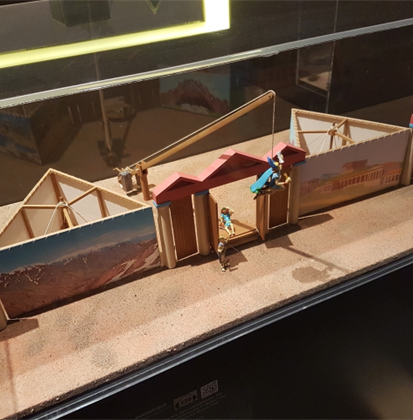
For example, the Greeks employed an entire set of mechanical technologies, including scaffolding, cranes, and pulley systems, to construct buildings. In addition, a wide variety of mechanical tools were also used extensively in the theater. For instance, you may have heard of the literary term “deus ex machina,” which means that when the plot reaches a bottleneck, a savior suddenly descends and pushes the plot forward. “Deus ex machina” originally referred to something literal: in ancient Greek theaters, a crane would be used to lower the actor playing a god from above onto the stage. At the same time, the curtains in the theater could also be switched mechanically, and they even conformed to the principles of perspective. The image below shows the deus ex machina.
We can see some mechanical creations and inventions, such as those of Hero. Although he did not live in the ancient Greek period, he was still a product of Greek culture; he was an inventor who grew up in Greek culture and spoke Greek. Hero had outstanding work in mathematics; for example, the formula we learn in middle school as Heron’s formula is in fact Hero’s formula, named after him. He also did some theoretical work, such as systematically summarizing the concept of “simple machines.”
What I especially recommend are many of his mechanical inventions, such as the odometer cart, similar to the ancient Chinese drum cart that recorded mileage. There was also a maid robot that could automatically slide over to your side; when you placed a wine cup in her hand, she could sense it and pour you wine, and when you took the cup away, she would automatically slide away. There was also an automatic door opener, which could use steam power to open the door. And there was the aeolipile, something like a prototype of the steam engine: by lighting the fuel below to boil the water, steam would emerge from two tubes above and drive the sphere to rotate.

Figure: Hero’s inventions
There is an archaeological artifact from ancient Greece called the Antikythera mechanism, which is astonishing. At present, someone has successfully reconstructed this early computer. It can convert between different calendars, infer the positions of the sun, moon, and other planets for the corresponding date, and predict solar and lunar eclipses. For example, it can convert a date in the Athenian calendar to a date in the Carthaginian calendar, and infer the positions of the sun and moon that day as well as whether there would be a solar eclipse or lunar eclipse. Its specific functions and structure are still being deciphered, but from the surviving fragments it can be confirmed that it at least involved coordinated operation of more than 30 gears in total (and possibly over a hundred). And this machine was only a little larger than a modern laptop.
Next let us talk about the Arabs. The Arabs received a large number of Greek texts and, mainly during the golden age of the Arab world—the Abbasid Dynasty—carried forward and developed Greek science and technology, chiefly including innovations in astronomy, mathematics, and mechanical technology.
The people of that era had advanced ideas. The Arab scholar Tayyib believed that “technology can come into being and develop because the original creator passes on what was created before to later people. Successors critically study these technologies and improve and develop them where possible. In this process, technology becomes more and more perfect,” which shows that he had a notion of technological progress and technological innovation.
In the Arab world, mechanics and engineering were regarded as mathematics, standing alongside arithmetic, geometry, astronomy, and music, and engineers and architects also enjoyed a relatively high social status.
There were also some inventors in the Arab world. For example, Al-Jazari wrote a book called On the Knowledge of Ingenious Mechanical Devices. He claimed that the mechanisms in it were “assembled through repeated experiments rather than through theoretical calculation.” Among them was a hydraulically driven automatic musical instrument, with puppets on top that could play music and a driving mechanism below. There was also the elephant clock, and so on.
From Greece to the Arab world, what I want to explore is what kind of technology these technologies belong to. Because perhaps later Wu laoshi will also talk about this: in the general understanding, science pursues theory and freedom, without utilitarian aims, whereas technology is more utilitarian. Indeed, practicality is one feature of technology. But the devices we mentioned earlier, such as Hero’s and the Arabs’ contrivances, like the hydraulically driven music-playing dolls, did not exist for practical purposes. The historian Dijksterhuis once commented on this: “What Hero produced were nothing but completely superfluous toys. Though often expensive and always ingeniously conceived, they were not intended to assist human work… They were all merely tricks… ingenious, trivial, dull, superfluous.” He also believed that slavery in Greece, Rome, and the Arab world at the time hindered technological development, because practical work was done by slaves, so these aristocrats and elites were all inattentive to their proper business; they did not consider practical matters, but only invented these wonderfully clever and useless things.
However, scholars of Islamic technology history give these activities a higher оценation. Hassan believed: “Devices intended to provide entertainment and aesthetic enjoyment… if one ignores the four elements listed below, then perhaps it is difficult to grasp their essence accurately.” These four elements are: 1) the emergence of a leisured class interested in mechanics (something rare in other civilizations and other periods); 2) the serious attitude of engineering personnel (they were genuinely engaged in research and in developing technology); 3) the inclusion of elements closely related to modern mechanical technology (although these technologies were not applicable at the time, they laid a high starting point for modern mechanical technology); 4) the pursuit of ideals rather than satisfaction with reality (they wanted to make something new and ideal, rather than be content with the status quo).
From ancient Greece to the Arab world, they had already formed a unique technological tradition, namely, free technology. “Free” does not apply only to science; technology also has such a dimension. In a certain sense, this dimension still remains a tradition in the West. Many people do technological research not merely for clear, visible, practical purposes.
We know that a recent case is ChatGPT. OpenAI began by playing the game DOTA; they used artificial intelligence in the game and played quite well, which drew Microsoft’s attention. Nvidia also developed early on under the impetus of the gaming industry.
There are other technologies as well, such as airplanes. The same was true there. After the Wright brothers’ airplane successfully took off, airplanes gradually became a very useful tool, but at the beginning many people developed them out of a mentality of challenging themselves, treating them like toys and games. During the roughly 100 years from the start of research and development to eventual success, airplanes had virtually no practical value at all, yet wave after wave of people threw themselves into it, pursuing excitement and fun.
Automobiles were also initially a kind of racing game for aristocrats. In fact, cars were not very practical at the time, because the roads had not been built properly; if one only had a car, it was still better to travel by carriage.
There are many similar examples. This is precisely a tradition that China very much needs. For technological development, one does not necessarily have to focus on those practical outputs. Maintaining a playful and enjoyable mentality may be a feature of Western technological history.
2、Looking at Watt’s Improvement of the Steam Engine to See Our Misunderstandings about Technology
And modern technology gradually tying itself to practicality is precisely the result of the modern alliance between science and technology. Given limited time, I can only give a cursory overview of the history of technology.
I will select only one case: Watt. By introducing how Watt’s technological innovation came about, I will explore the origins of technology. Watt is a symbol of the industrial age of our time; in the Watt era, how did Western science and technology form an alliance?
Watt was in fact not the inventor of the steam engine. As mentioned earlier, Hero had already designed a steam-powered device before him, and Leonardo da Vinci also designed a steam cannon. The direct source of the steam engine was the vacuum pump, an important scientific experiment in the study of vacuum before the steam engine, and the steam engine’s precursor. After that came other predecessors of the steam engine, such as Papin’s steam piston, Savery’s steam pump, and Newcomen’s steam engine. It was not until 1765 that Watt completed the improved design of the steam engine, and it was not until 1776 that it was successfully produced. This marked the beginning of the First Industrial Revolution.
The larger background here is actually the fusion of science and technology.
An important backdrop was the discovery of the vacuum pump, which revealed the existence of atmospheric pressure. This discovery came about because of the limits of water-pump technology. In Renaissance Europe, the Italian city-states were very wealthy and at the same time affectedly cultured and eager for grand achievements. As a result, many places built fountains as scenery for civic squares. Sometimes the fountains were even sculpted in the image of children urinating. This fashion spurred the rise of large fountains, and people vied to build ever larger ones: if you built one five meters high, then I had to build one ten meters high. In 1635, a duke wanted to build a fountain more than ten meters high, but no matter what, water could not be pumped higher than ten meters. So he commissioned the great scientist Galileo, hoping that he could work out a solution. Galileo at the time was elderly and already blind; although he had some research underway, it was not yet complete. After Galileo died, his secretary and estate organizer Torricelli discovered this unfinished research while sorting through Galileo’s documents, so Torricelli continued the work and ultimately discovered atmospheric pressure and invented the mercury barometer.
Later, by 1650, the mayor of Magdeburg, Guericke, invented the vacuum pump, and in 1654 he carried out a grand public demonstration, the well-known Magdeburg hemispheres experiment. But I want to stress that at the time these activities were regarded as sensational showmanship lacking practical value, merely a way to display how powerful vacuum, atmospheric pressure, and the vacuum pump were.
By 1659, Boyle further improved the vacuum pump, turning the Magdeburg hemispheres from copper spheres into glass spheres and making the experiment visible. Boyle carried out a great many public experiments. One typical experiment involved placing a small bird in a glass sphere; after the air in the sphere was pumped out, the bird died, showing that animals cannot survive without air. However, these experiments were more of a kind of popular performance art aimed at the public. At the time, many places had such experimental performances, showcasing newly invented instruments.
Then there was a man called Denis Papin. He had originally been Huygens’s secretary, and later replaced Hooke as Boyle’s assistant. As mentioned earlier, in many of Boyle’s experiments, small animals often died. In order to deal with dead animals, in 1681 Denis Papin invented a device for softening bones. He would put dead little birds in it and boil them; the bird bones would soften, making them easier to handle. This was the earliest pressure cooker.
The invention of the pressure cooker was actually mainly for medical experiments, because not only did vacuum pumps kill birds, other kinds of experiments also killed many animals, and there was a need to clean up the bones more quickly. And in this invention he got the inspiration for the steam engine, and later invented the piston steam engine.
We know that if you heat a pressure cooker and then let it cool, the lid cannot be opened, because when the steam cools it forms a vacuum, and atmospheric pressure presses the lid down. Early piston steam engines used this principle. Steam first fills the container, and after cooling the container produces “suction,” which in fact means using atmospheric pressure to drive the piston.
But Papin’s steam engine was a laboratory device and had not yet been commercialized. The first commercialized steam engine was Savery’s steam pump in 1690. The steam pump was actually not a true steam engine, but a steam air pump used for pumping water. This steam pump was named “the miner’s friend”; it did not use a piston and was mainly used to pump water from coal mine shafts.
Savery’s steam pump also applied for a British patent. At the time, Britain’s patent system was just beginning to mature; it was also in 1690 that Locke proposed the concept of intellectual property. After Savery’s steam pump obtained a patent, later inventors had to pay patent fees to him; for example, Newcomen’s steam engine had to pay Savery patent fees.
However, the steam pump had some shortcomings. First, it wasted a great deal of energy, because it required constant heating and cooling of the container; second, it could only pump water and could not convert thermal energy into mechanical energy, so its uses were single-purpose, mainly for mines, especially coal mines, because coal mines could use fuel for heating on site, and coal mines also had the greatest need for drainage. Still, it was not completely replaced by later steam engines, because it was smaller in size and could be deployed more flexibly.
Savery’s steam pump can be regarded as a derivative of the vacuum pump; when presented in patent demonstrations, it was described as a model of the vacuum pump.
In 1712, the Newcomen steam engine was introduced; its design may have combined Savery’s cylinder and Papin’s piston. After the steam condensed, it did not directly pump water; rather, it drove a piston back and forth, moving mechanical levers and mechanical arms, thereby producing mechanical energy to do work. It too was initially used to pump water, but because it drove mechanical motion, it could be made very large and could pump water from very deep places, breaking through the ten-meter limit.
The commercialization of the Newcomen steam engine was already fairly successful. By 1733, about 125 steam engines were operating in mines. The practical version of the Newcomen steam engine was extremely large, but scaled-down models would be used in teaching and experimental settings.
When we were in elementary school, we may already have heard the story of Watt: how when he was little he was curious about teapot lids, and when he saw the kettle lid jumping up and down, he asked his grandmother why the lid was jumping. His grandmother said it was because the water was boiling that the lid jumped; Watt kept asking why, and his grandmother could not answer. After that, Watt often studied this phenomenon and eventually invented the steam engine.
Similar legends have not only attracted the interest of elementary school students, but have also spread around the world. This story was first circulated by Watt’s son, but the version we know is not very credible. First, when Watt was born, his grandmother had already passed away; second, long before Watt was born, steam engines were already in use, and Watt was merely an improver; third, the principle is also wrong, because Watt did not discover the power of steam by way of the kettle lid. The earliest steam engines worked by using atmospheric pressure, relying on steam condensation to create a vacuum effect, rather than on steam expansion pushing open the kettle lid. Early steam engines were in fact “atmospheric engines,” and their principle is exactly the opposite of the kettle lid being pushed up.
What I actually want to discuss is that the very popularity of this story reveals a problem in our view of science and technology. We need to think about why this story became popular.
First, because the story was spread by Watt’s son, and was also verified by Watt’s aunt. But the earliest version of the story did not mention the kettle lid at all; instead, it described him observing the spout of the kettle. Moreover, the role who appears is not the grandmother, but the aunt.
This original version may be credible, but it may also not be, because promoting this story may have been intended to emphasize patent priority. After Watt’s death, young Watt inherited the company. They were mainly fighting lawsuits over priority rights, so Watt’s son may have told this story to publicize that Watt’s steam engine was a completely independent invention and had priority.
This is similar to Newton’s story about the apple hitting his head. That story was also told by Newton himself, and its background was Newton’s struggle with Hooke and others over priority rights. He wanted to show that the law of universal gravitation was something he came up with himself and had nothing to do with anyone else. Therefore, this story is not necessarily credible either.
Why was the story adapted into the form it has now? Why change the aunt into a grandmother? Perhaps it was to highlight a conservative and backward-looking image. Why change it into a pot lid? Perhaps because Watt’s contribution to the steam engine was misunderstood. The original version of the story was actually about studying the condensation of steam, by placing a spoon over the spout of a kettle and observing the droplets of condensed water on the spoon.
Of course, among us Chinese there is a very familiar view: setting the facts aside, “the story may be false, but the point is good.” I often hear this kind of defense. For example, a Chinese-language lesson plan interprets it this way: “It was precisely because he was able to pay attention to the things around him and study them carefully that he could invent the steam engine; and it was also because of his painstaking research and perseverance that he could become a world-famous scientist.”
But I am strongly opposed to this attitude. First of all, it does not conform to scientific principles: how can you promote the scientific spirit of seeking truth with an attitude of fabrication and deceit?
Second, if an adapted story does not correspond to historical reality, then the moral it promotes may not correspond to historical reality either, resulting in a widespread misunderstanding in China of how scientists or inventors in the tradition actually conducted their research.
What kind of values or patterns of discovery are promoted by the fabricated story of Watt? First, you must learn to observe nature, such as observing a kettle and the things around you. Second, the clever Watt needs inspiration, just like Newton’s apple, highlighting the importance of inspiration. Third, it emphasizes that scientists and inventors are usually independent and unconventional, and need to face the misunderstanding of the world. For example, conservatives like a grandmother do not understand the behavior of innovators, and innovators need to struggle against conservatives. Fourth, by shaping the background of Watt’s family poverty, it also emphasizes values such as diligence and hard work. Finally, invention is often understood as a wholly new creation, without paying attention to the fact that inventions have their background and prerequisites.
But in the history of science and the history of technology, we see more genuine and common patterns of invention. First, direct observation of nature is only a small part of it; more important is the need to read literature and engage in exchange. Invention is often not a sudden flash of inspiration, but is based on professional training and long-term accumulation.
In addition, most great scientists and inventors are not lonely; they received the understanding of their peers and the support of the public. And although some people were born poor and still managed to make contributions, in most cases, a good family background is more advantageous for technological invention and innovation, because technological invention and creation require material conditions. Finally, invention and innovation are often not about drawing inspiration directly from nature, but about moving forward by standing on the shoulders of those who came before.
Therefore, we often need to write stories to promote and popularize science; in fact, this stems from misunderstanding or bias toward the actual history of technological invention.
What was Watt’s family background like? He did indeed come from a family of artisans, but it was not poor. His father, James Watt, worked in the shipbuilding industry and was also a shipowner. In order to build ships, he set up a workshop at home, dedicated to making and repairing the various instruments needed for ocean voyages. For example, navigation required instruments such as the quadrant and the sextant; in addition, timing observation instruments, scales, and so on were also needed. Thus, Watt was immersed in this environment and received a great deal of hands-on education in the family instrument workshop.
Watt’s grandfather was a very respected man: he had been a teacher, taught mathematics and nautical navigation, and later became a local official similar to a municipal magistrate, so Watt could be said to have been a third-generation official and second-generation rich. His mother came from a family of letters and had an illustrious background as well; much of Watt’s cultural education was provided by her. Watt was indeed frail and often ill from childhood, and several of his older brothers and sisters died young, so Watt did not go to school, but completed his early education at his mother’s natal home. That is also why earlier versions of the story say it was his aunt. He received a good education at his mother’s natal home, and only when he was older was he sent to school.
When he reached the age of 18, Watt’s family circumstances changed: his mother died, and his father’s business and health also ran into problems. So Watt decided he had to stand on his own and make a living. He then went to London to study instrument repair while looking for work. But because he had entered the trade midway through and had not previously apprenticed in London, he could not find work and had to return to his hometown—a small village near Glasgow.
Just then he received help from a benefactor and had the opportunity to assist Glasgow University in repairing a batch of astronomical instruments. These instruments had been donated to Glasgow University, and many of them were damaged. At the time, Glasgow University did not have the ability to repair them, so it considered sending them to faraway London for repair. Since Watt’s family had some local reputation, someone recommended him to repair the instruments, so there was no need to go all the way to London to find an expert.
Some professors recommended Watt to repair these instruments, and Watt lived up to expectations, successfully repairing them. Among those who recommended him were the economist Adam Smith and the chemist Black. They spoke very highly of Watt’s repair work and said there would be more instruments needing repair in the future, hoping he would stay and work at Glasgow University. So Watt opened an instrument-repair workshop at Glasgow University and worked there as an instrument repairer.
During his days at Glasgow University, Watt was not lonely; he made many friends. For example, while at the university he kept in touch with his father, who often sent him some repair tools, because the family had a workshop and many repair tools, and his father thought Watt, as a repairman, would certainly need them. But Watt told his father, “Please don’t send any more tools…… six Chinese afternoon-tea cups, one stone teapot, a sugar box not too small, and one chamber pot, as quickly as possible.” The teapot and tea service were mainly for entertaining guests. This shows that as soon as Watt arrived at Glasgow University he made many friends, and later he also became a small discussion center within the university. His friend Robison commented: “In our little place, any young man with a marked interest in science is Mr. Watt’s acquaintance. His parlour is the gathering place for such activities—whenever we run into some difficulty, we go to Mr. Watt……”
Watt also had business acumen. During his university years he partnered with Craig to run a shop selling musical instruments and toys, and only gave up the business after Craig died.
Through his exchanges with university friends and teachers such as Bright and Robison, Watt gradually developed an interest in steam engines and related problems. Therefore, when faced with repair tasks, he was able to hit the mark.
In 1763 Watt received the task of repairing a teaching model of the Newcomen steam engine. The teaching model was a scaled-down version, and because the cylinder had a much larger surface area relative to its volume, heat loss was even more pronounced. Watt found that this machine was inefficient and began thinking about how to improve it. In studying the steam engine, Watt did indeed use a kettle; in his manuscript he even drew a kettle. He used the kettle to conduct experiments on steam condensation, with the aim of studying the phenomenon of water vapor condensation. It should be noted that at the time both Watt and his mentor Black mistakenly understood “heat” as a material substance, not knowing that heat is actually energy. They thought steam was a compound of water and heat, and condensation was a decomposition process. Thus, within a chemical framework, Watt treated heat as a substance and steam as a compound in his study of water vapor phenomena. Although from today’s perspective this scientific view was not correct, this scientific interest stimulated his enthusiasm for research. The theories and data in his experimental manuscript were all wrong, but these experiments were effective and did indeed inspire Watt to arrive at a practical improvement scheme. The first improvement was the addition of a separate condenser, which greatly increased thermal efficiency.
However, having only this invention was not enough. What was truly important was commercialization and production.
Watt made a key breakthrough in 1765, namely inventing the separate condenser, and in 1769 he obtained a patent. However, because the processing techniques for the piston and cylinder were not yet perfected, the initial attempt at production failed, and his partner Roebuck went bankrupt. Watt’s patent was eventually transferred to his creditor Boulton.
Originally Watt’s patent was due to expire in 1775, but Boulton lobbied Parliament to extend the patent until 1800, and formed the Boulton & Watt company in partnership with Watt. With Boulton’s support, Watt further improved the steam engine, and after the introduction of advanced manufacturing techniques, the steam engine successfully entered production.
Boulton also introduced what, by today’s standards, was a rather advanced sales strategy: providing free retrofitting services. Since many mines were already using Newcomen steam engines, these people could not simply buy Watt’s steam engine, after all, since they also had no idea how well it would work. Therefore, Boulton’s strategy was to offer free retrofitting, namely to add a separate condenser to existing steam engines, and then take a share of the fuel savings. This sales strategy helped Watt’s steam engine open up the market.
Thus, Boulton played an important role in the history of Watt’s steam engine. He was an entrepreneur who originally made his fortune by producing small toys and small metal goods. At the same time, he was deeply passionate about science and presided over a famous scientific society—the Lunar Society.
The Lunar Society met at the full moon. Its earliest members included old Darwin (Darwin’s grandfather, a writer and naturalist) and Boulton himself; famous figures such as the clockmaker and instrument maker Wedgwood also often took part in their activities, and these figures also included the American founding father Franklin; the society’s members also included people from different fields such as the physician William Small, the porcelain magnate Wedgwood, the mechanical inventor Edgeworth, the abolitionist writer Thomas Day, the chemist Priestley, and the pharmacist Stocks. Later, introduced by friends such as Robison and Small, Watt joined the Lunar Society and became a major figure in its later period.
Boulton was the core figure of the Lunar Society; after his death, the society largely stagnated. Small was also for a time a very important figure, but he died young.
The members of the Lunar Society maintained good ties with one another, and Watt often corresponded and exchanged ideas with Small.
A typical Lunar Society gathering, as recorded, went like this: “These people often got together. In July 1768, Watt’s friend Robinson (Robison) passed through Lichfield and ‘was charmed by the unassuming quiet and modesty of Dr. Darwin,’ found that Small was there as well, along with ‘the very warm friend Mr. Boulton.’ These gatherings were for work as well as for amusement; as time went on, they tried to dine at two o’clock, and usually planned to stay at least until eight. There was plenty of drinking, and the table was laden with fish, capons, Cheshire cheese, Stilton cheese, pies, and cream wine. During meals, the wives would occasionally join these men, and children would come and go. But once the table was cleared, they would set out instruments, plans, models, minerals, and engines. In the house or workshop, they could talk until nightfall……甚至持续到第二天。(经常在达尔文家过夜)”.
After Watt joined the Lunar Society, he won high regard from veteran members such as Boulton and Darwin. In small gatherings, Watt had already shown everyone his improvement plan. Everyone not only kept the secret strictly, but also offered Watt useful advice. These suggestions were very pertinent; for example, Darwin’s opinion was that although your ideal is excellent, there may be difficulties in implementation. Darwin said to Watt: “My dear friend, I have always kept your plan for improving steam a strict secret. But I begin to see some difficulties in execution. May God allow us to spend one week together, bringing Mrs. Watt—one week!—one month, a whole year.” In fact, he was right on the mark.
Boulton also enthusiastically recruited Watt. Boulton was the kind of person who, in 1769 when Watt was still cooperating with Roebuck, was also warmly invited by them to join, but Boulton wanted to cooperate with Watt alone and did not join their plan; instead, he invested a bit of money in them. He said to Watt, “There are two motives why I am willing to help you, one is affection for you, and the other is a fondness for ingenious projects that can make money.” Boulton did not put in much money, precisely so that after they went bankrupt he could take over and work with Watt to enlarge the enterprise. He thought Watt’s vision was too small: “It is not worth building a factory for only three counties. But I find I am worth striving for the whole world.”
After Watt’s initial failure, he was at one point discouraged and wanted to go to Russia. Boulton also very considerately advised Watt: “I am greatly surprised by the fact that you want to go to Russia,……you are not in good health, and long journeys or voyages are dangerous. Losing your companionship makes me feel somewhat ill at ease. However, I hope to help you as much as I can, and give you advice without regard for myself.”
The Lunar Society summarized some criteria for selecting members: 1) merchants or professionals, who have the same equal social standing. 2) Although no single science could interest them all, their interests were very broad, and usually overlapped. 3) They usually placed extreme value on the practical application of knowledge……and they cooperated with one another in solving personal and business problems, and in solving scientific and technological problems as well. 4) There is no doubt that none of the members’ primary interests lay in the English Midlands region; if anyone lived in a region inconvenient to reach Birmingham, he would not be accepted as a member.
The success of the steam engine owed a great deal to the influence of the Lunar Society. First, Boulton brought in the best craftsmen to manufacture steam engines; second, the boring machine used to produce cylinders was improved by Wilkinson in 1775, and Wilkinson was the brother-in-law of Priestley, a member of the Lunar Society; third, the gauge used to measure coal consumption for the purpose of collecting royalties was first developed by another Lunar Society member, Whitehurst. I introduced the Lunar Society because I think meetings like ours have a bit of that Lunar Society flavor. People from all kinds of industries, including entrepreneurs, inventors, and investors, come together to exchange ideas; I think this spirit is very important. In short, Watt lived in an era when science and technology were merging, and the way science and technology were integrated in his inventions was different from what we see today. Today, technological invention is mainly carried out under the guidance of very specific scientific theories, whereas, as we mentioned earlier, Watt’s understanding of “heat” was wrong; he was guiding his experimental research with a mistaken theory. But that was not important. In this matter, what mattered was not the scientific theory itself, but that it concentratedly embodied the impact of the emerging scientific culture after the Scientific Revolution on invention, including the rise of the scientific-instrument industry, the elevated status of craftsmen, the rise of free and open scientific societies, the rise of chemistry, and the emphasis on mathematics and experiment. All of these were evident in the process by which Watt improved the steam engine. The very fact that Watt was an “improver” is precisely what makes Watt more suitable as a symbol of the Industrial Revolution. Watt did not merely improve the steam engine; he improved “improvement” itself, shifting from qualitative improvements in function to quantitative improvements in efficiency. That in itself was a new approach that marked an epoch. In summary, by using Watt as an example, we have told the backstory of an innovator during the Industrial Revolution. Many of the elements in that story, including sales strategies and the organization of societies, are still not outdated. Part Three:Hu Yilin: If the AI revolution is like the Industrial Revolution, we will face a very terrible situation 3. Where is technology going? — Toward a better life We are entering the final segment: where is technology going? Where does technology come from? Where is technology going? My simple conclusion is that, from the Industrial Revolution to the rise of AI, technology aims to benefit humanity.
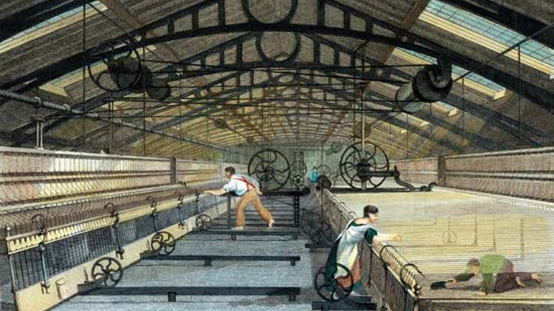
For another example, take income data. Between 1760 and 1830, average working hours increased by 20 percent, weekly pay rose by 12 percent, and if calculated on an hourly basis, actual wages instead fell.
Look next at food consumption. Engels also counted the consumption of meat and grain. Before 1840, Britain’s overall food consumption had been declining all along; in particular, meat consumption dropped sharply. It was only after the 1840s that food consumption hit bottom and rebounded, showing that people’s diets were in poor shape.
Moreover, anatomical evidence shows that English men born around 1850 were significantly shorter than men from the previous decades, and they still had not returned to the 1760 level by the end of the nineteenth century. The decline in height shows that there was malnutrition and developmental impairment at the time.
There was also the exploitation of child labor. In the 1830s, around 50 percent of workers in the textile industry were child laborers, while in the coal industry the figure was 33 percent. Child laborers were paid as little as one-sixth of adult workers’ wages, yet their daily working hours could reach as high as 18 hours, and they were often assigned dangerous tasks.
That is the situation in the early Industrial Revolution. In fact, it was no longer really “early” at all: from Watt’s improvement of the steam engine in the 1760s until 1840, nearly 80 years had already passed. If we are now in a Watt moment, then that means that our next 80 years may all be in such a state.
Earlier we mentioned the reduction in working hours: “In many parts of Europe two hundred years ago, people worked more than 100 hours a week; now in many parts of Europe they work only 35 hours a week.” Isn’t that a kind of progress? But the question is, who should we credit for that progress?
In fact, the very existence of 100-hour workweeks was itself a consequence of the Industrial Revolution. Before the Industrial Revolution, where was there such high-intensity work of 100 hours a week? Of course, this statement is statistically inaccurate. I found a table that shows the average weekly working hours of British workers in different periods.
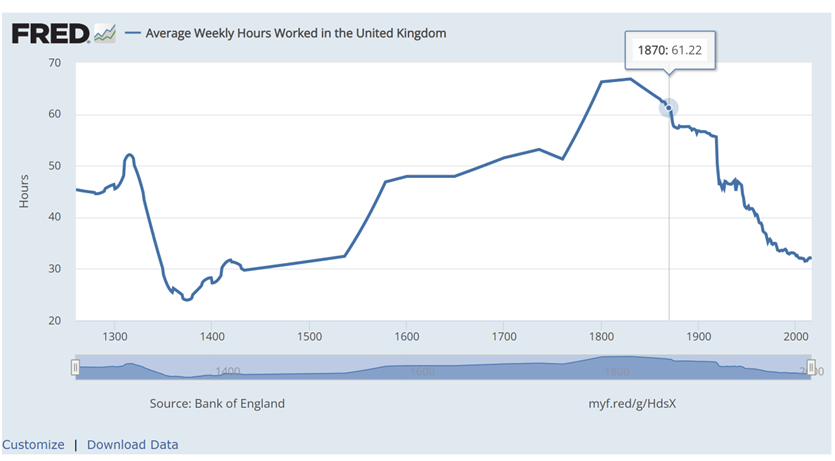
As you can see, the average working hours of British workers were quite low in the Middle Ages, and only began to increase gradually from 1600 onward, with the main rise taking place during the Industrial Revolution. Marked by Watt’s steam engine and the spinning jenny, the Industrial Revolution began to emerge; thereafter, throughout the entire period of the Industrial Revolution, workers’ hours continued to increase, reaching a peak in 1830. The decline in working hours after 1830 was because Britain then experienced its first economic depression, so this decline was not a good thing either; it meant high unemployment. The economic depression of the 1830s also marked the end of the Industrial Revolution.
There were also several important turning points, such as around 1870, when there was a sharp decline. What happened then? In 1864, the International Workingmen’s Association (the First International) was founded; in 1868, the British Trades Union Congress was established. These events marked the organization of workers, as worker groups were able to unite and struggle, after which working hours began to fall.
In addition, the two World Wars also reduced working hours to some extent.
To sum up, we can see that some people previously attributed the reduction in working hours to technological development, but that is not actually the case. In fact, the technological development that began in 1760 increased people’s work intensity; what really led to shorter working hours was, first, economic depression, and second, the labor movement.
The workers’ struggle included organizing social movements, establishing social organizations, and pushing for legislation. Among these, the Luddites, the Chartist movement, the Paris Commune, the First International, and the Second International are all very familiar to us Chinese. These activities rose and fell in succession, lasting for more than 100 years. Without these activities, without continuous struggle, whether workers’ living conditions would have improved automatically with technological development is hard to say.
This was the situation in Britain, the first country to confront the problems brought about by the Industrial Revolution. And some later-developing countries were still, well into the twentieth century, failing to solve the social turbulence caused by the early Industrial Revolution, including widespread unemployment, appalling workers’ conditions, widening gaps between rich and poor, shortages of supplies, and so on.
A typical example is the rise of Nazism. The unemployment crisis does not solve itself automatically, and if it is not solved, then who will solve it in the end? Hitler came to power to solve it. The Nazi Party issued a manifesto: “There will never again be workers being replaced by machines.”
When the Nazis came to power, they blamed communism, claiming that famine and war were brought by communism, and called on people to vote for them in order to solve these problems. And whether it is Nazism, communism, or Western Keynesianism, all of them need to address the social crisis brought about by the Industrial Revolution. If you cannot solve it in a more peaceful, more moderate way, then someone will certainly solve it in a more violent way. The question is not whether a social revolution is needed, but which kind of social revolution we are waiting for.
We cannot expect to do nothing and simply let technological development run its course, believing that technology will automatically bring humanity toward a better future. This view is suspicious.
Many people think that these problems are temporary, and that in the long run humanity will surely progress; no one would deny that. From the long-term perspective, the Industrial Revolution was of course a tremendous advance for humanity. But the question is, how long is “the long run”? For our generation, “the long run” is our whole lifetime. As mentioned earlier, that figure of 80 years is exactly a person’s entire lifespan, equivalent to three to five generations living within that span. Of course we can say that after 80 years, the Industrial Revolution will have become bright and promising, and the future will be better—but the problem is that you won’t live through those 80 years; you are the sacrifice, you are the victim.
Many people believe that as long as all of humanity progresses in the long run, then some people making sacrifices in the short term and serving as stepping stones should not complain in the slightest—even if that “some people” are actually the majority, especially ordinary laborers, and even if that “short term” may last several generations.
But there are still some people who do complain. These complaining people keep struggling, barely managing to secure a little welfare and some protective institutions, but later generations do not think that these were the result of their struggle; instead, they are attributed to the blessings of technological progress.
For example, when working hours fell from 100 hours to 35 hours, people think this was the result of technological progress, rather than the result of those generation after generation of strugglers fighting for it. These strugglers and struggles, including the May Day we commemorate and the Haymarket Affair in Chicago—what were they fighting for? They were fighting for changes in social institutions and protections for workers, but people today may all think that these were the credit of technological progress rather than the fruits of people’s struggle. And if people still believe that technological progress can automatically solve these problems, then we may be facing the next Hitler coming to power.
I previously recommended a book, Frey’s The Technology Trap, in which he says: “Most economists acknowledge that technological progress will cause some adjustment problems in the short run. But few mention that this ‘short run’ can be one’s entire life. Moreover, the long-run impact ultimately depends on the policy choices made in the short run.”
That is to say, the reason technological progress is a good thing and a form of progress in the long run does not depend solely on technology itself, but also on the struggles and adjustments people make to adapt to and respond to new technologies, as well as new social design and legal-institutional construction. All of these efforts are important; if we do not make these efforts in the short term, we may simply never have a “long-term” bright future.
Finally, let us talk again about the fourth mistake mentioned earlier: ignoring the differences between this Industrial Revolution and the first Industrial Revolution. This Industrial Revolution may be even more severe.
The prophet of artificial intelligence, Norbert Wiener, wrote in his 1950 book Human Use of Human Beings: “The introduction of automatons will introduce unemployment. Compared with the present industrial depression and even the crisis of the thirties, the latter is merely child’s play. Such a crisis will do harm to many industrial sectors, and may even do harm to industrial sectors that use the new potentialities. On the other hand, our industrial tradition by no means prevents industrialists from seizing quick and secure profits and slipping away before his own personal bankruptcy.”
Here Wiener was mocking those capitalists and industrialists who cared only about immediate profit and not at all about anyone else’s life or death.
Wiener pointed out that the danger now facing us is extremely frightening—the crisis of the 1930s brought the Nazis to power, but he thought that by comparison it was merely child’s play.
Why was the first Industrial Revolution not so frightening? Because the first Industrial Revolution created a large number of new jobs, filled employment gaps, and provided new work opportunities for the unemployed.
But now, the artificial intelligence revolution is a new revolution, and it has brought about a new problem, namely that AI has already learned how to learn. Some people claim that in the future artificial intelligence will create new jobs, but the question is: how do we actually obtain those new jobs? Human beings do not automatically adapt to new jobs; they must adapt through learning, and yet machines learn faster. Therefore, the AI revolution may create many new jobs, but humans will also find it very hard to compete with AI for those jobs. In the end, humans may only be able to do work such as sweeping dust for AI.
In short, the lessons we have learned from the Industrial Revolution are to prevent the following four kinds of mistakes.
First, we must respect history, and fully understand the conditions during the Industrial Revolution, paying particular attention to negative phenomena such as the unemployment crisis of that time. Because these phenomena may well happen again, we should read history.
Second, we should attribute things fairly, not crediting technology for everything good and blaming bad things on chance. We must correctly assess the positive significance of struggles such as the labor movement, and acknowledge that social reform and technological revolution are equally important. There is no doubt that we do not want to face again recurring labor movements, new Nazi parties, new Luddites; that is terrifying. Since we have already gone through this once, we should learn from it and promote fairness and well-being through some moderate means.
- We should have humanistic concern, and not place ourselves in the position of a player of the game Civilization, thinking that it is nothing more than sacrificing a batch of people; once you sacrifice one batch, it is over, and national power becomes developed. Such a view is extremely cold and inhumane. We should sympathize with those at the bottom, and not think that sacrifice is only natural. Technological progress exists to bring well-being to humanity.
Fourth, we should face up to the differences between the two Industrial Revolutions, pay attention to the new characteristics of AI technology, and prepare to deal with crises that are even more severe in many respects.
Finally, to summarize briefly, where is technology going?
First of all, we must admit that technology serves humanity, that technology is a tool, and human beings are the end, rather than the other way around.
The logic of many people today is actually that human beings are the tool, and technology is the end, because they take technological progress as a goal that ought to be pursued as a matter of course, and think that one generation can be sacrificed in order to promote progress.
This logic is dangerous. Why? Because technological progress is endless. You may say that it is worth it for our generation to sacrifice our own happiness for the accelerated development of technology, but what about the next generation? Must the next generation also sacrifice its own happiness to promote further technological development? Technology can always develop, technology can always progress, so every generation will face this problem. Therefore this logic is terrifying: it turns generation after generation into victims.
So, my position is that we must return to a people-centered approach, return to making people the end. We cannot simply use the long-term prospect of benefiting humanity, to cover up our short-term state of sacrificing ourselves for technology, being enslaved by technology. Whether in the long term or the short term, everything we humans do with the help of technology is for the sake of benefitting humanity itself.
Thank you all. My lecture ends here.
Translated from the Chinese original with AI assistance. The original text is authoritative.