标签:commodity

  • Has NFT Failed?

    Has NFT Failed?

    Has NFT Failed?
    Web3 & Bitcoin

    Has NFT Failed?

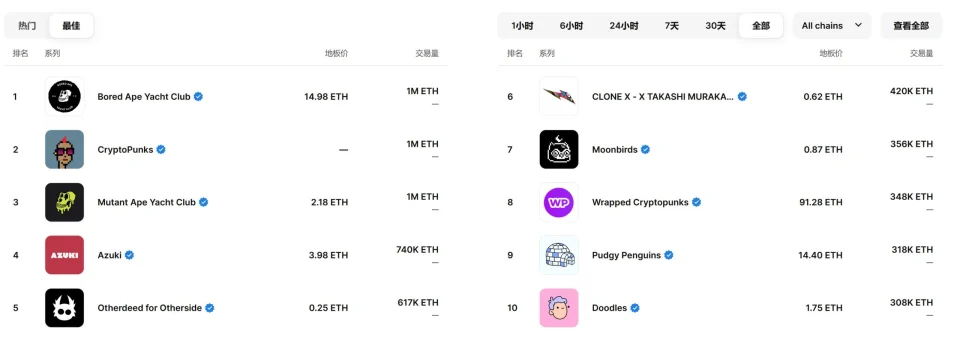
    https://twitter.com/epr510/status/1767519073330422056 If the BAYC floor price falls below 15E, has NFT failed? I don’t think so. First of all, if persistent price slumps count as “falsification,” then Bitcoin has already been falsified countless times. Besides, as for the pioneering Punks, they actually haven’t fallen that far. Even if projects like BAYC and Azuki all declined and perished, that still would not prove that NFT has failed. By the same token, we can look at the history of FT: Bitcoin has gone up and down, while the other cryptocurrencies have gone quiet one by one. Of the FTs that were hot more than ten years ago, aside from Bitcoin, probably only…

    Read more
  • Why Doesn’t Bitcoin Fit Gresham’s Law (Bad Money Drives Out Good)?

    Web3 & Bitcoin

    Why Doesn’t Bitcoin Fit Gresham’s Law (Bad Money Drives Out Good)?

    Many people who question Bitcoin focus on its so-called “deflationary” character: because the total supply of bitcoins is limited and tends to appreciate, people are inclined to hoard them rather than spend them, so liquidity is poor and Bitcoin cannot become a mainstream currency. There are also two dimensions to this issue: one is temporal, the other spatial. First, considering the prospect of future appreciation, we may use money as conservatively as possible and engage less in speculation and investment. In this sense, the weakening of so-called “liquidity” by Bitcoin is inevitable, but that is not necessarily a bad thing. In a series of earlier articles of mine (such as…

    Read more
  • Is Bitcoin Environmentally Friendly?

    Web3 & Bitcoin

    Is Bitcoin Environmentally Friendly?

    This article is an original entry in the 2013 essay contest organized by Bitren and was first published on the Bitren forum, so it did not debut on my blog. At first I thought I stood no chance of winning any prize, so last night I casually posted it on the blog; unexpectedly, it still won the second-place grand prize. Because I reposted it half a day early (to Babbitt), I have voluntarily deducted 10% of the prize money as punishment, and here I would like to apologize to and thank the Bitren website. 1. Does Bitcoin waste resources? Bitcoin’s proof-of-work mechanism, that is, the so-called “mining,” is often criticized:…

    Read more
  • Bitcoin: Common Sense and Dogma

    Bitcoin: Common Sense and Dogma

    Bitcoin: Common Sense and Dogma
    Web3 & Bitcoin

    Bitcoin: Common Sense and Dogma

    Recently I’ve been following some Weibo accounts and websites related to Bitcoin, watching from the sidelines and even taking part in some of the related debates—for instance, the arguments surrounding this Weibo post were very lively: http://weibo.com/1646744100/zBFt7q7D1 I must admit that paying attention to Bitcoin while I’m anxiously preparing my doctoral dissertation does make me seem a bit off task, but I’d still like to offer myself a defense: after all, this is not completely beside the point. First of all, of course, one buys Bitcoin hoping to make money, or at least hoping to hedge risk. Right now the international and domestic financial and economic environment is facing a…

    Read more
  • On the New Three Kingdoms and Artworks in the Age of Mass Media

    On the New Three Kingdoms and Artworks in the Age of Mass Media

    I only glanced at a few episodes of the New Three Kingdoms television drama, and I haven’t read many related reviews either. At present I also do not want to offer any comment on the drama itself; works of that sort are not worth criticizing. I am merely using New Three Kingdoms to recall certain general phenomena of audiovisual works in this era. When watching New Three Kingdoms, and when in earlier years watching various remade historical costume dramas, I often could not help thinking: why can’t you just make it properly? Why must the screenwriters insist on adding so many melodramatic, soap-opera-style gimmicks? Why can’t they show more respect…

    Read more
  • On the Discussion on the Teachers’ Blogs: The Dirty Books Sold by the Dangdang Online Bookstore

    Site Matters

    On the Discussion on the Teachers’ Blogs: The Dirty Books Sold by the Dangdang Online Bookstore

    Dirty Books Sold by Dangdang Online Bookstore 2007-03-19 09:38:15 http://blog.sina.com.cn/u/485ea879010007ez#comment I’ve been a longtime customer of Dangdang Online Bookstore, having purchased books worth several thousand yuan there. According to Dangdang’s existing records online, I have 20 orders in all on Dangdang, of which 19 have been completed, with total spending amounting to 3,225.6 yuan. But recently a very dirty book was delivered in an online book purchase (see below). Earlier, a book that had been soaked in water was also delivered! For Dangdang to treat customers like this is truly not decent. This book was mixed in with a batch of books I bought from Dangdang at the same time,…

    Read more
  • What Should “Commodity” Be?

    What Should “Commodity” Be?

    What Should a “Commodity” Be? —In Defense of Marx’s Definition of “Commodity” “What has ‘consumption’ brought?”—If you were to let modern people discuss this topic, especially if you handed it to Chinese youth—the most enthusiastic group about the “market economy” in today’s world[①]—their general line of thought would probably be: consumption promotes exchange, exchange promotes production, production in turn promotes consumption, and so on; in short, consumption will ultimately bring “abundance”—the abundance of wealth, the abundance of life, and so forth. Thus we often hear slogans such as “stimulate consumption” and “boost domestic demand.” In any case, consumption is always a good thing; surplus generates consumption, consumption creates prosperity… This…

    Read more