
I am very honored to speak today on behalf of the teachers of the undergraduate minor in history of science. Building the undergraduate major has always been a priority for us in the Department of History of Science at Tsinghua University. In China as a whole, we were also the first department of history of science to enroll undergraduates. At present we are training a minor; in the future we will also train a major.
So, why should undergraduates study history of science? Of course, one purpose is to train future scholars of history of science and strengthen the pool of applicants for our graduate program. But many undergraduate students will not necessarily continue on to history of science after graduation, and may not even pursue an academic path. So for ordinary people who go on to all walks of life, what is the point of studying history of science at the undergraduate level?
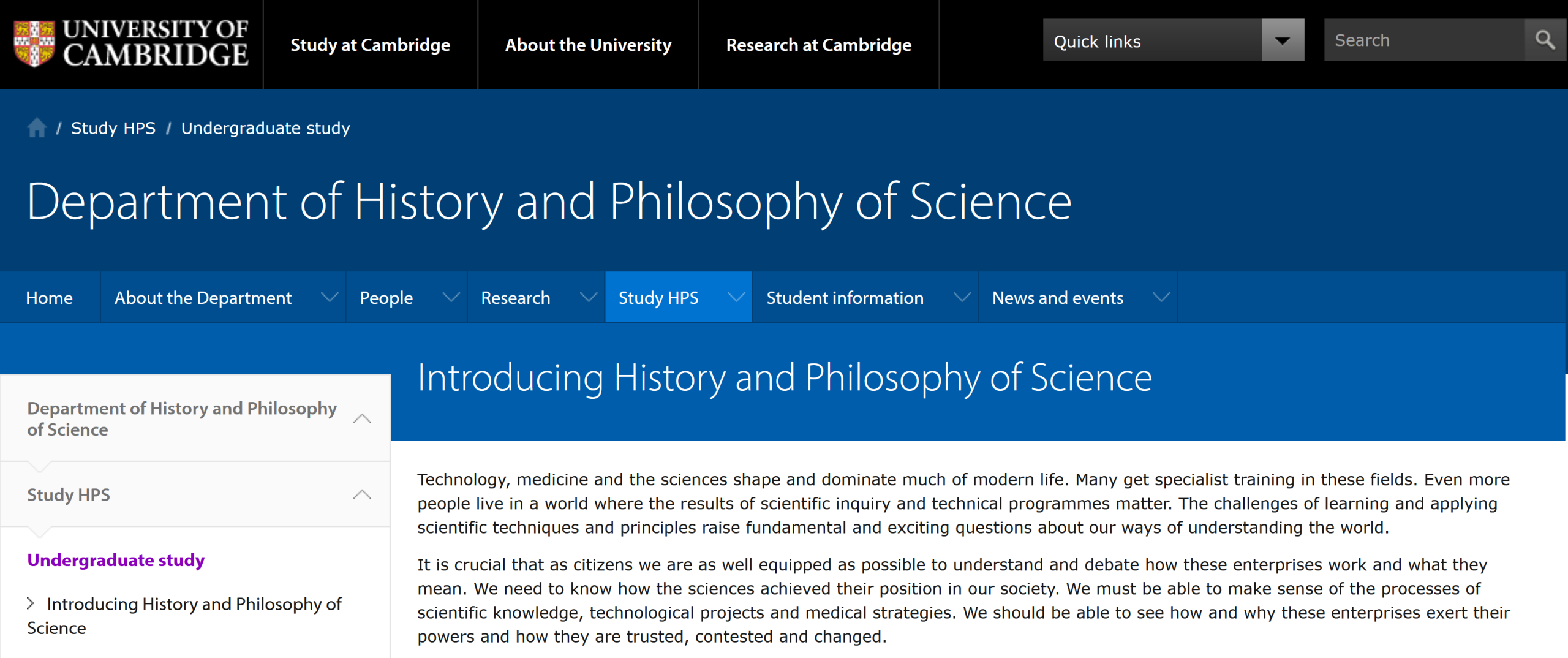
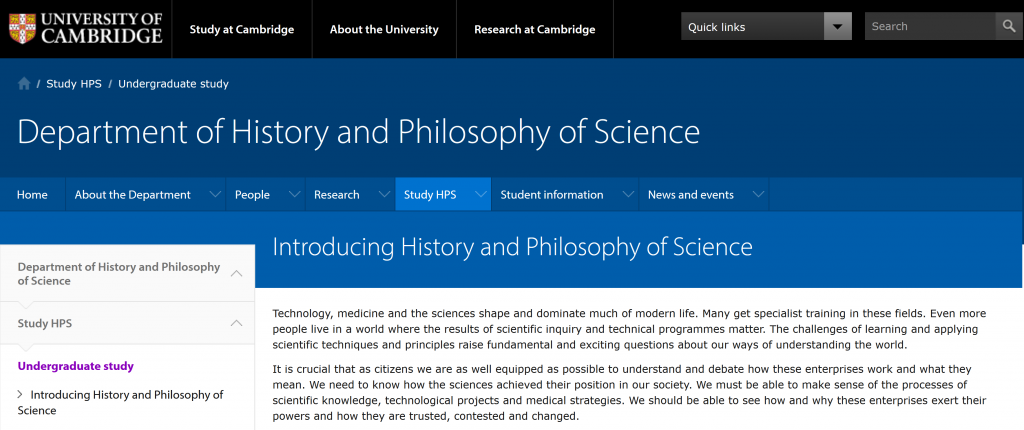
In China, our Department of History of Science is a pioneer, but internationally there have long been precedents. I found the undergraduate program of the Department of History and Philosophy of Science at the University of Cambridge. Their introducing page on the official website is very well written, so I will directly quote a few passages and translate them for everyone:
Technology, medicine and science shape and dominate many aspects of modern life. Many people are professionally trained in these fields, and many more live in a world that is to a large extent the result of scientific research and technological planning. How can this world be understood? Many fundamental or interesting questions involve science or technology.
The key thing is that, as citizens, we should understand and debate these questions as far as possible: how do enterprises involving science and technology work? And what do they mean? We need to know how science has come to occupy such a position in our society. We must sort out the processes by which scientific knowledge, technological projects, and medical decisions operate. We should see clearly how and why these enterprises exercise their power, and how they are trusted, contested, and changed.
The courses in the Department of History and Philosophy of Science provide rich resources for the above goals…
Many of the most pressing public issues we face today—climate change, food safety, public health and epidemic prevention, and so on—depend on some very basic claims, such as how we acquire trustworthy knowledge and whom we should trust. …
Courses in history and philosophy of science help students think about these questions so that they can take part in the many urgent debates surrounding science. …
All right, I’ll quote just this much. For the full text, you can go to their official website. Put simply, what is the undergraduate stage of university for? Professor Wu Guosheng has written several articles on this topic. The essence of “undergraduate” is not professional training (otherwise it would just be a vocational college), but a place for cultivating citizens and fostering personhood.
Of course, our primary schools and middle schools also have to cultivate citizens and sound personalities. So what is different about the undergraduate stage? The key point is that at the stage of basic education, what we cultivate is the citizen in the general sense: being able to make independent choices, to vote, to demonstrate, to voice dissatisfaction—these are the basic requirements of an ordinary citizen. But university undergraduate education should cultivate citizens “capable of debate.” Being able to take part effectively in debates over public issues requires a higher level of knowledge and training in ability.
There are many public issues, involving economic problems, social problems, military problems, gender issues, public health issues, and so on. Different specialized issues require different knowledge backgrounds. And today, science and technology issues weigh increasingly heavily in public affairs. It is not only questions like how to promote or respond to scientific and technological development that are important; various other issues, such as economic problems, military problems, public health issues, and so on, are all more or less entangled with issues of science and technology.
Of course, we call on professional scientists and engineers to take more part in debates over public issues. But because of specialization, people from different fields often cannot find a common language. Especially in the age of social media, information cocoons have become rampant. Whether among the public or among professionals, people are often narrow in outlook, placing more emphasis on conclusions than on argumentation. It looks as if there are debates everywhere in the marketplace, but in fact they are often only superficial, tangled up in positions or labels, or even degenerating into outright personal attacks. Debates like that are completely devoid of constructive value.
On the one hand, science and technology issues are becoming more and more important; on the other hand, constructive public debate is becoming increasingly difficult. In this kind of historical setting, those of us who have studied history and philosophy of science have been given an even more arduous mission.
We have a macro-level understanding of science and technology and their historical development, as well as a broad perspective that spans philosophy, history, and sociology. We can intervene in debates over all kinds of public issues; we can serve as a bridge of communication between the general public, the media, scientists, entrepreneurs, and the government; and we can also, in the independent capacity of the public or of intellectuals, raise or lead appropriate issues.
I hope that everyone will maintain the tension between reason and passion, and actively participate in public issues on the premise of respecting knowledge. Do not become either a fanatical ranter or a cold machine. Thank you!
Translated from the Chinese original with AI assistance. The original text is authoritative.