
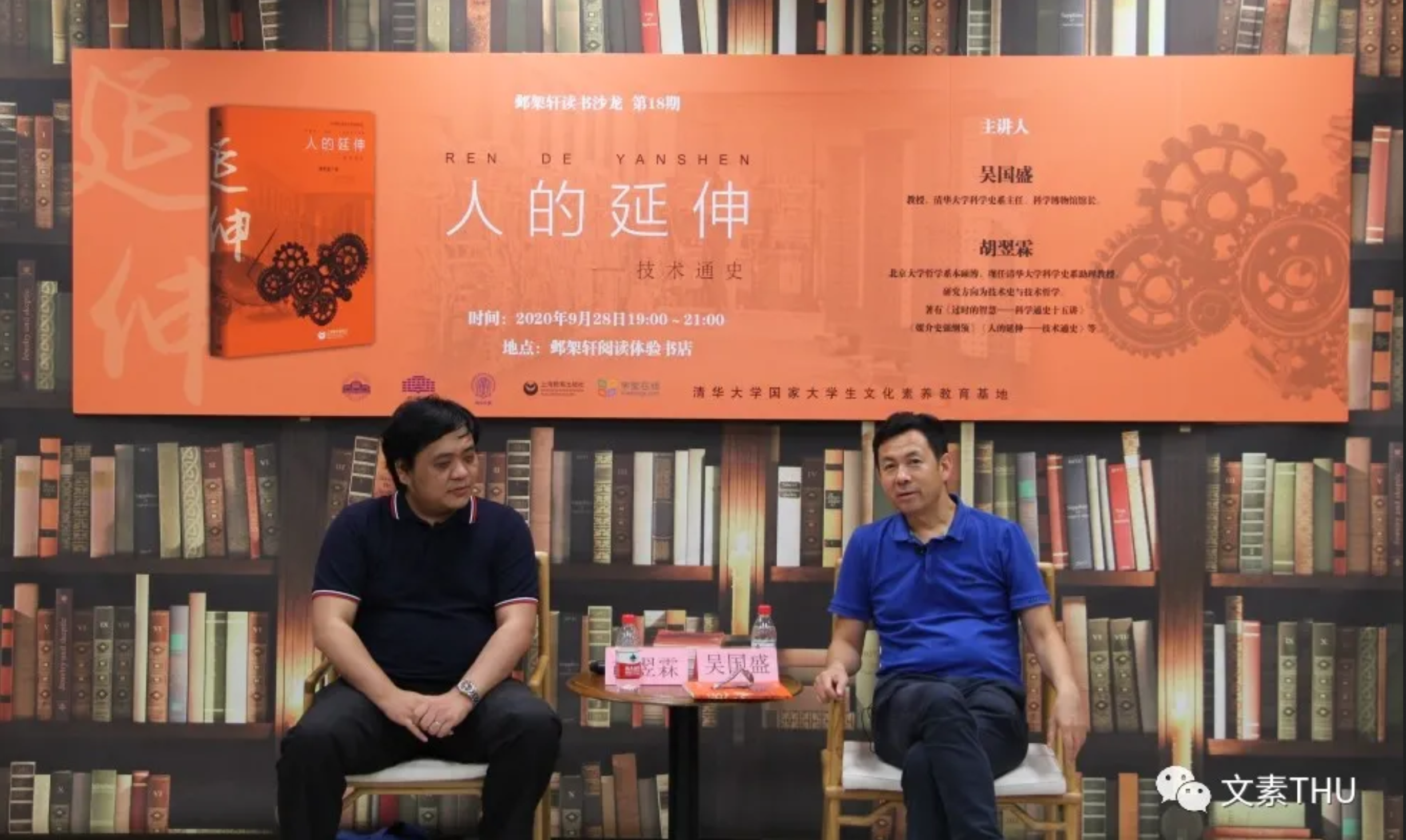
Thanks to Teacher Wang Wei and Teacher Wu, I put together this conversation with Teacher Wu, and it felt a bit like Teacher Wu was checking my homework. I thought the conversation went rather well. Some of the issues it touched on, especially concerning historiographical concepts, I may have a chance to write about in more detail later.
The following is the transcript, compiled by the salon’s official staff 整理的文字稿, and I made some revisions to it, though I cannot guarantee its accuracy. If you would like to reprint it, please contact 文素THU.
Host Wang Wei:
Good evening, distinguished guests, teachers, and students!
I am Wang Wei, Executive Deputy Director of Tsinghua University’s National Base for Cultural Literacy Education for University Students. I warmly welcome everyone to tonight’s 18th session of the Yejiaxuan Reading Salon. In the Chinese context, eighteen is generally a good number—think of the Eighteen Arhats, Eighteen Bids at Parting, and the Eighteen Scholars—so I am also delighted to have invited my two colleagues, Professor Wu Guosheng and Assistant Professor Hu Yilin, to take part in this event.
Professor Wu Guosheng is the founding director of the Department of History of Science at Tsinghua University and the founding director of the Science Museum. He is also a member of the Academic Degrees Committee of the State Council’s discipline review group for the history of science and technology, the director of the Science History Education Working Committee of the Chinese Society for the History of Science and Technology, and the director of the Science Communication and Science Education Professional Committee of the Chinese Society for the Study of Natural Dialectics. He is a cross-disciplinary scholar, and he is extremely well known in both the history of science and philosophy of science communities. In China’s fields of history of science and philosophy of science, he is an idol-level figure; he can attract countless followers simply by virtue of his style and his prose. His name recognition is the highest in our field!
Dr. Hu Yilin is an assistant professor in the Department of History of Science at Tsinghua University, whose research focuses on the history of technology and philosophy of technology. Although he is very young, he already has four monographs; let me name three of them here: Overdue Wisdom—Fifteen Lectures on the General History of Science, The Strong Program of Media History, and The Extension of Man—A General History of Technology. He is also very well known in our field, and is nicknamed “Little Wu Guosheng,” especially since in our Jiangsu dialect the sounds for “Wu” and “Hu” are not clearly distinguished. The usual practice is to place the author first and the commentator afterward. But since today we are following age rather than books, and since Teacher Wu Guosheng was also Hu Yilin’s doctoral supervisor back in the day, we should still honor teachers and respect education by putting Teacher Wu first.
This salon is jointly sponsored by Tsinghua University’s National Base for Cultural Literacy Education for University Students, the Library, Yejiaxuan Reading Experience Bookstore, Tsinghua Xuetang Online, Shanghai Education Publishing House, and Guangming Net. I would like to express my sincere thanks here to Shanghai Education Publishing House, Guangming Net, and the many sister units on campus at Tsinghua for their strong support. Next, I will hand the floor over to the main speakers for this salon, Professor Wu Guosheng and Dr. Hu Yilin. Please welcome them!
Wu Guosheng:
First of all, thank you, Professor Wang Wei, for the invitation! Yejiaxuan is a very well-known venue at Tsinghua, and this is my first time here; it really is excellent. Today happens to be a good occasion for me to talk with Teacher Hu Yilin about his book The Extension of Man—A General History of Technology. We all know that today is an age of technology, and people can very easily feel the enormous impact of technology on individual life and on the times. How does this influence come about? How has it shaped the situation we see today? This requires historical reflection. So the history of technology is a very important discipline. Yet in our minds, it seems as though this discipline has never really existed. We often hear about the history of science, but not the history of technology. Or rather, when there is a history of technology, it is a fragmented sort of thing—say, the history of mining technology, the history of iron and steel technology, automotive technology, or some specific technology. Teacher Hu’s book is a general history of technology, and that makes it interesting. Today I am very willing to have a conversation with him about this book.
Let me begin by talking about what a general history of technology is. In universities, studying general history is a common phenomenon. People hope that in a relatively short time, through overview-style reading, they can gain a comprehensive understanding of the history of a certain discipline. So writing general histories is very common—for example, general histories of China, Britain, or the West, including the “General History of Science” I teach every year in the autumn semester. After Teacher Hu came to Tsinghua, he taught a course called “General History of Technology,” and our students asked, “What is a general history of technology? Does technology even have a general history?” In our impression, science does have a general history: it is theoretically coherent, moving in a single line from antiquity to modernity; the problems it thinks about and the methods it uses have not fundamentally changed, and they have been formed generation after generation through accumulation and revolution. So we can relatively easily write a general history of science. From the rise of Greece, to the heyday of the Hellenistic world, to the loss and decline of Greek science after the collapse of the Roman Empire, to its inheritance and flourishing in the Arab world, and then back to the revival of science in Europe. After the Scientific Revolution, modern science emerged. The logic of general history of science is fairly clear.
A general history of technology is something plural and diverse. Once you say “technology,” there are all sorts of things. Does using chopsticks count as technology? Yes, it does. Clothing, food, housing, and transportation are all technology. How could there be a general history? This question is very interesting. Teacher Hu once wrote an article asking whether such a thin book can also be called a general history. In our impression, general histories are especially thick, and technology is so broad; yet he deliberately wrote something especially thin. So let us first ask Teacher Hu to explain: how can such a thin book be called a general history of technology?
Hu Yilin:
All right, thank you, Teacher Wu.
I am rather nervous, because Teacher Wu is my advisor, and back then we often discussed things in class as well. I have also been deeply influenced by his General History of Science. The day before yesterday, when I taught the “General History of Technology” course, a student happened to ask: “Teacher Hu, what is the relationship between your General History of Technology and Teacher Wu’s General History of Science?” I said it is a master-apprentice relationship. I grew up listening to Teacher Wu’s General History of Science. I grew up reading Teacher Wu’s books and listening to Teacher Wu’s lectures.
Why did I want to write such a thin general history of technology? This too is related to my discussions and debates with Teacher Wu. At the time, I said that I could write a slim booklet and it could still count as a general history of technology. What is a “general history”? I need to explain that again. Teacher Wu has taught General History of Science for many years. What does “general” mean? One meaning is the kind of comprehensive understanding Teacher Wu talked about: we have a comprehensive grasp of the entire course of science. Another meaning is that it is a comprehensive, general understanding—not one particular science, but science in general.
How is a general history of science possible? Although Teacher Wu has not spoken about this in a dedicated way, when we attend his classes and read his books, I have also been thinking about this question. First, we have to understand how the “general” in general history of science comes together. Even though general history of science is said to have a logic, developing from Greece to the present, and although we know it has gone through the Scientific Revolution, the Renaissance, and the gradual development of science to the present, this course is post hoc. Why do we say the history of science is so important now? Because science is powerful now, and science and technology have become the primary productive force. Looking back, we then trace where today’s powerful science came from. It is powerful because Newton was very powerful; before Newton there was Galileo; before Galileo there was Copernicus; before that there was Ptolemy; before Ptolemy there was Plato in Greece. We trace it backward from the present.
This makes us, as people today, feel that the general history of science has a unified logic. That too is a kind of “illusion.” In fact, general history of science is not unified in some sense either. If you include all the people who were not powerful, or all the things that made no direct contribution to what science is powerful today, then the history of science is also scattered.
Teacher Wu has a book called What Is Science, and some of his articles also discuss the turning points in the concept of “science.” The original concept of “science,” as we know, actually came from the Greeks, where it meant knowledge in a general sense. Knowledge in a general sense could be called science. In modern times, science took on the meaning of systematic knowledge, and then there came the scientific form represented by mathematics, physics, and experiment. In the broad Greek sense, science was also expansive in meaning; for example, knowledge of natural history was also a kind of knowledge, and thus a kind of science. For instance, is the knowledge of drinking water a kind of knowledge? In the broad sense, yes: how to fetch water, where there is water, where water is abundant, how to drink water. In this sense, science contains very many things. All these things can be systematized and theorized, but in fact the general histories that get written are comparatively simple, as though there were a clear line of development.
Conversely, let us talk about the history of technology. I think this corresponds to the history of science. Whether technology is plural and diverse depends on what attitude and what concept we use when looking at “technology.” We say that in the broad sense, as long as it is a tool, as long as it is a useful tool, then it is technology; or skills and techniques are also technology. That makes for a lot of things—everything becomes technology. But we can also, in a kind of Whiggish manner, trace backward from the winners; from what is powerful today, we trace back to what made it powerful before. At that point, we discover that there may also be a line of development. Why do we call it technology today? Today, technology actually means what is called technology—technology in the sense of industrialized technology, or so-called “applied science.” So when we ask people today, in a commonsense way, what technology is, many of them answer that technology is applied science, the application of science. Of course, this is a narrow understanding. It is roughly equivalent to understanding science narrowly as mathematical science and experimentation, a narrow conception of knowledge. But what does it imply is the most powerful technology today? It is the industrialized kind, the kind allied with science.
So how does my general history of technology come together? It is about where powerful technology comes from. Today’s technology can be traced back to the Industrial Revolution; tracing further back leads to modern science; tracing further back still leads to ancient Greece. So I think that, in this sense, science and technology are symmetrical. If we look with a broad concept, everything is science, everything is technology. If we look with a narrow concept, then the only thing that made modern technology powerful is that one line of development—or at least that one relatively clear line of development. That is my view.
Wu Guosheng:
Very interesting. In fact, the book does not discuss Eastern technology. Ancient China was a major technological power, yet his general history of technology basically does not talk about it. It mentions printing, but only Gutenberg-style printing, and does not really discuss China’s Four Great Inventions. How formidable Marx’s three inventions were: gunpowder destroyed the knightly class, the compass opened up global sea routes, and printing made the Protestant Reformation possible. Why doesn’t the book write about such important things? Let me press you again on the line of development. The three inventions that led to dramatic transformations in modern Europe—if we combine papermaking and printing, then we have the three inventions. You mentioned only the printing press; how did you think about that?
Hu Yilin:
There is also, in the way we write the history of science, a kind of omission: there may be different historiographical approaches. The traditional approach emphasizes the line from Copernicus to Newton. For example, Paracelsus is usually not written in, but alchemy was also very important. If you are writing something very short, with very limited space, do you write about Copernicus or Paracelsus, or both? If you write about both, then both become brief; there is always a choice to be made. There are several threads that led to the Scientific Revolution: one is the thread of astronomy coming out of Copernicus, another is the thread of medicine and alchemy represented by Paracelsus, and still another is the thread represented by natural history. There are many threads.
When we look at a relatively small overview of the history of science, it is also possible that this or that is not written in. So in my book, I caught one thread out of a tangle of threads, and I say that this thread is important. That does not mean that what I did not catch is unimportant; it can also form a thread. As the saying goes, “from a hundred rivers to the sea,” all of them still influenced the emergence of modern science. So some things are emphasized, some are omitted.
Of course, the historiographical strategy adopted in my book is consciously weighted toward mechanical technology, consciously weighted toward the Middle Ages and the modern period; what I seize upon most importantly is mechanical technology. We know that the concept of “mechanical” is also changing. The mechanical clock and the printing press we speak of, and later the steam engine, are in fact all centered on mechanical technology. This kind of emphasis can be compared to the history of science in general, which often takes astronomy or physics as one thread. Mine is a strategy that takes mechanics, and ultimately information technology, as the main line. Of course, I am not exclusionary; I am not saying that other things are impossible. Rather, I am saying that other things can be somewhat omitted within this narrative thread.
Wu Guosheng:
Before writing a general history of technology, the first question is what you mean by technology; embedded in that question is an understanding of contemporary technology. For example, in modern technology, IT stands out very prominently. On Sina, for instance, IT and science and technology are one and the same thing: science and technology means IT, and IT means science and technology; IT is rather important. You can talk about the historical origins associated with IT—for example, the history of electronic computers, the history of electricity, the history of calculation—and there is a thread there. But we know that understanding contemporary technology itself has many dimensions. From the perspective of information, it is of course what is called intelligence-ization. Intelligence-ization is one feature, so calculation contains intelligence; I think your book handles this quite well. Apart from intelligence-ization, we can also see that contemporary technology has another feature: the energy it releases is especially enormous. I’m curious to ask a question: why did you not write about nuclear-energy technology? Because we know that nuclear-energy technology seems to have been very important in the twentieth century—not only in a technical sense, but also because it was very important in changing the world order. You did not write about the international situation and the changes in the global pattern of development after nuclear energy.
I have another question. For example, aerospace is also an extremely impressive technology, a display of power. It seems that your book is not especially concerned with matters of power, but very concerned with intelligence-ization. Do you think that is the case?
Hu Yilin:
I think perhaps so. Of course, I also have a defense here. First of all, in Wu Lao-shi’s history of science, nuclear energy does not take up much space either; basically it is just mentioned in the final class, and not very much at that. In fact, the highlights of Wu Lao-shi’s course are still in ancient Greece; the Scientific Revolution is also a highlight, while the more recent part is relatively sparse. If one looks at scientific achievements, the twentieth century had very many, but when telling the story in a general history, it is treated in an abbreviated way.
My book is basically also very abbreviated when it comes to the twentieth century; what matters most is still the thread before that, so this omission is one aspect.
On the other hand, Wu Lao-shi has caught something correctly: what I pay more attention to is intelligence-ization. What is intelligence-ization? This is related to the title of my book, “The Extension of Man.” I did not write about why this book is called The Extension of Man. My book is already quite slim; adding another essay of interpretation would not fit the positioning of the book itself. Because the book is positioned as something relatively popular. I did not put in argumentative material; to say things obliquely and with deeper meaning, we can talk about the title slowly later, but not in this book.
But we can talk a little about it here. The extension of man, as one thread, does not have a direct relation to power; power can also serve as a thread. Wu Lao-shi often says that the characteristic of modern science is a “will to power,” usually translated as “the will to power.” The pursuit of power, the striving for power, is a theme of modernity. That of course is one thread.
This also forms a thread for me. What is this thread? What is technology? First of all, whether from changes in the concept or from the development of materialization, there is such a thread. It extends outward from the human body, extends and grows large, like a tumor, getting bigger and bigger, then drops off onto the ground; that is one picture. Technology grows out of the human body, and in the end falls outside it, becoming a frightening, alien thing. This is a metaphor implied by the title of my book. To begin with, in ancient times, the most primitive technology was bodily technique. The use of the body is the most important technology. Even when you make stone tools, you are still mainly using your body. Those tools, those technological implements, can always only be used when held in your hand. In modern times they gradually separate from your hand and are placed outside, but people still have to operate them—scaffolding, machines, pulley systems are all placed outside, yet it is still people operating them there.
Gradually, beginning with mechanics, technology seems to become able to turn by itself. Man only has to wind it up, and that is enough; it turns on its own. Up to today’s factory system and assembly lines, man has become smaller and technology has become larger. It is as if technology has become a huge thing, and human beings have grown out of technology. Human beings become things attached to technology, helping technology in production. In the end, artificial intelligence is really a complete break from the human. Human beings seem to be one thing and technology another; technology seems to have acquired humanity, becoming something like an external person. That is one thread, or rather one logic of development, the logic of technological development. I can call it intelligence-ization, or externalization, or a process of “extension, all the way to detachment.” What I emphasize is this process. This process has no direct relation to power; it has a more direct relation to organizational forms and modes of operation. What I may care more about is a tendency toward automation, or toward autonomy.
Wu Guosheng:
Yes, that is quite interesting. In fact, from the materials you selected, I can still see a somewhat conventional classification. The later chapters talk about the three Industrial Revolutions: the first, driven by the emergence of steam power and led by textile technology, which then led to steam engines being mounted on vehicles and produced railways and transportation of that sort—you wrote quite a bit about that. You also wrote about the electrical revolution brought about by the emergence of electromagnetism, electricity, telecommunications, and telegraphs, and you wrote about computers as well. The feeling one gets is that this tacitly corresponds to the idea of three Industrial Revolutions. But your view is that there has only been one Industrial Revolution—how could there be three? There was only one Agricultural Revolution, and only one Industrial Revolution. One can speak more finely within it: a steam-power revolution, an electricity revolution, a computer revolution—yes, that is fine. But there is only one Industrial Revolution. Then, by rights, the use of steam power is also something related to a certain kind of force, and it also includes what you just said about organizational structures; for example, assembly lines and standardization also very much embody the logic of modern industry. It is not that you do not write about power. Have you perhaps still been influenced by the three-stage view of the Industrial Revolution in your writing?
Hu Yilin:
I am indeed influenced by conventional views. The history of technology is also something we are still exploring. For example, in a situation where we still have not made clear even a history of science centered on mathematical and physical science, to then talk about a history of science based on chemistry may be too hasty. It may be better first to write out the development thread of the more conventionally understood, dominant history of technology.
Of course, when I write, I do not completely agree with conventional judgments. This includes the judgment on the Industrial Revolution that Wu Lao-shi mentioned; I still have my own ideas. I think conventional views do not mean error. On the contrary, they suggest some basic understandings or basic patterns. Why is it that when we now speak of the Industrial Revolution, or speak of the power of modern technology, the thread we think of is that one? That is not accidental. Indeed, there is such a thing that has had the greatest influence on changing the world and on our way of life. So these conventional things are what we should first pay attention to. Whether one thread is enough, whether we still need some other ideas and threads, may be something we need to keep working on next.
Wu Guosheng:
That is very good. We know that technology and science formally allied in the nineteenth century; technology then became what you just called technology, but before that technology was more technical than technological. Technology is something scientific, so your handling of the period after the nineteenth century is fine, no problem. But before the nineteenth century, technology was not constrained by science, and thus was diversified. Although you argue that science too is diversified, I do not quite agree; I think science is still relatively constrained. When I teach a general history of science, I would not begin with Egypt or Babylon; this semester I will start with Greece, and the earlier things do not count. Chinese people lack a clear concept of “science,” and always mix it together with science and technology. Before the nineteenth century, technology was in a free-floating state, extremely diverse, almost matching the diversity of human life itself. However many modes of life, how many forms and aspects of life there are, there are just that many technologies. Have you chosen a very narrow concept, such as mechanics? I of course also think that your current way of writing is indeed like this: you place great emphasis on the printing press, clocks, and all kinds of machinery. Why do this? I just defended it by saying that it is because of its influence on later industrialization. It is obvious that the Watt tradition indeed came from the tradition of mechanical casting and manufacture. If there had not been the Western manufacturing tradition from Leonardo da Vinci onward, Watt’s technological innovation and the Industrial Revolution would have been unimaginable. From this perspective, your book seems quite reasonable.
But we know that technology, if it only concerns the state of affairs brought about by modern technology, then the way you write it is a bit too Whiggish. We must understand one thing: in order to understand the essence of modern technology, you cannot only focus on modern technology itself. From a historical perspective, for one technology to become a dominant force at a certain stage of human civilization, there must be an underlying background. I have always had a way of putting this: in fact, human technology has three types. First, what floats on the surface is mechanical technology, tool technology, which in material terms comes down to implements and devices. For these things to function, they depend on the other two kinds of technology: one is social technology, and one is bodily technology. Social technology, if it involves the operation of power, we regard as a political issue. Social governance is the whole set of legal things, and that is not within our scope. But we also very easily understand that whether a tool technology, or a physical technology, material technology, or mechanical technology in the narrow sense can play a role depends on that thing.
You mentioned the issue of the pyramids. Mumford once said that the pyramids, as giant machines, are not “giant” because of their large scale, but because of the system of slave management that dominates behind them. What is astonishing about the pyramids is not only the material level, but even more the people driven behind them: a huge group of slaves, thousands upon thousands, even hundreds of thousands or millions of slaves, year after year doing extremely monotonous and boring things. Such a system of social control is one of the conditions that made the pyramids possible. But we see that you mentioned this at the beginning, yet later did not deliberately carry this thread forward. Did you narrate it, or did you want to set this thread off by contrast?
Hu Yilin:
This is very important. In the narrow sense, technology is the tangible and the ability to operate tangible things; it is always related to making things tangible. Mumford, the founding father of the history of technology, or an important classic writer, had a great influence on both Wu Lao-shi and me. He said you cannot just stare at tools; behind the tools, you must also consider how technology becomes possible, and bodily technology and social technology must both be taken into account. I very much agree with this, and there are some traces of it in my text between the lines.
After the modern period, another issue also arises: if we really want to consider social technology, should we not then turn a general history of technology into a political history or a history of social institutions? It is true that present-day social institutions are still a kind of social technology, a technology of domination, but to write it that way would go off-topic. When we focus on technology, we still first focus on technology in the ordinary sense as we understand it today, namely tool-based technology. That is the main line. Social technology is considered as background; I have not completely discarded that background. For example, when I discuss Watt, I do not spend much time on how he employed energy. From the most obvious material level, in terms of the exploitation of energy sources and fossil fuels, the steam engine was a major increase in energy efficiency. These are all very important aspects in traditional histories of technology. What I emphasize is its relation to science, and that too is one of my viewpoints.
Traditionally, the alliance between science and technology was in the eighteenth and nineteenth centuries: there were early signs at the beginning of the eighteenth century, and the alliance was formed only in the nineteenth century. But in Watt’s time, science and technology had already entered into a relationship. Not in the sense of science as theoretical science and technology as the practical level of objects, but in the sense that science, as a social environment, as a cultural background, as a mode of organization, entered into a relationship with technology. I write, for example, that Watt consciously applied experimental methods, and that patent examination and the sales market also incorporated a modern scientific spirit and culture that values quantification, experimentation, and efficiency. That is how Watt was able to succeed. Watt distinguished himself from the earlier tradition of artisans who tried this and adjusted that; he consciously used science, even though the scientific theory was wrong, and even though what he produced was not derived from the correct scientific theory. At this level, the relation between science and technology I talk about is a social-level thing.
After that, for example, the rise of electronic computers also had behind it a social demand, a social utility. The Internet, too, as we can see, is also a form of organization—why did the U.S. ARPANET come into being at the Defense Advanced Research Projects Agency? That is related to its Cold War background. There is also the World War II background of computers, and so on. All of these are important links for understanding technological development. So I am not only concerned with the material side of technology; I am also concerned with its social background. That is something I attend to as background. But the overall narrative still proceeds according to the notable achievements on the material side; only when narrating do I take its social background into account.
Wu Guosheng:
Just now we talked about the more original layer of technology as bodily technique, which comes down to the title of your book, The Extension of Man. First of all, the extension of man is the extension of the body. Marx said that technology is the inorganic body of man. Technology becoming the inorganic body of man first depends on the resonance of the organic body. If the organic body does not undergo this resonance, then it is impossible for inorganic things to become part of the body. In this sense, the transformation of the human organic body should also be included within the scope of the history of technology. When you talked about the early period of human origins, it seemed that you only discussed stone tools, and did not mention the shaping undergone by the human body. How did you think about this?
Hu Yilin:
That is very hard to talk about; I really can’t talk about it. When I talked about stone tools, I should also have mentioned that the reason stone tools are so important has a lot to do with the importance of archaeological materials. Of the archaeological materials we have left, a great deal are stone tools; wooden implements have all rotted away, not to mention body modifications, what clothes people wore, what tattoos they had—such things are extremely rare in archaeological evidence and can only be examined indirectly. One reason is that the material I myself have read is limited. Another is that it is also hard to write about—how exactly should these things be handled? Of course, on the one hand this is because my ability is limited; I can’t write it now. Although I think it is very important, I am still not quite clear on how to write it.
On the other hand, let me defend myself a bit: the way I am writing it now is also important. In my view, technology is technology because of this extension. What Wu says is the extension of the body. But I think there is another layer, namely the extension of life, the extension of lifespan. Technology is what remains after people die; extension in this sense is also a very important characteristic of technology. So, from the time primitive people first had technology, I often cite what the philosopher Bernard Stiegler says: “post-genesis,” that is, “post-species genesis.” Or, humans have two kinds of inheritance: one is the inheritance of DNA, like other animals, and the other is the residue left in external artifacts. What determines what an animal is, first of all, is DNA. What determines what a person later becomes is, besides DNA, also the material environment, that is, material conditions. Human beings are things that, after death, can leave transmitted objects in the world. This sense of extension is the other layer I am talking about; it is dual. One aspect mentioned earlier is the extension of the body, meaning that the gradually extended technology of human beings becomes alienated, becoming something relatively independent. The other layer is extension in the temporal sense from the very beginning: technology makes human beings historical.
In this sense, the reason the stone tools that were left behind are so important is that they are constrained by archaeology. Because only they remained; other things were not easy to preserve. If one merely grabs hold of what is easy to preserve and thinks that is what is important, that is a bias. But this bias is reasonable, because it suggests the very feature of technology as something that can endure. In this sense, I am also considering technology as a line of relatively external transmission. So I think this emphasis is still reasonable. Although this is indeed a kind of Whiggism, Whiggism does not mean it is without reason. This Whiggism is to examine history by means of what has survived up to the present. That is called Whiggish. To examine the origins of history by the extant, the things that have remained to the present, is a bias, but this bias is reasonable, because what it seizes on is precisely survival, and what the history of technology seizes on is precisely humanity’s external survival.
Wu Guosheng:
You devoted an entire chapter specifically to writing about writing. In what sense is writing technology? Writing does not seem to be a material technology. By treating writing as a chapter on technology, does that belong to the transmission you just mentioned—what part of technology does the emergence of writing fall under?
Hu Yilin:
According to Mumford, writing belongs to the container of civilization. He says that writing and cities are both crucial; cities are large containers, writing is the container of the spirit, and both are important containers.
Wu Guosheng:
Your line of thought does not seem very continuous. When you talk about modern times, you trace back the roots of the things that dominate modern technology and explain all three revolutions. Going further back, you bind together technology such as society and the body. But moving forward, that kind of binding seems not so obvious again. Do you think there is such a rupture? From the early modern period on, after finishing writing about writing, you move on to machinery, and the later content is basically machinery-centered. It feels almost as if there is a rupture between the first three lectures and the following twelve lectures.
Hu Yilin:
Yes, that may be a problem. It may be the same as what Wu wants to do: just now Wu said that later he would not talk about Sumer or Egypt, and would go straight from Greece. I think I could also go directly from mechanical technology; that would be more complete and more unified logically as well. But the reason I started from earlier material is, to be honest, that we inevitably fall into convention: when we talk about history, we always want to begin from the beginning. I remember Wu once said that the history of science should begin with the Big Bang of the universe, always wanting to start from the earliest point.
If we are starting from the beginning, what is most important? Writing cannot be ignored. Writing is closely related to settled human life, to urbanization, to the emergence of civilization, and to the emergence of history. Only after humans had writing did they have history, and only then did they have civilization. In this sense, it is simply too important. So I was inevitably tempted to write a chapter on it. Also because I originally studied philosophy of media, media ecology—I studied McLuhan, Walter Ong, and others, all of whom had insights into writing. In the spirit of not wasting things, I wrote down my thoughts about writing.
It is true, as Wu said, that the overall logic does have some problems; taking it out might also work, and perhaps work better. But once it is included, from the broad sense of the extension of man, I think it is still to the point. Writing, as a kind of external extension, makes the human spiritual world infinitely broad and objectifies it. People can see their own spiritual world across from themselves, rather than having it only in their own brains, unseen, merely imagined by themselves. Writing allows you to take someone else’s spiritual world and make it an object of study and discussion. That is, of course, extremely important. So I still wrote about it. But this may be a shortcoming.
Wu Guosheng:
I wouldn’t call it a shortcoming. I think you left out one link, and I want to ask you about it. We generally regard metallurgy as a marker of civilization, and on the material level metallurgy is also a crucial link. It was only after metallurgy emerged that human beings left the Stone Age and entered the Bronze and Iron Ages. Metallurgy itself also reveals more possibilities of human life—for example, money and coinage require metallurgy, weapons and arms require metallurgy, and daily life of course goes without saying. So metallurgy is generally considered a particularly important link in the history of technology. Why didn’t you write about it?
Hu Yilin:
That really is a shortcoming. One thing is that in this book I also tried, as much as possible, to leave out antiquity. In the case of writing, I had done research on it, so I wrote it up since it would have been a waste not to. I have not done research on metallurgy. The ancient part really is not the most closely related to the later logic, but it is indeed very important. Metallurgy is, as Wu said, a very important link. I think if I expand or revise the book later, I will certainly add it.
Wu Guosheng:
Then that brings us to the matter of expansion. We always feel that writing a general history of technology so slim is really not quite acceptable. Because technology, after all, whatever else you say about it—Whiggish or otherwise—is in the final analysis still a diverse thing. Science, let me emphasize again, and you may disagree, I regard as a singular thing; it has its own distinctive thread. When you say that there was science in ancient China or science among the Indians, those are retroactive designations, just like saying “even monkeys can act now”—it is a retroactive way of speaking. Technology is different. Since human beings became human, they have had technology, and understanding human beings is an understanding grounded in technology, not necessarily one that becomes a scientific understanding. Human beings can completely exist without science. In human history, science is a rare thing. This is what I have been saying all these years: science is a rare thing, not something that necessarily emerges in human evolution. But technology is definitely needed. In this way, however many kinds of human beings there are, there are that many kinds of technology. So there is a problem here. This book does not deal with Chinese technology; as a Chinese person and a Chinese historian of technology, you need some kind of justification.
Hu Yilin:
This is where I differ from Wu. I think technology is also retroactive. If there was technology in ancient China, what did it call it? We did not have the word “technology”; there are 技, 术, 器, 道, 门, 艺… These words are all related to the word “technology,” but they did not form a unified concept.
Wu Guosheng:
And also “工.”
Hu Yilin:
Yes, “工” is very important. “匠” is too. Which concept, exactly, corresponds to what we now call technology? That is also something produced retrospectively. We now feel that technology seems to be related to 技, 术, and 器. It seems as if human skill and utensils are seamlessly connected. But if ancient times had this thing called technology and every people had it, every culture could not do without it, then why did they not form this concept? For example, every culture has the concept of the sun, and everyone has a word corresponding to the sun. Every culture has the concept of year, month, and day, so of course there must be such a word; if you find that word, it proves this thing is indispensable and every culture has it. If “technology” is something every culture has, why was there no unified concept for it? And it is still changing. The modern Western concept of “technology” only settled in the nineteenth century, and it was still changing in the twentieth century. When people talk about “technology” now, they mostly mean IT; this word has been changing all along. So I think the history of technology in ancient China is also a retrospective tradition.
Let us break it down. All cultures have material artifacts, all have material civilization, all have such operations and uses of material things—no problem there. Every culture has to deal with matter. All cultures have bodily techniques, all have to use their own bodies, all have to learn all kinds of bodily skills—that also is no problem. But if all cultures have “technology,” if we use the familiar word “technology” in the present sense, then I would have reservations. What is going on here? The formation of the word “technology” and the success of technology are inseparable. What finally succeeded succeeded, and how do we look at how it succeeded? We find that it was human beings conquering nature, transforming nature, humans using technology in pursuit of benefit. Technology is very powerful; it can exert human power. Only after these things succeeded did they become seamlessly connected and form the word “technology” in its modern sense.
When we look at ancient China, did it have related things, things similar to the West? Of course it did, and it also had things related to modernity. But the logic of their development, the thread of their development, may well have been different. Let me put it this way: we can say that both science and technology are concepts with a broad sense, a narrow sense, and changes from antiquity to the present. For science, let us define science 1, science 2, and science 3. Science 1 is broad-sense general cognition, general knowledge. Science 2 is systematized knowledge, knowledge organized into a theoretical system. Science 3 is modern natural science, represented by mathematical science and experiment. There is science 1, science 2, and science 3. Technology likewise has technology 1, technology 2, and technology 3. Technology 1 is general bodily skill. Technology 2 is tools, instrumentized tools, tool technology represented by labor-saving machines. Technology 3 is modern applied science, modern technology. It too has a process of historical development.
The science Wu often talks about is the small kind, and technology is the large kind. Usually one compares science 3 with technology 2, or science 3 with technology 1. If one compares science 1 with technology 1, both are large; if one compares science 3 with technology 3, both are small—that is my view.
Wu Guosheng:
You especially value useful things in the contemporary world. Why, throughout the book, didn’t you write about biotechnology—say, life sciences, chemistry, non-mechanical technologies? Why didn’t you write about them, and how did you think about that? In terms of usefulness, biotechnology has plenty to offer. In pharmaceutical companies, IT and biotechnology probably each account for half the world. I have no objection if you devote a chapter to IT, but if you don’t write about biotechnology at all, then perhaps that would be understandable if you were writing about the nineteenth century and saying something like “study math, science, and chemistry well”—you didn’t say “study math, science, chemistry, and biology well.” But biology matters a great deal now. Since the molecular level, the life sciences have entered the realm of technological intervention, and biotechnology in the past half-century can be said to have achieved brilliant results. Why not write about it?
Hu Yilin:
There are many questions like this. There’s too much I didn’t write about.
Wu Guosheng:
No, speaking in terms of importance, it’s precisely those things that matter in your logic that we’ve brought up.
Hu Yilin:
One reason is that what this book writes about is what is called a general history of technology. Biotechnology is very important, but in fact it is inseparable from the development of modern biology. What we call modern biotechnology is biology itself, or a derivative part of biology. When we write the history of biology, we often cannot avoid writing about technology; in particular, a history of twentieth-century biology has to write about biotechnology. That gets handed over to history of science, so I don’t write it on my side. Because this is also a division of labor: some things history of science has to write about, and I won’t write them here. Including what I mentioned earlier, things that political history necessarily talks about, I don’t need to write much about either. I focus on something that history of science isn’t very good at writing, and that other disciplines’ histories also aren’t very good at writing.
Wu Guosheng:
But you devoted an entire chapter to mechanics, which is something history of science definitely has to discuss. That is central content for us in history of science. What was your intention in writing that section?
Hu Yilin:
Because I have my own differences from what others have written; I do have a certain degree of innovation. If I also had distinctive research and original ideas in biotechnology, of course I would write about that too. Mechanics is related to a line of development centered on machinery. We actually say mechanics is basically machine studies. How machine studies became mechanics already, in a certain sense, implies the alliance between science and technology today. A foreshadowing is buried there. That is very important in my thinking. Because my way of writing has its own characteristics, I kept that chapter.
Wu Guosheng:
I think that although I’ve asked a lot of tough questions, Teacher Hu can answer them all. I’m still willing to talk a bit about some of the more interesting parts of his book. One characteristic of the book, though I’m not entirely satisfied with this, is that it is still too thin. Major events are only skimmed over, touched on lightly, when in fact there is still a great deal of room to expand. In discussing the application of technology, I still hope for more detail. Because technology reveals itself through details, while the principles of science are more important. But technology seems to have many details too. The innovation and evolution of technology are achieved through changes in details, and this book could still be expanded.
For example, the part where you discuss the development of the loom is quite good. Every time the loom was innovated, child labor was employed. Children are short, so it’s especially easy for them to crawl in and out of the machinery. This gave rise to modern condemnations of the inhumanity of capitalism and industry, including Marx’s furious denunciations of the capitalist’s cruel exploitation and inhuman treatment of the working class. These things are still very interesting. I place more emphasis on the idea that if one writes a general history of technology today, one still needs a trans-traditional understanding of technology. In the past, when we wrote histories of technology, the reason we couldn’t write a general history of technology was that what we wrote always became a long string of things linked together; otherwise, it was the seven-volume Oxford History of Technology, or some multi-volume work. It is very hard to see a single-volume history of technology that also leaves you feeling thoroughly satisfied. The reason is that the author doesn’t have the kind of boldness Teacher Hu has—one aspect is that he doesn’t have that kind of courage; I just dare to discard things, and if I don’t write them, then I don’t write them. Ordinary people, when they write, try to write everything, and the result is that it becomes bulky and lacks a clear thread. This general history of technology has a relatively clear thread. What thread? It is that the technologies that have milestone significance for today’s technological age are all listed out. As for the others, not necessarily. This approach is very right.
Second, placing mechanical technology, or material technology, against a social background is actually quite important. For example, the workers’ machine-smashing movement back then. Because every technological innovation brings harm to workers’ interests. Every technological innovation brings structural unemployment for workers. Of course capitalists benefit—they get higher profits at lower cost—but workers gradually become sacrificial victims. For example, in China the reduction of spindle counts led to a large number of textile workers losing their jobs; that too was technological innovation, increasing efficiency. Historically, the Luddites’ smashing of machines was also based on this. In the past it was said to be negative, said to obstruct technological innovation and progress, but looking at it today, things are not so simple. The logic contained in technological development is not a fixed logic. You cannot judge it purely by whether it improves efficiency or whether it brings new technology. Teacher Hu’s book discusses a good deal of this, and I think it is quite moving.
There is also the bodily technology that was just mentioned. In evaluating whether a technology is good or bad for humanity, one must evaluate it by focusing on bodily technology itself. For example, the computer technology we use now. In the case of computers, you discover that it is a technology that gradually leaves the body idle. At first computers had keyboards, as if all ten fingers were used together; later the mouse appeared, and only two fingers were needed, leaving eight fingers idle. In the future there will be an even newer mouse, and perhaps even two fingers won’t be needed; maybe just moving the eyeballs will do. So the development of computers, the development of technology, has a kind of “de-corporealization” phenomenon. People often realize that in the IT era, according to the development of IT technology, human evolution will just mean the body getting smaller and the head getting bigger.
Hu Yilin:
The head won’t even need to get bigger; artificial intelligence will do the thinking for you.
Wu Guosheng:
I think this is something worth reflecting on. Because every technology will trigger, first, reactions of adaptation and non-adaptation in the human body. For example, using the mouse too much can lead to mouse syndrome—perhaps tendinitis; typing on the keyboard too much, what happens to the shoulders; sitting in chairs too much, what happens to people—this is one thing to think about. Another thing is that the emergence of every new technology will make some people benefit and some people suffer. That is a political evaluation, and I think it should also be written into history of technology. If a history of technology only writes the history of the evolution of technological objects, then it is far from enough.
So I think this book still has a great deal of room to expand. If you expand it in this way, perhaps it could solve the problem of the broken links, the fractures, that we just mentioned. Also, could you perhaps consider merging some sections? Put the electricity parts together. Electricity, after all, is generous: telegraph gets its own chapter, and electric light gets its own chapter too. Why are they separated like that? Electric light and telegraph look to us like the same sort of thing.
Hu Yilin:
Electric light and telegraph are two different stages. In my last course on the history of technology, I put electric light before telegraph. I viewed electric light as part of the process of the Industrial Revolution. The invention of the electric light was first of all Edison applying the assembly line to invention itself. Assembly-line-style invention made the invention of the electric light a product of that process. Electric light illuminated the factory and enabled it to operate twenty-four hours a day, further advancing the assembly line. Including the fact that electricity made assembly-line driving smoother. So I place electric light in the stage of the factory assembly line. Telegraph, on the other hand, is more closely associated with the later information age. Informatization separates information from the messenger; telegraph was the first time that human beings and information became different things. Information no longer needed to be carried by someone running with it, but could instead spread invisibly and without form through circuits. That is more closely related to the later information age, so I separate them.
Wu Guosheng:
In addition, I think this assembly-line section could perhaps also be expanded? Including things like McDonald’s and KFC—are they intrinsically related? Because the characteristic of McDonald’s is standardization: first, costs go down; second, employee training becomes simpler; third, hygiene standards are relatively stable. The reason it was able to undercut Chinese snack food when it first came to China was precisely because of these advantages. Can McDonald’s be seen as a model of food industrialization, or everyday food industrialization?
Hu Yilin:
Teacher Wu speaks very well. Earlier we said, what is the relationship between a general history of science and a general history of technology? I said it was a teacher-disciple relationship. I regard the general history of technology and the introduction to philosophy of technology as sister courses, mutually echoing one another. Some things in philosophy of technology correspond to the course. Including, as I see it, history of technology: first of all, why write history of technology, or why read history of technology? First, it is to understand oneself; that is a philosophical purpose. What is philosophy for? Who am I? Where am I? What am I supposed to do? These are the three great questions of the soul. Who am I? I am a teacher, I am a farmer, I am a worker. What can you do, what do you know how to do, what can I do, where am I—these are all actually questions of history of technology. History of technology exists to answer the question of who you are, where you are, and what you are supposed to do. So my history of technology contains this kind of philosophical concern: what human beings should be like, or how human beings should live. But these things have not been made into special topics, because this book is still written in the style of saying little while implying great meaning; they are latent within it. But if we specially reflect on studying history, history of science, and history of technology, we find that in many cases there is nothing new under the sun. Many of the problems we face now have no answers to be found in history, but similar predicaments can be found.
The food-delivery riders trapped within the system have been much discussed recently. The food-delivery system is extremely efficient, assigning routes to each rider, and as a result they are squeezed dry. Every minute and every second is arranged with precision, and the rider has no way out. If you want to resist, then quit; if you quit, someone else can take your place and continue doing it, and the system keeps operating just the same. New technologies are not necessarily a good thing. I have not only discovered this from Luddism and from modern science, but also from the very beginning, from the Agricultural Revolution itself, including sedentarization. Sedentarization was not a good life for people back then. Our traditional narratives usually say that primitive people were miserable, in great pain, struggling against heaven and earth all day long; after they had technology, life got better and better. In fact, that is not how it was. Primitive people lived quite well: they worked three and a half days a week, or maybe just three days, and ate well too, with rich nutrition. After the Agricultural Revolution, peasants had a monotonous diet, heavier labor, crowded lives, crowded dwellings, and a shrinking sphere of activity; it was miserable. The same was true with the Industrial Revolution. At first the Industrial Revolution looked wonderful; everyone felt that the world had been transformed and human power was very great. But people at the time described it as cruel and barbaric, not civilized—that was barbarism, barbaric industry. Now it is actually the same. The information revolution that has developed today is not necessarily a good thing. For those of us in the midst of technological revolution, it is painful; perhaps the pain outweighs the enjoyment.
So what should we do? We are not, after all, exalted gods. If we were playing a game, you just click the mouse: happiness here goes down by 10 percent, the mortality rate there goes up by 20 percent, and if it seems like nothing, you just move on; after the revolution, everything flourishes again right away. But for each and every person in actual technological innovation, in actual history of technology, 10 percent might be me—my unemployment, my suffering, my being squeezed dry. Those are problems we need to face. You can’t say, “It’s fine, you’ve sacrificed yourself, and humanity will be better in the future.” Human beings are precisely not such cruel creatures. Human civilization is precisely supposed to contain this kind of concern. So this is also a dimension of concern that has always been present in my writing of history of technology and my doing of philosophy of technology. My general history of technology class sounds optimistic. Because I narrate it according to the traditional, triumphant modern line of increasingly powerful technology. But my philosophy of technology is pessimistic: human beings have no way out. What can human beings do in the face of the tide of technology? Not much. What we can do is read books, look at history of technology, and think through problems. After we’ve looked at it, we may still not have a solution, but at least we can understand these problems more deeply, and understand the issues of the relationship between technology and human beings that are happening now and have already happened.
Wu Guosheng:
Your book is already the result of your lectures at Tsinghua. Could you introduce the situation of the Tsinghua students in class—what purpose did they have in choosing this course? Were they surprised before enrolling? What did they gain after taking the course? And while you’re at it, sell your book once more.
Hu Yilin:
I’ve already taught the “General History of Technology” course through three complete rounds, and now this is the fourth round.
Wu Guosheng:
How many people selected it?
Hu Yilin:
It’s 150 people now.
Wu Guosheng:
That’s quite a few.
Hu Yilin:
The capacity of the course I set is 150 students. In the past I hoped the course capacity would be 150, and only eighty or ninety people would select it. This year, 150 people have already filled it up, which shows it’s still pretty good. At the very least, this course hasn’t been met with a flood of bad reviews; at the very least, it’s still acceptable.
As for the students, there hasn’t been all that much direct interaction. But there are some students who, in fact, mostly got in touch with me after taking the full courses “Philosophy of Technology” and “A General History of Technology,” and the feedback should still be pretty good. On the one hand, some perspectives or ideas really hadn’t occurred to me before; after taking the course, especially with respect to the problems of our era, they became more concerned, and that is definitely there. After finishing the course, some came to ask about a double degree, or postgraduate recommendation, or to participate in other activities of the Department of History of Science, and there should be quite a few of those as well. Of course, I shouldn’t go around bragging recklessly about this either.
Wu Guosheng:
Each lecture has only so much content.
Hu Yilin:
This is compressed; this is the result of my compression. The class could never be like this in its entirety. When I teach, I also have other content that isn’t included here. For example, sometimes I talk about perspective, and I’ve also talked about photography. What’s in the book is a product of compression. This book is a trial balloon, a way to probe the waters and draw out a jade-colored brick: first make a short version to try it out. At the same time, I’m also writing longer material. On the other hand, there’s also the kind of boldness Teacher Wu mentioned: I deliberately made it as short as possible, to see how short I could make it, intentionally trimming away some content.
Wu Guosheng:
Today I deliberately asked him questions in a nitpicking spirit, making the questions a bit sharper. Of course, I think this book is still worth reading, especially since thin books are easier to win readers over; everyone is pretty busy these days. But I still think many parts ought to be written in later. For instance, ancient hydraulic engineering is very important. Our Tsinghua has a Department of Hydraulic Engineering, and yet you don’t even write about water conservancy. Hydraulic engineering forged Oriental despotism, as the German Wittfogel once said. I think that anything that triggered social change, developed and altered social relations, and set off a rethinking and reshaping of human nature is worth writing about. Just now I listed many things, from life technologies, from water conservancy and metallurgy; I think these things may well be expanded later.
Hu Yilin:
Let me add something. The third meaning of human extension: in the end, what is important and what is not important in the history of technology? On the one hand, my earlier defense was that one can tell the story backward from the present, using what is strongest now to construct a kind of Whiggish importance. But an even more important perspective is the one Teacher Wu mentioned: the change in human beings, the change in human ways of life, the reshaping of the human lifeworld. Every small technological change, including a button or a zipper, is a kind of shaping of human life. This shaping also has a standard of measurement: for instance, if you travel from a world without buttons to a world with buttons, can you adapt quickly? In that way, one can measure the importance of such a technology. When we say you travel from a world without agriculture to a world with agriculture, or vice versa, the readjustment you face at that point is tremendously significant. You need to reorganize your lived experience and reorganize your way of life. In this sense, we can have a subjective measure of the importance of technology. Whether, if I crossed into that world and that world did not have this technology, I could survive; how much change or how much adaptation would be required in order to fit into that world’s way of life. In this sense, measuring the importance of technology from the standpoint of human beings is a general perspective.
Wu Guosheng:
Very good. Of course I still recommend everyone read this book. It is concise and forceful, richly illustrated, and the images are all legally used images; Teacher Hu even added a very long table of image sources at the back, legal sources.
Hu Yilin:
Legal sources means I logged into Wikipedia; its images are all under CC copyright, and you can use them as long as you indicate the source. This is a resource that we Chinese are not very used to or very familiar with. In fact, many Western research materials are willing for everyone to use them, including public image resources and art resources. So I used CC copyright and made use of these public resources. I see that many images in China are drawn and messed with in a haphazard way. Western Wikipedia and the like are still relatively reliable, and they all have sources. If you click into the image page, you can see who submitted the image, where it came from, and on which pages it is used. When I teach, I also put the image links into the PPT, so where the images come from, students can go look them up.
Wu Guosheng:
This book is not only richly illustrated, but also includes recommendations for further reading. If you’re not satisfied after reading this book, you can keep on reading. We’re taking this opportunity to recommend the book. Our conversation is about done; students are welcome to ask questions.
Host Wang Wei:
Many thanks to Professor Wu Guosheng and Dr. Hu Yilin for this splendid dialogue. The two teachers were both sparring fiercely and humorously witty, spilling the black dirt behind the book. This opportunity is rather rare. If the audience here has questions about the general history of technology, including the general history of science, you are welcome to ask them.
Questions from the audience
Hello, teachers. First of all, I would especially like to thank the two teachers for their conversation and sharing. I’m a graduate student at the Tsinghua Academy of Education Research, and I’d like to raise a basic question. I know relatively little about the history of technology and the history of science. What are the essential attributes of an intrinsic definition of technology? Why do I ask this question? Because my specialty at the Academy of Education Research is educational technology, Educational technology, but in our field there is controversy over educational technology itself—what exactly educational technology is. Some people say: does chalk count as an educational technology? If it does, then the slides, multimedia, computers, and information technology we use now are still quite different. If I want to understand it from the essence, from technology itself, what connotative definition and fundamental attributes does it have? I’d like to ask the teacher about this question. Thank you!
Hu Yilin:
I think the essence of technology is education. How should I put it? Technology is something that can be learned. What is technology? It’s something you need to learn after birth. Humans are different from animals: humans have technology, animals do not. Where is this reflected? Animals are born as what they are; this is also what Teacher Wu was talking about. A dog is born as a dog, but a person is not yet a person when born; he has to learn, receive education—that is, learn technology. So technology is something external to the inborn body, external to the inborn person, something learned later in life. Everything needed for learning is technology. Does chalk need to be learned? If you brought a primitive person over, would they know how to use chalk right away? No. If it needs to be learned, then it is technology. That is my definition.
Of course, a definition cannot solve your practical problem. Your question is in the modern sense. New things are technology. When we talk about technology, it is often linked with the new and the high-end. New technologies are technology; old technologies are not technology. Is a chair technology? Old technology used to be technology. Before there was chalk, if you introduced a piece of chalk into the teaching environment of antiquity, introducing enough chalk would change the educational mode of that time no less than the introduction of PPT into present-day education. The introduction of blackboards and chalk also once had a huge impact on teaching methods; it’s just that now that impact has been completed, and succeeded. Chalk has already succeeded; chalk has already achieved success. We are all familiar with it, and there is no need to study it specially anymore. PPT has basically also succeeded. What you should be studying are those things that have not yet very successfully integrated into the teaching environment, those things still in the stage of testing and exploration; we call those technology. Of course, what you now call educational technology may, fifty years from now, no longer be educational technology either, and will, like chalk, have become an old, outdated thing.
Wu Guosheng:
I can also say a few words. The only institutions that have really invited me to give lectures on philosophy of technology have been schools of education, not ours. I’ve been to the School of Education at Nanjing Normal University, and I’ve also been to the School of Education at Beijing Normal University; the questions there are pretty much the same as yours. What is technology? We study educational technology, so what is technology? Teacher Hu’s answer just now was quite interesting: according to his definition, education is technology, and technology is new things; old things don’t count.
I won’t approach it from that angle. What I want to say is: where lies the professional legitimacy of educational technology? Is advancing education through technological means a sidetrack, or not a wrong road? We know that education in any culture is a matter of transmitting an existing tradition; the original purpose of education is precisely this. But establishing the specialty of educational technology is somewhat subversive. If you adopt what Teacher Hu just said—that if what you use is old technology, then it doesn’t count as technology—then educational technology itself is supposed to make some breakthroughs, to change the educational model through some external means of breakthrough.
I have always been skeptical of this. Take PPT, for example: I often criticize this thing. Some schools say that if you don’t use PPT, you’re not allowed to teach. That is completely absurd. PPT has its applicability. In the past, without PPT, a teacher would write for a long time and waste time. In some cases, when analyzing a painting, PPT is a little better. Those of us who teach the philosophy of history rely on our mouths—what use is PPT to us? Will PPT change the way people think? I say that PPT has created one way of learning, namely seeing, but it has not trained the way of learning through listening. I’m giving this example to say that in real education, the introduction of new technologies must be handled cautiously; that is my view. Why cautiously? First, in terms of the nature of education itself, it is something with conservatism as its background color. We often see people criticizing education as conservative, but I say education itself is conservative. The Ministry of Education is currently the most conservative ministry; of course this has to do with the nature of education. Because it concerns the transmission and continuation of human culture and civilization, it is inherently conservative. Second, the introduction of new technology can inadvertently trigger some new problems and may change the original intention of education. So the introduction of new technology should be cautious. China has a very powerful technology worship, thinking that only the use of new technology counts as truly doing education. That is why educational technology in middle and primary schools is so lively right now—because it encourages the use of some new technologies, such as distance learning, Internet+. We know that internet learning and distance learning are definitely not as good as face-to-face learning. Although we studied a whole semester of online classes last semester because of the epidemic, this semester the students are still willing to come to class and learn in person. The effect of what happens on the spot or is heard on the scene cannot be replaced by the internet. It’s just like listening to a concert: even if a CD has higher fidelity and a perfect, flawless timbre, it still cannot replace the live effect of listening at the concert venue. Every time they ask me to speak at this point, I take the opportunity to criticize the significance of technology for education.
Questions from the audience
Teacher Wu, Teacher Hu, hello, and thank you very much for your wonderful dialogue and debate just now! I have a technology-related question that I’d like to ask both teachers. Does technology ultimately make people farther apart or bring them closer together? Why did I think of this question? Because now many people use social software like QQ or WeChat, which is very convenient: as long as we have our phones, we can get in touch with almost all the teachers or classmates we want to contact. But now we see something called a chatbot. This chatbot can give a response to our conversation, and it already feels very much like a human being. When we face a screen, we may not be sure whether we are talking to an AI or talking to a person. So, as Teacher Hu just said, technology is an extension of human beings: when using technology, are we communicating with a person, or are we communicating with the extension of the person itself? That is the question I would like to ask.
Hu Yilin:
I’ll put aside your specific example for the moment and say something about the relationship between technology and distance. Professor Wu and I both study Heidegger, and Heidegger analyzes human spatiality. We say space means Cartesian geometric space, but Heidegger says no—that too is an extended result, something measured under a specific technology. The concept of distance in the general sense, or in its most primitive sense, is not measured by a coordinate system, but by actual accessibility. For example, I have a teacup “at hand,” and at the same time I say, what about “by the door”? That is a concept of distance, a concept of space. This distance is linked to the way our bodies use technology. Heidegger has a famous example: the glasses on the bridge of your nose are farther away than the painting in front of your eyes. When you wear glasses and look at a painting, the painting is directly before you, while the glasses are what make you face the painting more directly and more clearly, yet they themselves remain in a hidden state and are comparatively far away from you. So the concept of distance is, in essence, guided by technology. Relations between people have always been related to technology as well. We usually speak of spoken language; broadly speaking, if spoken language and writing are both technologies, then the emergence of writing already changed the way people communicate with one another, making it possible for people who seem very far away to communicate by letter. From electricity and telegraphy to the internet today, all of this is technology changing the way people communicate with one another. So in my book I specifically devote a chapter to the telegraph, because it is about technology changing the way people communicate. One distinctive example is that the rise of telegraphy and the rise of spiritualism occurred at the same time, and together they promoted the spread of spiritualism. Why? Because the telegraph made people feel that the human soul was independent. One could deal directly with souls, transcending space, invisible and without form. The telegraph promoted a change in everyone’s understanding of the soul, and many forms of spiritualism accordingly became popular. Once you understand communication, you also have communication among souls. The body can be separated from the soul; bodies do not need to meet each other face to face or draw close to one another, but your soul can be closer than your body.
Computer-mediated communication today is like this as well. I think it is better to say not that it increases distance or decreases distance, but that it creates a new kind of distance. Distance is not a simple measuring stick, not an objective scale. Distances are different; another different distance has been opened up.
Returning to the example you gave: does smart reply in artificial intelligence increase the distance between you and the person you are chatting with? Not necessarily. With this thing in place, you may actually place more value on bodily relations, and more value on immediate, face-to-face relations. Conversely, friendship of souls is unreliable—is the soul fake? Is the soul a disguise? Telegraphy encouraged people to think that relations of the soul were more important than those of the body; in the age of AI, by contrast, we may return to bodily relations, feeling that bodily relations are what give us solidity, that the closeness of the embodied person is what feels real. Our conception of distance is changing, and this is an important example of technology influencing our way of life.
Wu Guosheng:
Yes, I also think technology is not something that is destined to either increase or decrease distance; it depends on what technology we are talking about. I recently read an article about the theory of the information cocoon. Chinese people now have one billion users of WeChat, making it into a “China in WeChat.” This technology has an important defect: the concept of Moments. It governs the people who use WeChat. The source of the information it assembles—that is, the information circle—goes through a process of gradual elimination and selection. You only come into contact with information you approve of, only with information you like, only with things you believe in, and this makes people closed off. This problem in China today may be related to the widespread use of WeChat: people no longer have the patience, nor the opportunity, to listen to other voices. We are always listening to things we are already familiar with and willing to believe. This is the “information cocoon,” and the idea is quite interesting.
Modern technology is not just a simple extension of certain functions, an increase in speed, or an improvement in efficiency. In fact, it contains the introduction of new asymmetries into our social relations, the introduction of new patterns and structures, and that is especially worthy of our reflection and vigilance. In this sense, WeChat—this great technological invention—has brought people closer together; it is especially convenient for keeping in touch, and QQ is the same. WeChat uses the relations of Moments to gather information about the people around you. Not to mention even worse technologies, such as Toutiao, which uses big-data methods to cater to your preferences and selectively push information to you. Such things are worse: they make you increasingly narrow-minded and parochial, or, in Heidegger’s terms, enclosed within Gestell. This is something that must be criticized.
The question you just raised is whether technology makes us closer or more distant? That should become a clue for questioning and criticizing technology.
Hu Yilin:
What we are really pursuing is what kind of relation of nearness and farness, what kind of relation of intimacy. The internet today is becoming more and more radicalized, and this is true whether in China or in the United States. What camp are you in? First take a side. If it were an actual discussion, a roundtable, it would not become so radicalized. When people discuss things, they are polite with one another; that is how communication technology shapes the way you interact with others.
Questions from the audience
I am a first-year doctoral student who entered this year. My first question is: if your new book has a foreign-language edition, what term are you planning to choose for the word “extension”? My second question is to ask both teachers: I feel that when studying the history of science and technology, one inevitably has to gain a deep understanding of the specialized knowledge of all aspects of science and technology, but as a philosophy major, one can also not possibly become a physics expert, a chemistry expert, or an aerospace science expert. To what depth must your professional knowledge reach into the specialized knowledge of science and technology in order to construct a history of technology or a history of science? There are 150 students in the class, and many of us know nothing at all about physics or chemistry. When I listen to you teach, can I still get to the essence of it? Thank you.
Hu Yilin:
As for the foreign-language term, my wording is a tribute to McLuhan. He has a book called Understanding Media, with the subtitle The Extensions of Man. If I were to use it, I could only follow McLuhan; I remember that he used man, and if he used something else, then I would use the same thing.
I pay tribute to his book title because it is a title from history—that is the answer to the first question. As for the second question, our course is essentially still a humanities course, and should not be understood as a science course. If you want to do history of science or history of technology, and study the history of science and technology, then you need to have at least a certain basic interest in the sciences. No matter what you study, you are in fact a highly specialized person. For the broad field of history of technology, even after studying physics, you may still not know much about chemistry. But at the level of spirit, a basic interest in rational thought, engineering thinking, scientific thinking, and technological thinking may still be different from one another. In short, you at least need some understanding. Once you have understanding, then in turn you can criticize it—criticize what technological logic and technological rationality are. But if you know nothing at all, then that probably won’t do either.
I think the first point is that you cannot know nothing at all. You live in modern life, you go through university, and you have a certain basic understanding of the sciences, science, and technology. With this basic understanding, you have the foundation for reflection. You cannot reflect on something you understand absolutely nothing about; reflection must always be carried out on something you already understand to some extent. The requirement here for one’s specific specialty is not very high.
Questions from the audience
I am a teacher at the School of Public Health. This topic is wonderful; it reminds me of Kevin Kelly’s book What Technology Wants. From what you just said, I also feel that this can be thought about from the perspective of coevolution in relation to humans and technology. Humans and technology have a kind of symbiotic relationship, like the symbiosis between mitochondria and human cells, like the symbiosis between gut bacteria and humans. Perhaps in fact the relationship between technology and humans is a symbiotic one; we are simply unable to perceive it while we are in this environment. I want to ask: Kevin Kelly uses biological organisms as a metaphor for technological organisms. What is your view of the future of technology as an extension of man? Are you more pessimistic, like Hawking, or more optimistic, like Musk?
The second point is that I, like Professor Wu, am from the College of Earth and Planetary Sciences, Peking University Class of 2007, so we count as alumni.
Hu Yilin:
Kevin Kelly’s books are all pretty good. From the point of view of those of us working in philosophy of technology, there is not much novelty in them, but their strength lies mainly in popularization; they are very well written. Whether he treats technology as biology and organisms, or discusses the evolution of technology, or even technological philosophy, as a popular writer he writes quite well. When I teach the course on the general history of technology, the first class is about Kevin Kelly, and this is related to the first student’s question earlier, namely the definition of technology: technology is something that has not yet taken effect. In the Chinese version it is called “something that has not yet run properly.” We always treat new things as technology, and this comes from Kevin Kelly’s definition.
I also more or less agree with Kevin Kelly’s talk of technological evolution. Evolution, as a perspective rather than as a discipline, means that one must clarify the concept of environment. It explains evolution by competition for survival within an environment. The history of technology cannot directly apply the idea of evolution, because, as we mentioned earlier, human evolution is already different from that of other animals. Technology participates in human evolution; it is an external genetic material. The evolution of technology also cannot simply be treated as the evolution of an independent species. Symbiosis, as you put it, or parasitism—these are all analogical modes of thinking. What can we read out of an analogy? What we can read out is a certain tendency, and in my view this tendency is a pessimistic one: human beings are like handy men helping technology hatch its eggs, while technology has its own rules of reproduction and its own logic of reproduction. If humans do not help it hatch its eggs, someone else will. It has its own logic and rules of evolution. In this sense, I incline toward a pessimistic picture.
This pessimistic picture does not mean that technology will cause disaster; rather, it means that technology is becoming increasingly detached from the control of specific people. Human beings were never able to control technology, because humans are not God; humans are fundamentally a scattered heap. But humans do have influence, and they do influence the development of technology—for example through invention, promotion, and prohibition. In ancient times, people really could determine the development of technology, but now that is becoming increasingly difficult. In that sense, the picture may be relatively pessimistic. Pessimism does not mean despair. From the perspective of the relationship between human beings and technology, there is still a way out. But this issue is too large, because it is not something that can be made clear in just a few words. I can only briefly state my attitude, not spell out a specific viewpoint.
Wu Guosheng:
Technological optimism and pessimism share a common premise: they treat technology and human beings as two separate things, and that premise is wrong. Because the biological analogy you just mentioned, Kevin Kelly’s, is somewhat inappropriate. We say that technology cannot realize itself apart from human beings.
First, technology in a certain sense resembles biology because human beings have infused it with intentionality. Without human intentionality, technology is nothing at all. For example, does a car run? What does “run” mean? Running is intentional; only organisms can perform the action of running. A car’s wheels can turn, but it does not run. If you separate human beings from it, all the intentional acts concerning technology, and all the biologically like features, become inconceivable. Human beings and technology are rather like a mirror relation; you cannot talk about technology apart from human beings, and you also cannot talk about human beings apart from technology. So optimism and pessimism have entered a mistaken path by presuming that they are two separate things: when human beings can dominate technology, that is optimism; when they cannot, that is pessimism. But we know that the relation of domination between human beings and technology is only superficial. The deeper relation is a mirror relation. If you say pessimism, then what is worth being pessimistic about is not technology’s conquest of human beings, but precisely some aspect of human nature that makes one pessimistic, even despairing. Modern people see relations between people as hostile, governmental, controlling relations. That is why we can use this to understand what machines give us. In today’s human nature, it is not a relation of conquest and control; of course, machines also cannot be seen as hostile relations. Likewise, if modern people were in some relation where it is either eat people or be eaten by people, then you would immediately think that the arrival of aliens would be very unfavorable to us. It depends on what kind of human beings we are.
If you cannot think about the relation between technology and human beings as a whole, then your thinking has gone astray, as if human beings and technology existed independently. What we just said is, first, that human beings cannot exist independently apart from technology; to be human is precisely to have to use technology, and only by using technology can one become human. Conversely, one can also say that no technology can be detached from human beings. Technology detached from human beings is not technology; it is a pile of scrap metal and broken iron, a heap of things already on the verge of decay. Some of the worries or fears of modern people are based on certain misunderstandings and misreadings. For example, will intelligent robots in the future be able to reproduce themselves? Then let me ask: if such technology existed, would it arrive fully formed in a single day? If it would not arrive all at once, then before there is any sign of it, couldn’t humanity simply stamp it out, or improve it? For example, Google is now developing intelligent autonomous driving technology. Did autonomous driving technology arrive in a single day? Of course not. Although it has already been put on the road for trial runs, it still mistook a person riding a bicycle for a piece of steel plate and killed him. The emergence of such technology did not happen in a single day. Why? Because human beings do not grow in a single day; human beings themselves have temporality. The process of innovation in new technology already carries temporality, and this temporality comes from human beings. Since there is temporality, new technology cannot possibly grow into a demon overnight and wage war against human beings. So all these optimisms and pessimisms are based on certain misunderstandings. If there really is optimism and pessimism, then it is optimism and pessimism about human nature itself, not something brought about by technology.
Hu Yilin:
I partly agree with Professor Wu’s view: technology is the projection of human intentionality. What do people who fear artificial intelligence actually fear? They fear that artificial intelligence will do to human beings what human beings once did to human beings. Human beings once colonized, enslaved, and conquered other human beings, and they feel that artificial intelligence will do the same. They feel that artificial intelligence seems human, and even more capable than humans; that it will be like us. That is what they fear. If artificial intelligence were to act like a god, then there would be nothing to fear.
At another level, human beings really should be afraid, because this is a terrifying future. What kind of human is artificial intelligence like, after all? Is it like a pacifist, or like a colonialist? Another frightening issue is the temporality Professor Wu spoke of. The development of technology takes time, but the problem is that the temporality of technological development involves a kind of lag. Once people infuse certain intentionality into technology, technology lives longer than people; it has inertia. People say they regret it, they don’t want it anymore, they need to redesign it, but there is no going back. Once technology has spread, it is too late for the originator to regret it. I say I won’t produce it anymore, but others learn to make it and spread it, and they will improve it further on the basis of yours. The characteristics of technology are all projections of human beings, and that is true. But the problem is that once people project something outward, they cannot take it back; or rather, the cost of taking it back is not the same as the cost of projecting it outward. That is very hard to accept. It is possible to take it back, but the pace of taking it back is very slow, just like the climate crisis we talk about: you want to stop it, but the brakes won’t hold; the inertia is too great. Inertia is the problem we need to face. In the slow process of technological development, there is a self-reinforcing inertia, and this inertia causes the force with which human beings want to pull back and the force with which they want to push forward to be unequal. It is very easy to push forward—just go with the current. Whatever you push on the crest of the wave, it is easy. But to block the crest of the wave, even just to slow things down a bit, is very difficult. So I think the pessimism lies here.
Wu Guosheng:
If his problem is that big, then it can be no problem at all. The climate problem now has great uncertainty, because all countries have already clearly realized this problem, yet all countries are unwilling to act.
Hu Yilin:
Uncertainty is also part of today’s technological crisis. Why is it a crisis? Precisely because of uncertainty. If everything were certain, things would be easy to handle. The problem is uncertainty. Technology’s power is very great—I mean, it may be fine, or it may collapse in five years. When can you know with 100 percent certainty that it will collapse in five years? By the time you see it, it is already too late to take measures; that is what the crisis is about. Right now the power of technology and the power of human beings are too great, which makes technological development extremely fast. At some critical point it may spiral completely out of control, and by the time you want to deal with it, it is already too late.
Host Wang Wei:
The two teachers still seem not quite finished, and I know there are some audience members on site who still want to ask questions, but our livestream has a time limit, so I’m very sorry we can only stop here.
Today’s sharing by the two guests, especially the main title of their book today, The Extension of Man, actually very typically highlights the purpose of the Yejiaxuan Reading Salon: the salon activity very much hopes to accomplish the extension of books. Everyone can buy and read this book, and I also want to thank Dr. Hu Yilin for giving me a copy, because this book is truly, as Professor Wu Guosheng just said, richly illustrated and smoothly written. I finished it in one afternoon; it was a bit like reading it in a fast-food way. I am a fellow specialist with them, and tonight I heard many things extending beyond the book itself, including ideas about design, the conception of the writing, what shortcomings there are, and even extensions into teacher-student lineages and sister courses. Our Yejiaxuan Reading Salon also hopes that teachers and students, through the author and the translator, can enter the book and better see the extension of the book. Here we also sincerely hope that next time, when Dr. Hu Yilin writes a general history of technology of more than 1,700 pages, we will continue to help Dr. Hu promote it. Here we once again thank Professor Wu Guosheng and Dr. Hu Yilin for their wonderful sharing, and also thank all the audience for coming. Thank you.
Translated from the Chinese original with AI assistance. The original text is authoritative.