
The History of Technology survey course has now run through its third round. The course summaries for the first year and second year were both quite detailed, so students who want an overview of the course can refer to those earlier installments. This year’s summary will be written a bit more briefly.
This year, because of the pandemic, the spring semester was taught entirely online. Since it was my first time doing an online format, I didn’t add any new material; instead I just reheated yesterday’s leftovers, selecting relatively mature parts from the previous two years and teaching them again.
With the teaching plan adjusted for next semester, I will continue teaching the History of Technology in the fall semester. In the next round of the course, I’ll add more new material, especially content that is relatively modern.
The assessment format this time also remained unchanged: a big assignment (a reading note or paper) plus an open-book exam. My open-book exam has always allowed students to bring a computer and look things up online, so the pandemic mode didn’t really change much. Students could freely search for materials at home, but they had to complete their answers within the stipulated two hours.
The difference is that this time the final exam required electronic submission. Generally speaking, the gap between typing speed and handwriting speed is not especially huge, so the amount of work was still four questions in two hours, with seven questions to choose from and four to answer. If you are quoting large sections of electronic materials, then answering electronically should be more convenient.
Many students felt pressed for time and ended up unable to finish writing. This actually comes down mainly to a question of answering strategy. For all of my questions, one can find plenty of reference materials, but if you haven’t done any related thinking or reading beforehand, and only search and read after seeing the question in the exam, it can consume a lot of time. If you are prepared in advance, remember and think about the related issues mentioned in class, and have read relevant works outside class, then you can handle the exam with ease.
In fact, for some questions, looking up too much material is not necessarily better, because the materials vary widely in quality, and it is hard to identify the most appropriate sources in a short time. Many people instead find lots of off-topic materials, while saying nothing at all about the related content covered in the course; in that case, it would have been better not to look things up at all.
The exam questions in an open-book test are all open-ended. I encourage students to disagree with the teacher’s views, but if you have not found or proposed a clear and independent viewpoint, it is still safer to begin by developing what has already been covered in the course.
Of course, there were also students whose performance was outstanding: they were able to sort through and evaluate sources in time, find very apt quotations, and turn an essay question into a small paper with clear structure. Those answers were certainly high-scoring ones.
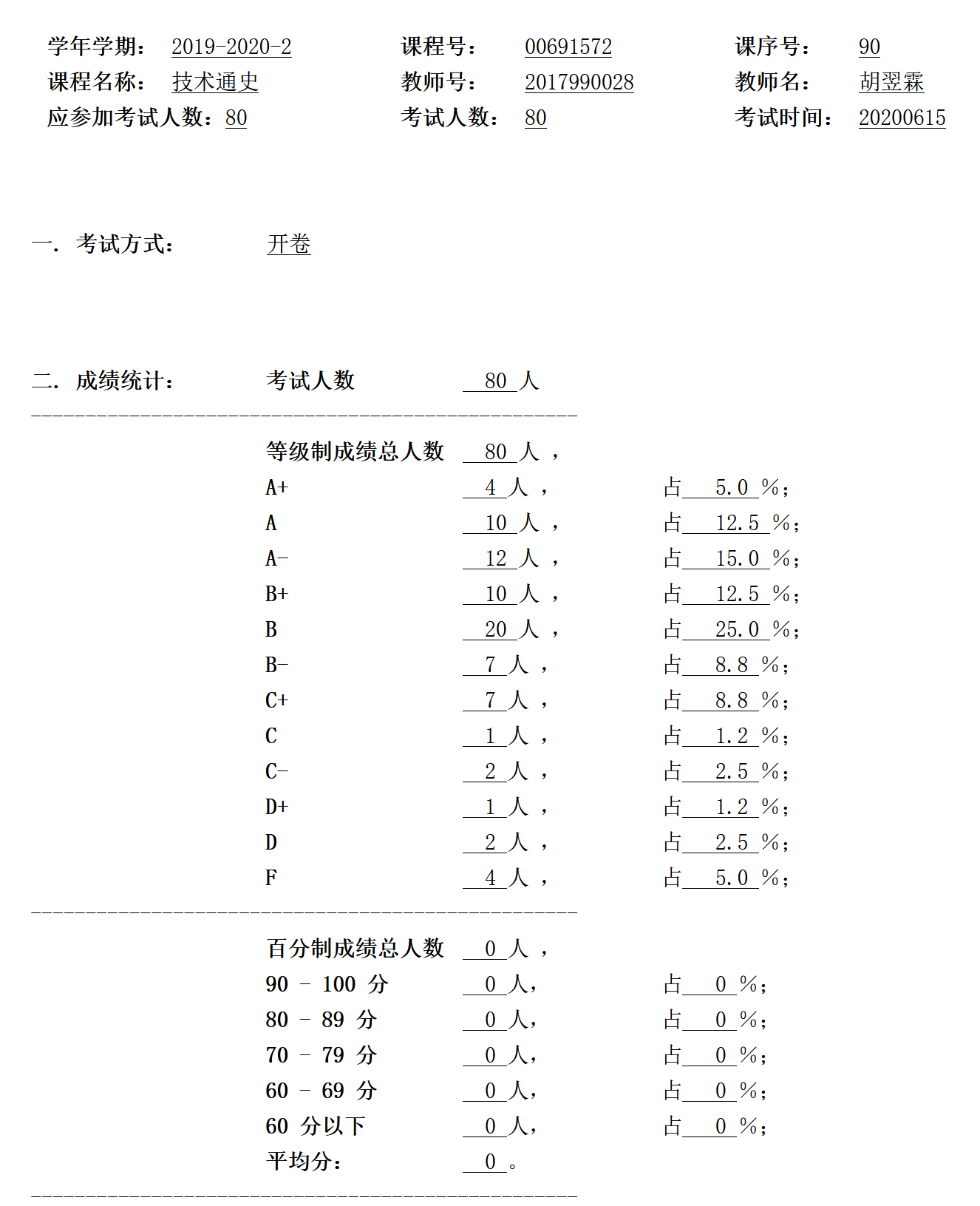
This time my grading was relatively generous: 80% were above B-, and 32% were above A-. Still, there were a few failing grades given because of plagiarism or absence from the exam. (I should explain this to the students in the course: Tsinghua currently does not have a designated conversion standard from percentage grades to letter grades. My actual conversion was adjusted according to proportions while ensuring orderliness; for example, 80 points is B-, 79.5 is C+, but what is displayed may still be rounded to 80 points. The final grade is always determined by the letter grade; the percentage grade is for reference only.)
The final exam questions were written by me and graded by me as well. Since the university did not give a deadline, I fell into procrastination and graded a bit slowly. (If there had been a deadline, I probably would have mobilized more teaching assistants to help with grading.)
The reading notes were graded by the teaching assistants, and they also wrote quite a few comments, so they were fairly conscientious and responsible. I looked through the high-scoring and low-scoring assignments, and for the students who did very well or poorly on the final exam, I also went back to see how their papers were. Overall, I felt the TAs’ grading was responsible and reasonable, and I did not change it. Of course, whether it is me or the TAs, there is always a certain degree of subjectivity and chance in grading. I hope students can take it easy and go with the flow.
What follows is a question-by-question analysis.
1. This course has limited time, and there are many important things that were not covered. If you were to teach one more class, which topic that the teacher did not cover would you choose? Design a lesson for the “History of Technology,” and write down the topic you have chosen, your outline, your approach, and the highlights.
This is a retained question; it has appeared in both of the previous two years. The second question that had appeared in both previous years did not appear this year, but this one continued to appear. I am not afraid of students predicting the questions in advance; in fact, I even hope they prepare a bit more, since that can really inspire me.
Overall, my scores on this question were the highest on average, because the question is relatively open-ended. As long as you provide a reasonable topic and design, you can be given a relatively high score. But there were not many answers that were truly especially interesting.
The main problem with low-scoring answers was their grasp of the course theme. First of all, this course is called the History of Technology, and after all, technology is the main thread. Topics such as medicine or genetic science can indeed be included within the horizon of technological history, but in actual treatment they should still differ somewhat from the usual way general history of science is told, with different emphases. If the outline and approach fail to reflect the characteristics of “technological history,” then the answer is not ideal. In addition, many students’ outlines were not like “one lesson” at all, but more like “one whole course”: the history of medicine from ancient times to the present, with both Chinese medicine and Western medicine to be covered—how could all that possibly fit into one lesson?
Excellent answers often chose a more focused topic, for example, one lesson on the history of airplanes, which is much more appropriate. In addition, some students would explain where this lesson would fit within my whole History of Technology course, and at which point it would serve exactly as a supplement linking the earlier and later parts.
2. What does Mumford mean by the “Megamachine,” and how does the role of the Megamachine differ in ancient society and modern society?
The second question had the second-highest average score, just behind the first question. This may be because it was relatively easy to find decent reference materials. In particular, students often cited Zhen Xinyan’s articles, and basically, their understanding was accurate. So as long as one was willing to search for and cite materials, this question generally did not receive low scores.
Many students are probably not very good at managing time, so they are relaxed and at ease for the first one or two questions, but become increasingly tense as they work through the last two. So this time, it was clear that the later the question, the lower the average score—a phenomenon that is basically reasonable.
I mentioned Mumford’s idea of the “Megamachine” in the second lecture, “The Rise of Civilization,” but only very briefly: it is basically some kind of “social technology” or “organizational structure” that turns people into “mechanized” components of a social machine. Then in the ninth lecture, “Mass Production,” I again mentioned the problem of “the mechanization of people” in the industrial age, and finally recommended Mumford’s The Pentagon of Power. Of course, one cannot get a high score by relying only on the in-class material, but if one has formed a basic impression from class and then goes on to look up the literature, it should be easier to grasp the key points.
3. Eisenstein认为印刷机是科学革命和宗教改革的“动因”,那么更早发展出印刷术的中国为何没有发动科学革命呢?
This question corresponds to the fifth lecture, “The Printing Press,” but in class I did not say much about Chinese printing. The question is open-ended, and the question itself can also be challenged—because, in a sense, like the Needham Question, this question of mine is also a “pseudo-proposition.” Only if one presupposes that China “should have” triggered the Scientific Revolution does it make sense to ask “why it did not”; but if that presupposition is not valid in the first place, then the question should of course not even be asked.
Many students noticed that this question is, in a sense, a variant of the Needham Question, but a few of them answered it entirely as if it were the Needham Question—saying, in essence, that ancient China lacked the soil for modern science, and lacked an environment of natural philosophy or free scholarship, while mentioning printing only very little. That was somewhat off topic. Even if one wants to challenge the question itself, one should still unpack it in relation to the wording of the prompt. The key issue remains the relationship between the printing press and the Scientific Revolution.
Eisenstein’s The Printing Press as an Agent of Change is also one of the recommended readings. If you have outside reading, or even further reflection, it becomes easier to grasp the key points. If you have not read Eisenstein, you can still begin from my course content and think of some approaches. At least two lines of thought were mentioned in class. First, Gutenberg’s “printing press” is different from China’s “printing technique”: from the beginning it appeared as a kind of “machine,” not merely a “craft.” In China, the technique of movable-type printing was always rather cumbersome, related both to the characteristics of Chinese characters and to machinery, and was not easy to automate or industrialize. Second, I pointed out that the so-called “agent” is a kind of cause as “mediation,” similar to a catalyst: if there is no raw material, or if the raw material is completely different, then the same catalyst cannot produce the same result. If you answer to this extent, you can secure a basic score.
A few students went further and pointed out that, in fact, printing did not fail to bring about transformations in China: changes in Chinese intellectual traditions such as the civil service examinations, academies, and Neo-Confucianism also had printing as a driving force behind them.
4. Taking the case of the vacuum pump as your starting point, discuss the relationship between science and technology during the Scientific Revolution.
Very few students chose the fourth question, and its average score was relatively low as well, because this question was indeed rather difficult to answer. The vacuum pump is a classic topic in the social history of science, and I also recommended the famous book Leviathan and the Air-Pump, but what I said in class had nothing to do with that book.
In the sixth lecture, “Experimental Science,” and the seventh lecture, “The Steam Engine,” the vacuum pump both made an appearance. In the section on “experimental science,” the air-pump experiment is a very typical instance of performance science and a model of popular dissemination. The development of scientific instruments is relatively independent of theoretical science, yet they stimulate each other. In “The Steam Engine,” we see that the vacuum pump was essentially the precursor of the modern steam engine; the inventions of Papin and Savery both originated from the tradition of the vacuum pump. This also shows how the vacuum pump laid the groundwork for the Industrial Revolution and, eventually, for the alliance between science and technology.
To answer this question, of course, one still has to speak around the vacuum pump, but many students merely searched in a general way and answered about the “relationship between science and technology” without connecting it to the vacuum pump. That was not very good. Of course, the question is still open-ended, and students may also challenge the wording of the prompt: is it really appropriate to take the vacuum pump as a typical case for discussing the relationship between science and technology? Perhaps the vacuum pump is only a rare exception and not representative enough. But even so, one still has to answer around the vacuum pump; one cannot wander too far off topic.
As for what the relationship between science and technology was during the Scientific Revolution, there is no standard answer either. Simply put, I do not think the technology of that time can be regarded as direct “applied science.” But the vacuum pump does show that the connection between science and technology was indeed becoming increasingly close.
5. Some people believe that the Liverpool-Manchester Railway completed in 1830 marked the completion of the First Industrial Revolution. Please discuss your views, and briefly explain the significance of railways for the Industrial Revolution.
This was the most popular choice, and its average score was in the middle range. It mainly concerns the content of the eighth lecture, “The Industrial Revolution.” In the slides, that lecture also included a discussion of the concept of the “Industrial Revolution” itself, but in the actual class, because time was limited, this was not developed in depth. Still, students who were interested and had thought more about it after class should have had a somewhat firmer idea when answering this question.
This question has two parts: first, how one understands the “Industrial Revolution,” and second, how one understands the significance of railways. Of course, if you agree that the appearance of the railway marked the completion of the Industrial Revolution, then these can also be merged into a single question.
I personally agree that the Industrial Revolution was by no means ever “completed,” but was rather a long process that continues to this day. After the Industrial Revolution, humanity has hardly ever returned to a stable “normal state”; instead, it has remained under the constant replacement of the lifeworld.
But if one insists on saying that there was a sign of completion, then one can refer to how “Newtonian mechanics” marked the “completion” of the Scientific Revolution. Completion here does not mean an abrupt halt, as if scientific change simply ceased from that point on; rather, Newton signified the establishment of a new, integrated “system.” In this sense, the railway also marked the closure of a “system.” Railways integrated several key threads of the Industrial Revolution—steelmaking, textile machinery, and the steam engine—forming a complete industrial loop. This kind of comprehensiveness and systemicity is also something I mentioned in the course.
6. What, exactly, is the “information age”? Please give a brief definition and explanation in relation to the history of technology.
Question 6 had the lowest average score, mainly because by this point time is usually tight, and students have limited time to sift through materials. Another reason is that the materials one can find for this question are not very useful.
This question is related to Lecture 12 on “the telegraph,” Lecture 13 on “the computer,” and Lecture 14 on “the internet.” In fact, when discussing “the telegraph,” I already mentioned that the reason I placed the telegraph after “the electric light” in the sequence of lectures, even though chronologically it should come earlier, was precisely because the last three lectures are linked together as belonging to the category of the “information age.”
Unfortunately, however, this was the question in which students mentioned the course content the least; basically, almost all of them discussed it based on definitions found on Baidu.
To define the information age, one must first define the word “information.” But in fact, this is a very recent word, and in a sense it can be said that the formation of the contemporary meaning of the word information itself is precisely the result of the information age. The information age has brought “information” to the fore, enabling humanity to grasp all things as “information.”
And the reason people have been able to view “information” in a new way is inseparable from the development of related technologies—the telegraph marked the separation of information from the messenger, the computer broke down the boundary between material objects and numbers, making everything informational, and the internet constructed an entire virtual world created by information technology.
Of course, there was absolutely no standard answer to this question, and students did not necessarily have to mention the line of thought I just gave. The key points are: first, the definition and explanation should have a coherent line of thought; one cannot simply copy a definition and then fail to discuss it further. Second, it should be connected to the history of technology, with the significance of the relevant technologies mentioned (for example, at the very least, saying that internet technology makes information itself valuable, and so on). Third, it is best if one can relate it to some of the course content.
7. Under the pandemic, the promotion of online education has accelerated greatly. Can you give one or two similar cases in the history of technology: changes in the environment, whether accidental or sudden, that strengthened or suppressed the development of a specific technology? Please briefly describe the causes and consequences of the relevant cases.
Question 7 was also completely open-ended, but the students’ answers were astonishingly convergent. The most commonly cited examples were World War II (promoting nuclear technology, computers, war technologies, and so on); the Great Stink and the Great Smog in London (promoting sewage-disposal technology, etc.); and the Black Death (promoting medical technology), among others.
One student mentioned how SARS promoted China’s e-commerce, which is actually the easiest thing to connect with the COVID-19 pandemic, yet only one student made that association. Some students mentioned that the melting of glaciers in the Holocene promoted the rise of agriculture; some mentioned that Pacific Island peoples, after migrating to islands with different environments, would develop different technological tendencies. These relatively distinctive answers would earn slightly higher scores. And when discussing World War II or the Black Death and the like, one still had to see whether the brief account of the “causes and consequences” was smooth and well handled. Many students were probably too pressed for time here; their language organization was relatively weak, and both coherence and clarity suffered, so their scores were not high.
Translated from the Chinese original with AI assistance. The original text is authoritative.