
Published in *China Science Daily* (2019-08-16, Section 7, Book Review)
“Who am I?” — this may be the oldest and most enduring great question in the history of human thought. Philosophers have poured their energies into it, and modern science has also advanced human self-understanding from different angles.
Some say human beings are rational animals; some say they are political animals; some say they are tool-making animals… But in any case, few people would doubt this point: “I am one person.” The question “Who am I?” is immediately transformed into “What is a human being?”, thereby bypassing any inquiry into the “one.”
No matter what I am, I am first of all an “individual.” Isn’t that self-evident?
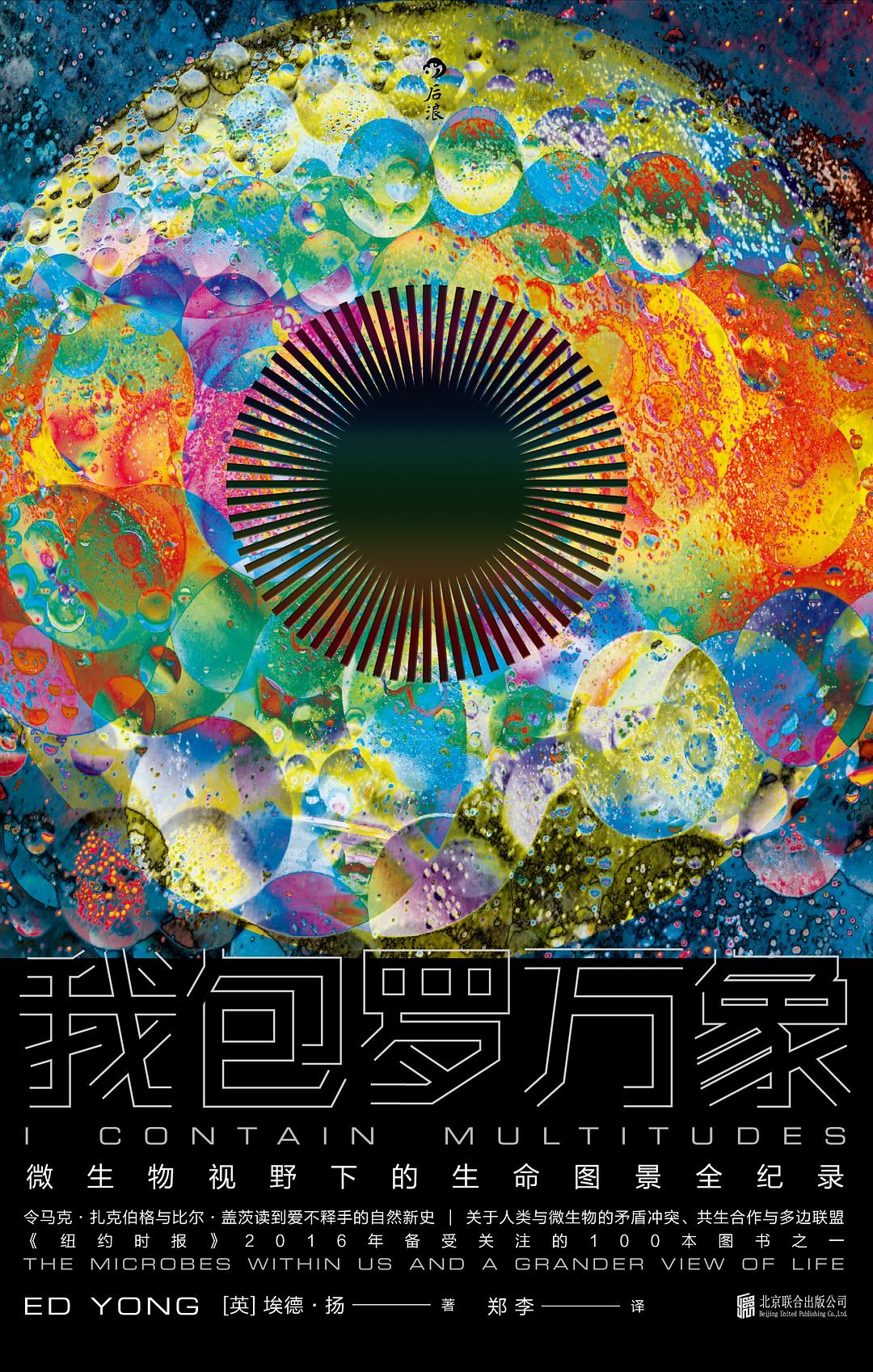
Ed Yong’s popular science book on microbiology, *I Contain Multitudes*, begins by unsettling this self-evident common sense. Borrowing Whitman’s line, “I am large, I contain multitudes,” the author argues that the “I” has never been singular: “each of us is a legion” (p. 4).
This “legion” includes the countless cells and tissues of the human body, as well as the countless microorganisms that live in symbiosis with it. From the ordinary person’s point of view, each person is just an individual; but if we look from the perspective of microbes, “each person or animal is a world with legs, a mobile ecosystem that can interact with others.” (p. 235)
When we point to a person and say “one,” how exactly do we determine the boundary of the individual? Is it based on spatial boundaries, or on continuity through time? Yet spatially, microbes and we share the same space, inseparable from one another; and in terms of developmental continuity, the development of animals often requires the participation of microbes. Without microbes, even if development can proceed, it would produce a completely different individual.
Even the “free will” in which human beings take such pride is hard to separate from microbes. In recent years, scientists have proposed the concept of the “gut-brain axis” (p. 64), holding that the environment of the gut microbiota is directly related to the brain’s responses. For example, feeding mice B-frag bacteria makes them more eager to explore and socialize (p. 62); transplanting gut bacteria from autistic children into mice causes the mice to exhibit repetitive behavior, aversion to social interaction, and so on. (p. 63)
Since microorganisms participate so profoundly in the growth process and bodily functioning of every “I,” why not simply regard them as “part of” the self? They are like countless cells: no more than “components” of the “individual,” while the “individual” still remains a “single” whole, doesn’t it?
But things are not so simple, because microorganisms are, after all, indeed foreign “others.” At birth, infants acquire their initial microbial communities from the mother’s vagina, and during growth they continually interact with the outside world, forming their own distinctive microbial internal environment under different external conditions. Microbes that have taken root in the human body may also be expelled and cleared away in some situations (such as when antibiotics are taken). They are not like organs or tissues, which are indeed relatively stable “parts” of the individual; rather, they are a bit like pluggable and unplugplable “peripherals,” playing some role that lies somewhere between self and other, inside and outside.
This is somewhat like human technological tools: we rely on them in order to survive, and when we use them as naturally as if they were extensions of our own limbs, they seem to become part of our body.
The author also noticed this analogy, and he believes that microorganisms, “like tools such as computers, pens, and knives, can be used to create wonderful works, or to awaken terrifying delusions.” (p. 74)
The author tries to use tools as an analogy to explain the “neutrality” of microorganisms, that is, there is no absolute sense of “good bacteria” or “bad bacteria.” The same bacterium may play the role of a “good” bacterium in the gut, but once it enters the bloodstream it becomes a dangerous agent. Even bacteria that stay in the gut can, when the body develops certain diseases or disorders, seize the opportunity to break through at any moment and further worsen health. And some clearly pathogenic bacteria (such as Helicobacter pylori, which causes gastritis) may also be beneficial in other respects (such as preventing acid reflux).
Philosophers of technology may further deepen this analogy—neither technological tools nor microorganisms are things that are neither good nor bad, but neither are they truly “neutral”; in a certain sense, they possess their own “autonomy.” “Technological autonomism” holds that every technology has its own logic, that technologies issue invitations or demands to human beings, urging humans to adapt as much as possible to their biases. Human beings continuously transform the technological environment, and the technological environment in turn continuously shapes human beings.
The relationship between microorganisms and animals is similar: microorganisms are animals’ external environment, and at the same time one of the internal builders of their behavior and functions. Animals actively shape their own internal microbial environment in response to changes in the external environment (p. 139), just as human beings always have to learn and adapt in order to change their own “toolkits”; at the same time, human beings use their “toolkits” to transform the external environment.
The author finds that, compared with other animals, human beings are relatively less dependent on microorganisms: “Strangely enough, humans can survive. For other animals, complete sterilization means rapid death, but we humans can endure for weeks, months, even years.” (p. 11)
In my view, this is not all that strange, because human dependence on “others” is actually the strongest of all. If we do not wear clothes or have shelter, people cannot last a few days in the dead of winter; if we simply subsist on raw meat and drink blood, even modern people with weaker constitutions would find it hard to survive. In the thousands of years of human evolution, human beings have not only continually shaped environments of symbiosis with microbes, but also continually shaped a technological environment on which life depends. Therefore, when human microbial environments are cleared away, the technological environment can still barely support human survival. But if we clear away all the microbes and technological environments with which human beings live in symbiosis, then I fear people would not be able to last even a few weeks.
In response to the ancient question “Who am I?”, microbiology and philosophy of technology arrive at the same destination by different routes: they discover that the “individual” is not some closed, isolated existent, and that the boundaries between “inside” and “outside,” between “self” and “other,” are not fixed givens. But this does not mean that we should really begin referring to ourselves as “we.” The “I” of course still truly exists; we simply ought to look at ourselves from a dynamic, ecological perspective.
The ancients believed that the human body, the “microcosm,” resembles the “macrocosm.” From the perspective of modern biology, the ecosystem of microbes inside the body also resembles ecosystems at the macro level. Therefore, a deep understanding of microbial ecosystems may also illuminate symbiotic relations in the animal kingdom, and even provide insights into questions of human interpersonal relations or the relationship between human beings and technology.
Whether treating individuals or governing society, the traditional approach is linear: if something goes wrong, either something beneficial is lacking, or something harmful is present in excess. So the solution is nothing more than “tonics” or “detox.” People’s attitudes toward the spread of new ideas or new technologies are also nothing more than these two extremes: either they embrace them enthusiastically and treat them as delicacies, or they reject and resist them, regarding them as monstrous floods and beasts. But microbiology tells us that supplementing one probiotic may crowd out other probiotics’ living space, and eliminating one harmful bacterium may allow a more dangerous one to seize the opportunity and rise up (p. 193). In dealing with others, we should seek a path of symbiosis between embrace and expulsion.
Translated from the Chinese original with AI assistance. The original text is authoritative.