
Published in the *Chang’e* supplement of *Science and Technology Daily*; it has now also been turned into a WeChat public account article, with only minor changes made at publication. In fact, the piece had been commissioned back then, but I caught a cold and it was delayed for a while; only now have I remembered to make it up.
On November 13, the 26th General Conference on Weights and Measures, held in Versailles, France, passed a resolution revising the International System of Units and redefined four units, including the kilogram, in terms of physical constants. With that, all seven base units of the International System of Units will have been changed to “natural” definitions. According to Terry Quinn, the former director of the International Bureau of Weights and Measures, the success of this reform is “the greatest change in metrology since the French Revolution.”
In a certain sense, it is only today that the metrological revolution launched alongside the French Revolution has truly been completed.
From the very beginning, the establishment of weights and measures was never a purely scientific or technical matter; it has always been driven or hindered by political factors. In China, when Qin Shi Huang established the first centralized, unified dynasty, the unification of weights and measures was precisely intended to strengthen that rule. By contrast, the French revolutionaries at the end of the eighteenth century, inspired by the spirit of overthrowing despotism and advocating equality, zealously promoted the unification of weights and measures.
Traditional weights and measures always derive from authority imposed from above; for example, the king’s foot has often become the highest standard for units of length. At the same time, at the grassroots level, the units actually used in daily life were often wildly different and difficult to interconvert. Even standards used by different trades within the same city could be hard to reconcile, let alone communication across cultures and national borders.
Revolutionaries strove to overthrow authority and upheld the universalism of equality for all, and thus they would accept neither the authority of the old weights and measures nor their confusion. But if one rejects authority while also needing to eliminate confusion and achieve unity, how can that possibly be done?
Many scientists, including Lavoisier, threw themselves into the creation of the new system of weights and measures. Their thinking was simple: the unification of weights and measures must certainly be based on authority, but that “authority” cannot be a king or any particular person; we can let “nature” itself play the role of supreme authority.
“Natural standards” became the guiding principle for building an entirely new International System of Units. People hoped that even if mountains collapsed and the earth split apart, even if any central regime were leveled to the ground, the system of weights and measures would still be able to resume operation at any time and remain consistent.
After twists and turns, and after Lavoisier was sent to the guillotine by the revolutionaries, the French finally established a brand-new system of weights and measures. They defined one ten-millionth of the length of the meridian passing through Paris as the meter, then defined the liter as a cube with sides of 1/10 of a meter, and then defined the kilogram by the weight of one liter of water at 4 degrees.
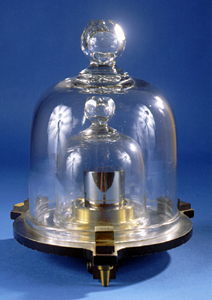
But taking the meridian as the basis was clearly not perfect enough. First, it is impossible to measure length each time one needs it by first running a circle around the earth; the project of measuring the meridian was rather cumbersome. The French Academy of Sciences dispatched multiple expedition teams to measure the size of the earth in various ways; the project can be called the Apollo Program of that era. But such a project could not be carried out frequently, so when the meter standard was actually promulgated, it was based on the meter prototype and kilogram prototype—two alloy artifacts produced from geodetic surveys. They were defined as the meter and the kilogram, and later replicas made from them were distributed to scientific institutions in countries that adopted the metric system.
So the original metric units in fact had a dual definition: one based on nature, and one operational definition based on physical artifacts. The conflict between these two definitions has always remained unresolved.
For example, as measurement technology advanced, every time the length of the meridian was measured again, a new value might be obtained; but the meter prototype could not change its own length at will. If one insists on the “natural standard,” then the meter rulers used in actual measurement would be constantly reset. But if one insists that the meter prototype is the highest standard, then what meaning is left to the so-called natural standard? Is it merely a self-deceiving gimmick?
Influenced by the French, the British also promulgated a new weights-and-measures law in 1824. They were dissatisfied with the metric standard centered on Paris and instead tried to base their own unit of length, the yard, on the seconds pendulum—that is, on the length traced by a pendulum with a certain period. Ironically, in 1834, when an accidental fire damaged the length standard that had only just been established, the British immediately encountered setbacks when they tried to rebuild their system of measurement on the basis of natural standards. They discovered that the uncertainty of the seconds pendulum was too high; its precision simply could not be relied upon. In the end, they could only redefine the standard yard using a copy of the old yardstick.[1]
Over the following hundred years, scientists in effect compromised with the over-ambitious ideals of the French Revolution. They no longer pinned their hopes on natural standards that could be reproduced at any time even after mountains collapsed and the earth split apart, but instead put more effort into the manufacture and custody of “prototypes.” In 1889, at the first General Conference on Weights and Measures, new meter and kilogram prototypes made of platinum-iridium alloy were established.
By agreement, the prototype itself is the strict standard of the unit of measurement; the kilogram prototype is always 1 kilogram. Though metrological prototypes have nothing to do with the king’s foot, they still seem like a kind of supreme authority, the sovereign among measuring instruments, issuing absolute standards. But who measures the king? And who measures the accuracy of the kilogram prototype itself? The answer is: other sub-prototypes produced at the same time using the same process. Only by comparing the kilogram prototype against a total of six sub-prototypes could people learn the changes in the prototype’s weight. The result was that, after 100 years, several sub-prototypes had become about 50 micrograms heavier relative to it. Perhaps we should say: in fact, it was the kilogram prototype that became lighter. But paradoxically, we cannot say that, because before a new standard is established, even if a layer of skin is scraped off the kilogram prototype, nominally it is still 1 kilogram.
Of course scientists were not satisfied with such an awkward predicament. Since the French Revolution, the ideal of making nature the sole authority had never been abandoned. People came to realize that it was not enough merely to find a definite benchmark in nature; more importantly, our technical means had to reach a sufficient level of precision and reproducibility. Metrology institutes in different countries no longer needed to go to France to collect replicas of the metrological prototypes; instead, they could produce their own measuring standards at any time according to a unified standard.
Over the next hundred years, besides continuing to carefully safeguard the two prototypes in Paris—especially through the threat of war—the greatest task of metrologists was to establish a comprehensive system of measurement (including all the other base physical quantities such as the second and the ampere) based on nature. The unit of length was the first to return to a natural standard (initially through the spectrum, later through the speed of light), followed by the candela and the second. This year, with the redefinition of four units including the kilogram, this grand project spanning more than 200 years has finally drawn to a close.
In the end, Paris got what it wanted and lost its supreme authority, handing the scepter back to nature. But in fact, the scientific community has always held the power; what is called naturalization is in essence universalization and decentralization. Under the new system, Paris is no longer the center, and no particular person or city enjoys privilege. Scientific research is free, equal, and universal—that is precisely the scientific legacy left by the revolutionaries of the French Revolution.
[1] Chris, *Measuring the World*, trans. Lu Xinyu, Life·Reading·New Knowledge Sanlian Bookstore, 2018, p. 94.
Translated from the Chinese original with AI assistance. The original text is authoritative.