
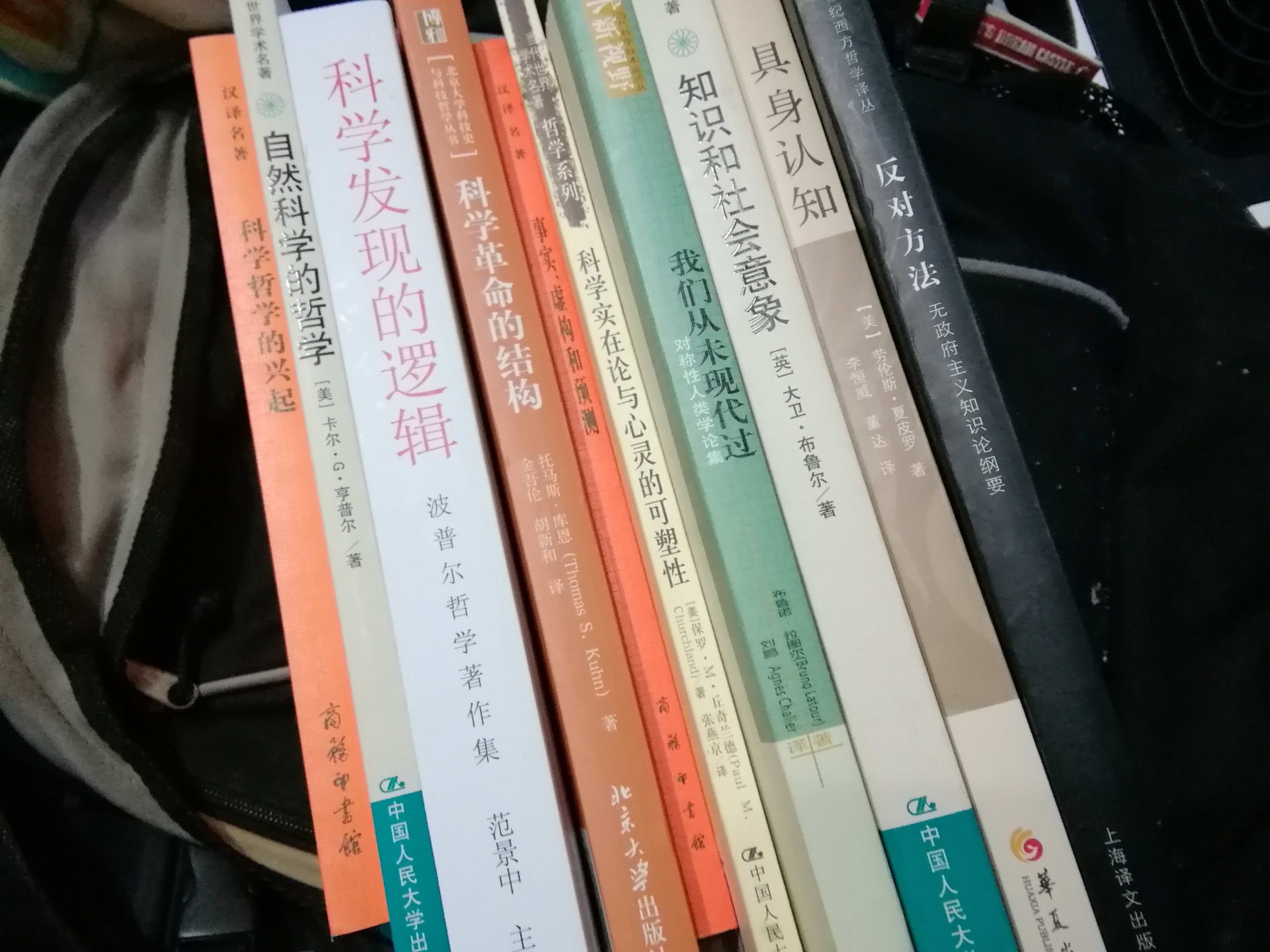
This week the new semester has officially begun, and today the course I am responsible for has also opened for business: “Selected Readings in Classic Works of Philosophy of Science.” This is one of the foundational professional courses offered to first-year master’s students and first-year doctoral students not trained in our department. This year there are altogether just 5 new students enrolled, with no students from other departments, and two auditors.
Class time is every Tuesday afternoon starting at 1:30, and the class usually ends a little after 4 o’clock. The location is Room 204, Building 1 at Tsinghua University. Auditors are welcome. But because of the nature of this course, it is a student-led reading class (see below for details), if you just want to come and casually listen to a lecture, then this is not the right one for you.
Teaching format
The basic format of the class is for teachers and students to read together 5 to 7 classic texts in philosophy of science (one book every 1 to 3 weeks, usually one book every two weeks), using Chinese translations that are easy to obtain as the standard, while students with the ability may refer to the original foreign-language texts.
The emphasis is on student self-directed learning, with students leading the class. Each class is chaired by one student, who presents the chapters in sequence and guides the discussion. The teacher is only responsible for occasionally jumping in and, at the end, offering a summary.
Graduate study is fundamentally different from undergraduate study. The essence of undergraduate education is “general education,” with the aim of cultivating a free personality while laying a solid foundation for entering a corresponding field of research. Although undergraduates are also fundamentally different from primary and secondary school students, basically speaking it is still centered on “learning.” At the graduate level, as the name suggests, one has already entered the stage of “research” rather than the stage of laying foundations. Graduate students are first and foremost researchers, not students.
But the problem is that, given the current situation in our discipline, many graduate students do not have a stronger academic foundation than undergraduates. Many students have not received sufficient training in the history, science, and philosophy of scholarship, so at the outset it is still necessary to set up foundational courses. On the other hand, because graduate students come from such varied backgrounds—some have already studied related material long ago, while others know almost nothing—and because their future research directions will differ greatly, it is difficult to design course content that suits all new master’s and doctoral students.
Therefore, with respect to the two foundational courses currently offered by Professor Zhang Butian and me, the significance of the course format in fact outweighs the significance of the course content. Senior Brother Butian’s course leans more toward a translation class: reading together an English work in the history of science, becoming familiar with academic English and translation/reading techniques under the guidance of a master of small-scale translation—this is of course of immense value; which book is read is secondary. My course also focuses on reading philosophical works, but it does not emphasize foreign-language ability. Instead, it gives greater prominence to organizing, understanding, evaluating, and discussing the material; at the same time, it also lets students try their hand at chairing the class, giving extended presentations, and organizing discussion, which may also count as training in students’ expressive and communicative abilities.
Reading method
Although, compared with intensive reading courses that only read half a book in an entire semester, the reading load in my course is much heavier, in fact it is still basically an intensive reading course; what matters more is the understanding and organization that come after reading.
Every student must read all the books on the syllabus, but one student is responsible for presenting each book in class. The other students should also have already read the relevant book before class, and need to participate actively in class, asking one another questions and discussing. The best outcome would be for me, as the teacher, to withdraw completely, and participate freely like an ordinary student or even an auditor; of course, if the student presenter cannot hold the room, I will step in to rescue the situation at the appropriate moment.
Different books have different characteristics, and therefore different ways of reading them. Some books are themselves quite simple and easy to understand, but it is not easy to present them well; one needs to consult other materials or subject them to critical examination, bringing in one’s own thinking, in order to make the simple content come alive. Some books are themselves difficult to read, in which case the focus may be on sorting out the book’s logical thread. The presenter should, according to the characteristics of the book itself and in combination with their own stylistic preferences, independently arrange the format of the presentation. After leaving a little time at the end of each class for my summary, they should guide the atmosphere of the class in their own way.
I personally suggest a “four-point” method of summarizing: that is to say, while reading and commenting, pay attention to organizing: key points, difficult points, highlights, and points of doubt.
“Key points” refers to the most basic work of summarizing the gist of the chapters. The presenter should pay attention to sorting out the general theme of the book in a simple and clear way, introducing the approximate content chapter by chapter. But in fact this work is not crucial. Aside from the presenter, the other students should also have at least a basic grasp of the structure.
“Difficult points” are those parts in the reading process that are not easy to understand, or those that seem easy to understand but are actually prone to misunderstanding. The presenter in particular needs to pay attention to these and not let them pass too lightly. Of course, we do not require every sentence and every paragraph to be understood thoroughly, but we also cannot avoid them too much. The presenter should especially keep an eye out for some difficult points, providing help to the other students or asking for help in class. Some difficult points can also be used as impromptu questions, with either the presenter or me asking the other students, in order to test the strength of their outside reading.
“Highlights” are the places where this book makes you feel—or where the academic world thinks—that it shines the most. Noticing the highlights is often not the same as noticing the key points. Especially for philosophical books, the summary and conclusion themselves are often secondary; many subtle links in the entire argumentative structure are what truly shine. For example, an example, a citation, and so on. The organization here is highly personal.
“Points of doubt,” meanwhile, require maintaining a certain reflective attitude toward the text. The best way to respect a philosopher is to engage them in dialogue with a critical attitude. During the reading process, any questionable aspects, any erroneous or missing parts, should not be let go lightly. Of course, many things that we think are wrong may more likely be cases where we have not fully understood the philosopher’s logic. So we are not necessarily trying to pick holes in philosophers; rather, we should note down our own doubts and discuss them with the other students.
Principles for selecting books
This course does not set a fixed reading list. Instead, under certain guiding principles, it flexibly selects books according to the interests of the teacher and students. The books read each year will not be exactly the same, and in this way the course can remain fresh for me personally, while also allowing for teaching according to students’ aptitudes.
First of all, the broad principle is to take orthodox philosophy of science as the main focus, selecting classic major works that have had significant influence in the field of philosophy of science.
Students who are familiar with me know that my own philosophical inclination is toward continental phenomenology, while so-called orthodox philosophy of science, though it originated on the Continent, eventually basically followed the path of Anglo-American analytic philosophy. Although I lean toward phenomenology, I would by no means think analytic philosophy is worthless. On the contrary, I would actually recommend that beginners in the history, science, and philosophy of scholarship who lack a philosophical foundation read more texts in the Anglo-American style.
Many people who study phenomenology often get only its form and not its substance; they learn a mouthful of “jargon,” speak in cloudy, evasive terms, but often merely indulge in mystification. Orthodox philosophy of science, by contrast, began by “opposing metaphysics” and advocates speaking clearly and rigorously. In fact, phenomenology does not claim that speech should be unclear or imprecise; on the contrary, phenomenology likewise emphasizes, or rather emphasizes even more, the “clarification” of concepts. But if one cannot fully understand this point, and does not understand the principle that words are merely “formal indications,” then one can easily go astray in studying phenomenology.
Works in orthodox philosophy of science, on the one hand, are not as obscure and difficult as phenomenology; on the other hand, they are also suitable for exchange among people from many different professional backgrounds. Whether one works in the history of science, the sociology of science, or the philosophy of technology, it is worthwhile to read and discuss these questions together.
Of course, I will later also offer courses such as “Selected Readings in Original Works in the Philosophy of Technology.” In those courses, there will be opportunities to read many phenomenological works. “Selected Readings in Original Works in the Philosophy of Technology” is a required course in the “history of science and technology” track. I will make sure to offer it at least once every two years, so that every student can choose it either in the first year or the second year of graduate study. Please look forward to it.
Second, another major principle is to choose complete philosophical monographs; that is to say, to read literature in units of “one book,” and not to read overviews, general introductions, textbooks, and the like, and also to avoid reading collected volumes as much as possible.
The first purpose of making this choice is to avoid fast-food-style reading. In an era when reading experiences are increasingly fragmented, sitting down and calmly reading an entire book has become something increasingly rare. Philosophical research must keep pace with reality, but it must not sink into rashness. We do not want to read through a comprehensive overview and then be able to rattle off what Zhang San’s “-ism” and Li Si’s view are, as if we understand a lot, when in fact it is only at the level of Baidu Baike; that is utterly meaningless.
Further, I also hope that reading can, as far as possible, avoid taking things out of context. The conclusions of some philosophical works, when stated aloud, are banal; others are thunderous and stirring. But if one merely repeats a few conclusions, in fact there is no real significance at all. How philosophers ultimately arrive at these conclusions—their horizon, citations, logic, examples, and so on—these are more important.
A single article or a segment of conclusion is not enough to construct a complete “context,” whereas a monograph can be said to be a basic unit. Of course, a monograph itself also has its larger context, often responding to certain views of other philosophers or written on the basis of the basic paradigms of its era. But relatively speaking, the length of a book is already enough to establish a “small habitat,” and the author can make a coherent case and create a self-contained context.
If we merely extract a few stray remarks from an author and praise or criticize them, that is often taking things out of context. But if we can examine these statements in the context of the whole book, before and after, and then evaluate them, we can speak with much greater confidence.
Finally, the selected books should, as much as possible, take into account the various stages of development in philosophy of science, and be flexibly chosen according to students’ disciplinary backgrounds and academic directions:
- 1 to 2 books from the initial stage of philosophy of science (logical positivism)
- 1 to 2 books on falsificationism and historicism
- 1 to 2 books on special problems (the problem of induction, scientific realism, the demarcation problem, philosophy of cognition, etc.)
- 0 to 2 books on SSK (sociology of scientific knowledge)
- 0 to 2 books on postmodernism and others
This time, the suggested books I am bringing are as follows: (Students may choose from these books, or provide other titles themselves, as long as they conform to the principles above. I have read more than half of these books, but not all of them; some may not be the best choices, so let’s see how things go as we read them.)
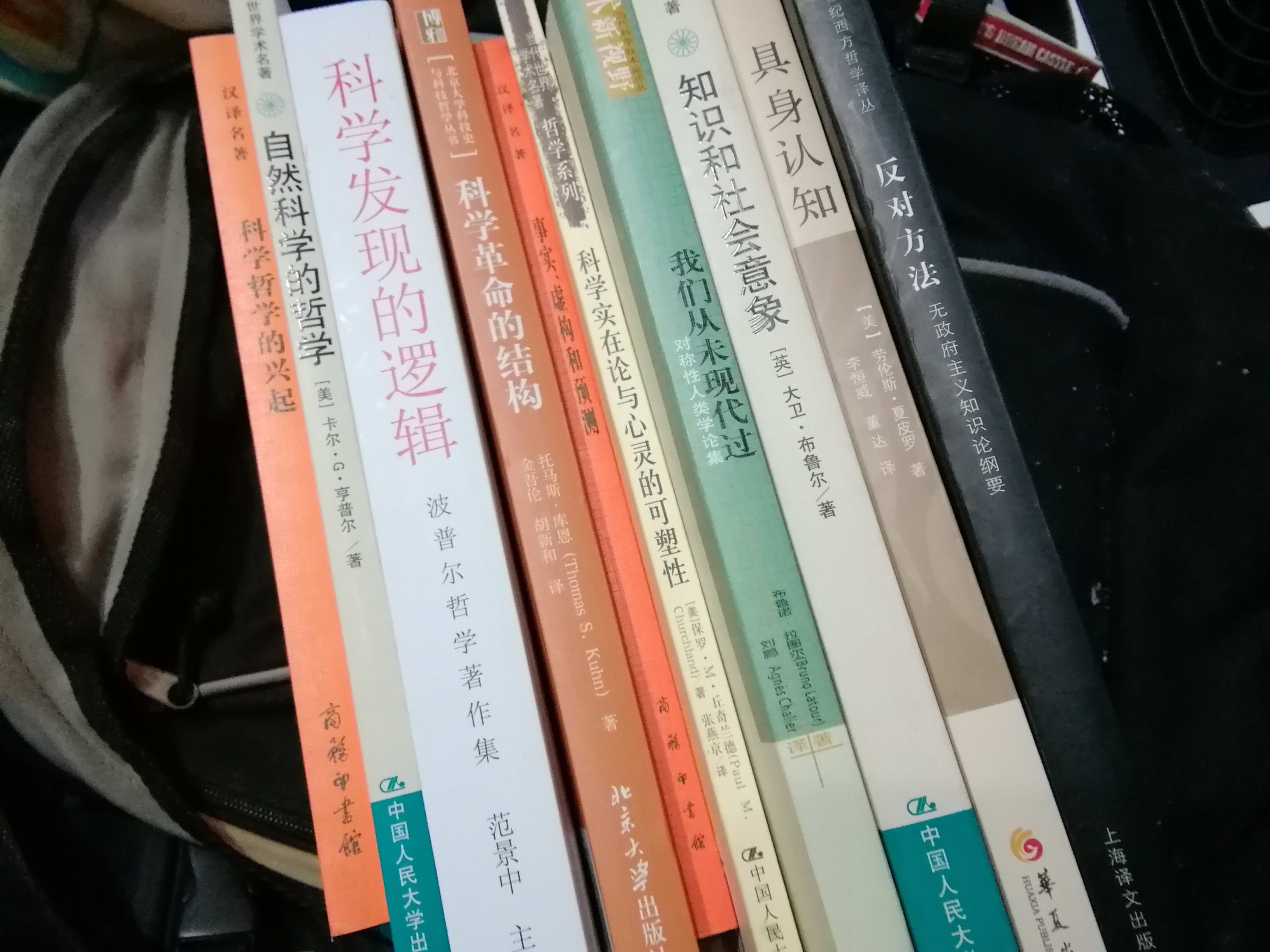
- Lai Xinbaha:《The Rise of Philosophy of Science》
- Hempel:《The Philosophy of Natural Science》
- Popper:《The Logic of Scientific Discovery》
- Kuhn:《The Structure of Scientific Revolutions》
- Lakatos:《Proofs and Refutations: The Logic of Mathematical Discovery》
- Churchland:《Scientific Realism and the Plasticity of Mind》
- Goodman:《Fact, Fiction, and Forecast》
- Shapiro:《Embodied Cognition》
- Brewer:《Knowledge and the Social Imagery》
- Latour:《We Have Never Been Modern》
- Feyerabend:《Against Method》
The selection result of this final cohort, consisting of 5 students plus 1 auditor, was the following 6 books:
- The Rise of Philosophy of Science
- The Structure of Scientific Revolutions
- Fact, Fiction, and Forecast
- Scientific Realism and the Plasticity of Mind
- We Have Never Been Modern
- Against Method
Next week (September 26), I will give an introductory lecture, attempting to briefly sort out the development history of philosophy of science as a whole and some basic questions. Then the class after that will not come until after the National Day holiday (October 10), so even the first student to give a presentation will still have at least three weeks to prepare, which should be quite ample.
Assessment method
Regular participation 30%: class discussion, spontaneous questioning
Presentation 30%: each person is responsible for presenting at least 1 book (2–3 weeks; if the class becomes larger, two people may cooperate)
Reading report 10%: may be developed into a written text based on the presentation assignment
Final paper 30%: based on the reading range of the entire semester, choose your own topic, make use of the books read in class and search for other relevant literature, and write an academic paper (more than 5,000 Chinese characters; requirements vary from person to person. Students with a solid foundation should aim to write in a form that could be published directly; students with a weaker foundation will have lower requirements, but should start as early as possible. During the writing period, keep in touch with me, and I will provide the necessary guidance)
Translated from the Chinese original with AI assistance. The original text is authoritative.