
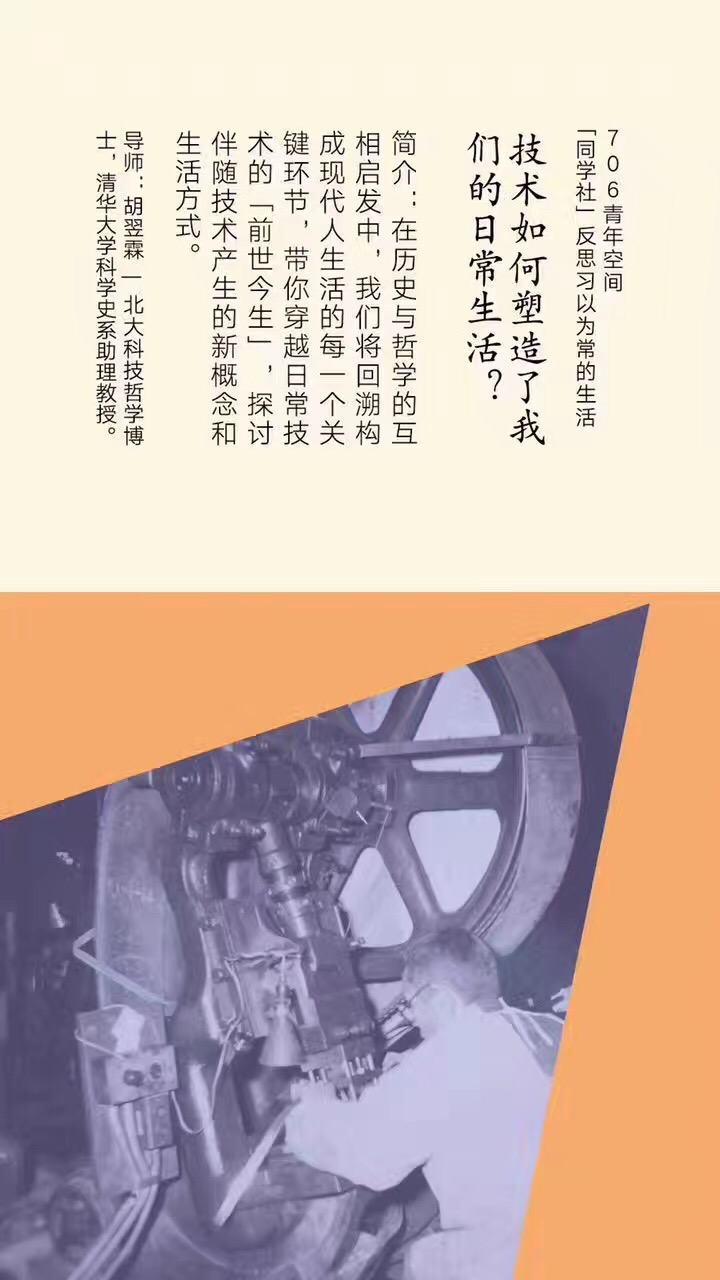
Again invited by 706 Youth Space, I am preparing to open a course during the summer vacation, starting in late July, once a week, for about 5 to 6 classes.
They are experimenting with the “project-based learning” format. I don’t know it in depth; broadly speaking, it is nothing more than a course form centered on students, guided by questions, and distinguished by interactive discussion. I am also willing to explore a livelier teaching format.
Know Thyself
The course I plan to teach falls within the fields of the history of science and philosophy of technology. On the one hand, this field is extremely profound; on the other hand, its threshold is actually very low. For the starting point of philosophy is not the difficult texts of the great philosophers, but each person oneself—who am I? Where do I come from? Where am I going? Each person can, and should, begin philosophical inquiry from oneself. So-called “Know thyself” is not the preserve of faculty and students in philosophy departments; rather, it is a major question that everyone is bound to face.
The difference is that different people have different attitudes and ways of dealing with this great task of “self-reflection.” Many choose to avoid it altogether: as children they obey their parents’ arrangements, as adults they obey their leaders’ commands, and as long as they can muddle through and wait to die, that is enough—why bother with these empty questions that offer no practical benefit? Those who are indifferent to, or even contemptuous and mocking of, questions of “self-reflection” are not the right audience for my course.
What I hope to attract, first and foremost, are people who care about “self-reflection,” people who are not satisfied with drifting with the tide and living in a daze, and who hope to gain a deeper understanding of their own ideas and circumstances. If that is the case, then this course has meaning.
The Unusual in the Usual
Among those willing to engage in self-reflection, most people are more concerned with obvious behavioral issues, especially major decision-related ones. For instance, when Confucius spoke of “three self-examinations each day,” what he was reflecting on was whether one had done certain things well in the course of interacting with others. Such reflection is of course very important, but I want to emphasize another target of reflection: reflecting on the “environment” that is normally taken for granted.
Technology has the property of “self-effacement,” because when it functions normally, it often remains hidden and unremarkable, only becoming glaringly visible when it breaks down. For example, when a pair of glasses is being worn properly, it is almost transparent; only when it is unsuitable or malfunctioning does it draw attention.
When technology goes wrong, we are forced to examine it and trace the source of the malfunction. But if some technology has not yet gone wrong, is it not worth reflecting on? On the contrary, the more something silently operates and the less it attracts attention, the more powerfully it exerts a subtle influence on our lives. Our tendencies of thought, our ways of living, our aesthetic tastes, and our value judgments are all shaped by the “environment,” and “technology” is the kind of environment that shapes us most profoundly, yet most covertly.
So what I hope to do is to reflect upon and investigate those things that, without our noticing, subtly shape us.
Transcending the Limits of an Era
So how do we reflect on these things that are ordinary and quietly operating? The historical perspective can give us insight—what now seems constant and eternal was, historically speaking, often quite new. So when these technologies were not yet popular, how did people live? When these technologies had just begun to spread, how did people view them? Through historical tracing and reconstruction, we try to place ourselves into the life-world of the ancients and feel the impact and transformation brought about by technology.
If a person has always worn glasses, then to understand the influence of the glasses on him, what he should do is not put on another pair, but take them off. Historical inquiry into technology serves precisely the function of helping us “take off the glasses.” By recalling the scenes from when we were not wearing glasses, and reenacting the astonishment of just putting them on, only then may we step beyond the limitations of our own era and examine our daily lives from a higher vantage point.
Tracing history is not because the ancients were wiser than we are (and therefore should be imitated), nor because the ancients’ circumstances were the same as ours (and therefore can be borrowed from), but because the ancients are different from us (and thus deepen our understanding of ourselves). Only by comparing with the view after removing the glasses can one feel the meaning of the glasses; only by comparing with another era can one feel how this era shapes us.
The Routines of Inquiry
At this point, the guiding questions for my course become fairly clear.
The meta-question is of course “Know thyself” (who am I? What kind of person am I?). And the concrete operational questions can be developed in the following steps.
First, pay attention to some everyday life scenes that have already become habitual, choose a “cross-section,” and investigate what technologies are quietly participating in it.
Next, trace history and look at how people lived when the relevant technologies did not exist, or perhaps how that particular life activity simply did not exist at all. When the relevant technologies first began to spread, how did people accept them? Who accepted them first, and who opposed them?
Finally, return to the present, compare different ways of life, and think about what new dimensions and new possibilities this technology has brought to our lives, and what it has made us lose.
Some Examples
For example, I wake up in the morning to my alarm clock and get up to go to work. This scene may involve technologies and artifacts such as clocks, mobile phones, electric lights, beds, numerals/text, sound devices, and so on. Take the clock, for instance: it was not always there in antiquity. When there were no mechanical clocks, how did people solve the need for “timing”? The answer may be that ancient people simply had no need for “timing” at all. They rose with the sun and rested at sunset; “time” was always presented through its relation to various concrete things, and there was no need for some technology to deliberately provide people with an objective, accurate, silently passing “time.” So how did the mechanical clock become popular? Whose kind of life first needed this timekeeping technology, and for what purpose? The answer is the monasteries of medieval Europe. Monks needed to pray at fixed times every day, rain or shine; only they needed to arrange their life rhythm according to “God’s time,” rather than according to the immediate relation of concrete things. In a certain sense, the modern person’s “objective time” is precisely an extension of “God’s time,” and the modern nine-to-five rhythm is an extension of monastic life.
Or take eating a meal, rice with stir-fried dishes. This scene involves storage technology (refrigerators), transportation technology, agricultural technology, running water and gas, the steel industry (woks), and even petrochemical technology. For example, typical Chinese stir-fry requires durable iron woks and large amounts of vegetable oil. But the refining of vegetable oil actually depends on the modern petrochemical industry, because the extraction process capable of producing large quantities of cheap vegetable oil requires gasoline as a solvent. This process was invented in mid-19th-century Europe, and only after that did vegetable oil become a cheap everyday consumer good. So the Eight Great Cuisines of China, which today are dominated by stir-frying, mostly do not have a more ancient history; they are products of the industrial age.
Or take receiving a WeChat message, with a friend asking me to meet in the afternoon at Wudaokou to discuss something. This scene involves technologies such as communication and transportation. Imagine that in antiquity, without any instant communication technology, the delivery of letters depended on transportation; how did people in ancient times “make appointments”? (Festivals were very important gathering occasions.) How did they communicate? When “communication” was entirely subordinate to “transportation,” did ancient people have the concept of “information”—something that existed independently of specific media and was “transmitted” through communication? What impact has this notion of “information,” which transcends physical space and time, had on the thought and values of modern people?
Course Arrangement
The above are some examples I came up with off the cuff. Because I was very busy in the previous period, I have not yet carefully planned the course; perhaps by then I will prepare each week as it comes. Of course, depending on the students’ level of participation, I may make temporary adjustments at any time. I would like the students to be more proactive, so that I can take it a bit easier. The basic design is to alternate between student discussion and my lecturing, with three class discussions corresponding to the three stages of inquiry in the “routine,” and I will intersperse one or two short lectures in between. Each class will discuss one scene and two or three kinds of technologies. In the final one or two classes, everything will be handed over entirely to the students: they will choose a cross-section of daily life on their own after class and investigate it, then present their organization and reflections in class.
Translated from the Chinese original with AI assistance. The original text is authoritative.