
This piece appeared today in the *China Science Daily*; it is an impromptu essay I dashed off in half a day after being commissioned to write it. The original title was “How to Understand the Relationship Between Science Popularization and Technological Innovation”; when it was published, the title was changed and two paragraphs were cut. The cuts were actually pretty good, so I’ll just post the reprint here directly:
http://news.sciencenet.cn/sbhtmlnews/2017/5/323655.shtm
Since 2001, the third week of May every year has been designated the National Science and Technology Activity Week; this year is already the 17th edition.
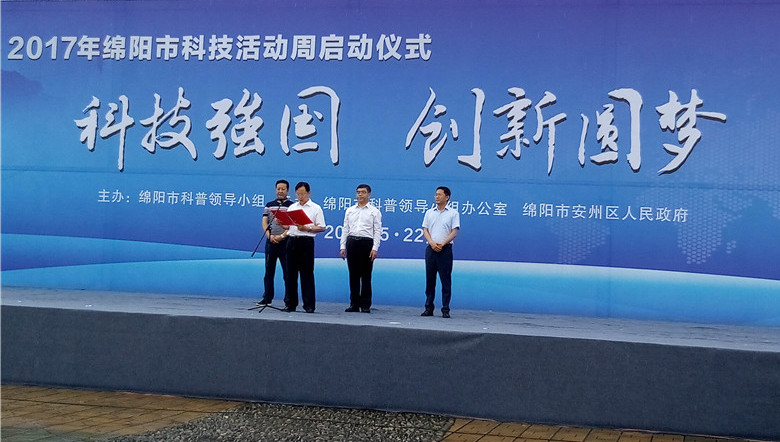
Science and Technology Week is positioned as a “mass science and technology activity,” aimed at raising the scientific awareness and scientific literacy of the entire population. In form, it is basically a collection of science popularization activities. Every year Science and Technology Week has a theme, and this year’s theme is “Building a Strong Nation through Science and Technology, Innovating to Realize the Dream.” In previous years the themes were “Innovation Leads, Shared Development” (2016), “Innovation and Entrepreneurship, Science and Technology Benefit the People” (2015), “Scientific Life, Innovating to Realize the Dream” (2014), and “Scientific and Technological Innovation, Better Life” (2013). From 2006 to 2012, for seven consecutive years, the same theme “Hand in Hand to Build an Innovative Nation” was used. From 2004 to 2005 it was “Technology People-Oriented, Building a Moderately Prosperous Society in an All-Round Way,” in 2003 “Rely on Science, Defeat SARS,” in 2002 “Science and Technology Create the Future,” and the theme of the first Science and Technology Week in 2001 was “Science and Technology Is Around Me.” It can be seen that from 2006 onward, the word “innovation” has run through everything and has always been the keyword of Science and Technology Week.
“Innovation” is of course a good thing in itself, but no matter how good a thing is, it always has a context in which it is appropriate. For example, encouraging graduate students in relevant science and technology specialties to do innovation is entirely in order; but in the context of mass science popularization activities, the banner of “innovation” is not necessarily so fitting.
Learning old knowledge is ultimately for the sake of innovation, but in the course of learning, there is no need to keep stressing innovation all the time. Some of this old knowledge may eventually be eliminated, but it, too, is something won by previous innovators through difficult and tortuous exploration. In a certain sense, “clinging to the old” is also a kind of respect for “innovation.” If we do not respect the innovations of our predecessors, if we do not thoroughly digest and implement their innovations, then on what grounds can we expect our own innovations to be properly received by later generations?
Exploration forward and absorption backward are two opposite directions. These two kinds of work are equally important. Overemphasis on being novel and striking will inevitably lead to empty grandiosity and arrogance; overemphasis on following the old paths will inevitably lead to stagnation and self-enclosure. Only when the tension between the new and the old is just right will thought and society be full of vitality.
What is called “science popularization” more often represents precisely this dimension of “looking back.” Every item of scientific knowledge was originally the innovative work of a small number of specialists, but when that knowledge is no longer confined to a few people and a few specific fields, when it begins to be accepted by more people and applied in broader fields, then it gradually changes from new to old. Finally, when that knowledge becomes common knowledge known to all, it turns into an old doctrine awaiting further breakthrough.
This process of turning innovation into doctrine is nothing other than the process of “science popularization.” Only by going through this process can the potential contained in innovation be fully tapped, and only then can its defects and room for improvement be fully exposed. If innovation is not popularized in a timely and sufficient manner, then its driving force for social development will be greatly discounted.
Ancient China was by no means lacking in technological innovations that led the world; many new ideas and new techniques appeared far earlier than in the West. But many innovations often eventually fell into oblivion, gradually buried by history, and could not, like those in the periods of the Western Scientific Revolution and Industrial Revolution, keep inspiring more innovation and enter a virtuous cycle. What ancient Chinese lacked was not the inventive mind, but an environment in which innovation could be fully digested. By contrast, early modern Europe, through the development of commerce and the spread of the printing press, greatly strengthened the speed and scope of knowledge dissemination, and this is what enabled science and technology to develop at an accelerated pace through successive transmission from one generation to the next.
The pioneers of the Scientific Revolution were often also “keepers of the old”: Copernicus mastered the Ptolemaic system skillfully and even admired the older ideas of Plato, trying to revive the Platonic tradition and thereby establish the heliocentric system; Newton rejected the too-radical worldview of the mechanists, introducing into the system the seemingly more old-fashioned concept of action at a distance, and thereby established classical mechanics; Einstein adhered firmly to Maxwell’s equations and carried the principle of relativity through to the end, thereby discovering relativity… We often emphasize the side of innovators that is original and breaks with convention, but rarely do we emphasize their other side: their immersion in tradition and respect for their predecessors. Yet these two sides are equally important.
In today’s China, many grassroots science enthusiasts lack precisely this awareness of “keeping to the old.” They try to overturn Einstein, but they have not thoroughly digested Einstein’s knowledge, and they even lack mastery of the mechanical system since Newton. How could they possibly achieve any innovation?
Rather than focusing on innovation, science popularization should be grounded in keeping the old. It should stand squarely and unapologetically on the opposite side of “innovation,” and place more emphasis on the history of science and technology rather than its frontiers. Respect for tradition is the true admiration of innovation.
*China Science Daily* (2017-05-22, Page 1, Main News)
Translated from the Chinese original with AI assistance. The original text is authoritative.