
I once supervised the small-group discussion section attached to the course “What Is Science?,” and at the time I also talked about related experiences and thoughts. But I did not say much. Recently, it seems that the Peking University Yuanpei Program hopes to promote small-group teaching across the board, and Teacher Wu hopes that I will once again systematically sort out my thoughts on the matter, so I am writing another piece here.
Form
By small-group teaching here I mainly mean the form of a small-group discussion class led by teaching assistants as an adjunct to large-class teaching. And unlike the “problem-solving sessions” attached to the usual foundational courses in the sciences and engineering, the small-group teaching we are talking about here is more applicable to general-education or frontier courses, especially courses in the humanities.
The main form of the “problem-solving sessions” for foundational courses in science and engineering is answering questions, whereas the main form of the small-group classes we are talking about is discussion.
For example, there is a weekly large lecture led by the teacher, plus a small class led by a teaching assistant. The large lecture may have several hundred participants and is basically conducted in the form of the teacher performing solo; in the small class, all the students are divided into groups of twenty or thirty, and each small class is led by one teaching assistant (usually a graduate student).
For some courses, if there are only about twenty students enrolled to begin with, there is naturally no need to divide them further, but the form of “large lecture—small-group discussion” can still be applied.
In discussion classes, the role played by the teaching assistant is mainly that of a facilitator and observer; the students are the protagonists of the discussion class. The teacher and the teaching assistant can, according to the progress of the course, assign corresponding questions for reflection and reading materials. After the students read and think on their own, they exchange ideas in the discussion class. Each session can designate a few students as lead presenters, a few others to comment, and the rest may participate freely.
Although it is a free discussion, it cannot be completely loose and scattered. It is best to have common topics and reading materials so that the discussion has a focus and speaks to something substantive. But these materials are only a starting point; everyone can go off and find more reading materials and launch their own topics.
Positioning
Why set up such small-group discussion classes? Of course, because they are beneficial to teaching. This involves one’s understanding of university teaching. What is the purpose of university teaching? What kind of people is it supposed to cultivate? More concretely, what is it that a university course hopes students will gain?
In any case, university education should be distinguished from primary and secondary education and from vocational education. Primary and secondary education belongs to basic education; its objects are minors, and the content taught consists of the most solid things in the sciences that have already settled into basic doctrine. Therefore, although primary and secondary education should still emphasize cultivating students’ capacity for independent learning and free thinking, in general it is still mainly about top-down indoctrination of knowledge. Vocational schools, on the other hand, aim to train people with skilled specialized techniques. Although they too must pay attention to students’ creativity, they are after all mainly about imparting established knowledge or skills.
Undergraduate education is different. The content to be learned is no longer fixed knowledge, and the goal of learning is not any definite occupation. The entire undergraduate stage seems to be spent in a haze of uncertainty. In my view, that is precisely the meaning of the undergraduate years: to search for oneself, and to establish one’s own position and direction.
The sea of learning is boundless; there is an infinite amount of knowledge worth studying. Some of that knowledge is the essence accumulated by the times—for example, reading and writing, basic cultural common sense, and numerical and logical ability. This knowledge background is necessary for entering this society in this era, so society compels everyone who is about to join it to learn these things. That is the meaning of “compulsory education” in primary and secondary school. But after we have learned these things that we “have no choice but to learn,” what should we study next? Every teacher or experienced “person who has been through it” can teach students all kinds of knowledge, but they no longer have the authority to force you to learn it. As an adult, a university student can, and indeed must, decide his or her own direction. What is worth learning, what is suitable for oneself to learn—these are ultimately things one must decide for oneself.
The greatest meaning of the entire undergraduate stage is to find one’s own path. The difference between a university student who eventually decides to become a farmer and a farmer who inherits the family profession lies in the fact that the former is a matter of free choice, whereas the latter may objectively and subjectively both lack room to choose. A person who gives up a university diploma to start a business on his own is not negating the meaning of university; on the contrary, he is precisely realizing the meaning of university and determining his own direction.
From the standpoint of results or “efficiency,” undergraduate education is often a “waste of time.” Many students eventually take up occupations unrelated to what they studied in their student years. If so, if he had skipped the four years of undergraduate study, or even begun sharpening the skills related to his present occupation at an even younger age, then he would certainly be able to do it better. Yet this squandering of youth in college cannot be omitted, because society is not a big machine; it is made up of countless free and distinctive individuals. Getting everyone onto fixed tracks as quickly as possible may indeed improve efficiency, but the society as a whole will inevitably become rigid.
After saying so much, what I want to express is nothing more than this: the meaning of university teaching does not lie in cramming some fixed things into students, but in enabling each student, according to his or her own personality and strengths, to find his or her own road.
This is true on the scale of the entire university life, and also on the scale of each specific major or course. In middle school, when studying math, physics, and chemistry, everyone learns roughly the same things; but if one continues to study math, physics, and chemistry at university, then there are countless roads to choose from. Physics includes many specialties and topics; no one can be equally proficient in all directions and make breakthroughs in every area at the same time. Which direction to pursue in depth and research seriously is something each student can, and must, choose for himself or herself.
Therefore, general-education courses are especially important in university. Such courses aim to broaden students’ horizons, to open up more room for choice, and to help students find their own position and interests.
So general-education courses are not common-sense courses; they are not intended to transmit some unalterable body of knowledge to students. Ultimately, general-education courses are meant to inspire students to learn independently.
Meaning
Once the positioning of university teaching and general-education courses is clear, the significance of small-group discussion classes becomes self-evident. In the process of top-down indoctrination, the student’s self is suppressed; only when students read independently and communicate freely does the student’s self come to the fore. In communication and argument, everyone can more clearly display and grasp his or her own role.
The teacher’s lecture merely provides a rough map. After hearing the same lecture, each person will be interested in different things, and the ways of probing and developing them will also differ. But if these individualities have no chance to be expressed and to collide, they will eventually very easily be buried.
The basic logic of the discussion class is that the teacher’s lecture is not treated as a ready-made, fixed learning objective, but as a starting point or guide for each person to further search for his or her own objective. What is truly meaningful is not the knowledge that the teacher clearly and explicitly lectures, but the things each student gains through freely developing and independently learning out of his or her own interests and strengths. In a discussion class, what the teacher has lectured and the assigned reading materials are not treated as the endpoint, but as the starting point; not as finished products, but as raw materials. For the same reading materials, each person has his or her own interpretation, and according to one’s own interests and background, each person will further search for more materials and dig deeper.
Previously, when I was arguing with others after the course opening summary, I wanted to draw a diagram to explain my understanding of the course’s goals. That diagram also works well here:
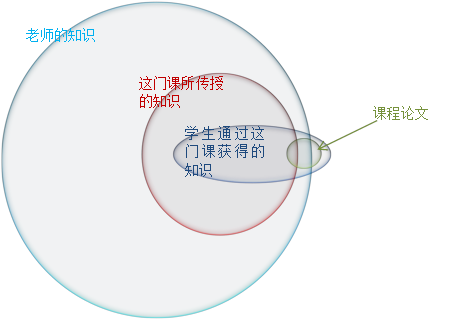
What this diagram is trying to express is that a good student does not need to master wholesale all the knowledge the teacher conveys in a general-education course. What makes a good student good is not memory, but the fact that through independent learning and free thinking, he or she can use a unique eye and talent to break through established barriers, go beyond the classroom, and even break through the teacher’s territory. Such a course is not merely the teacher’s top-down indoctrination; it is even more an interaction between teacher and student. In the end, the teacher can also benefit from it, opening up his or her own horizons and using students’ feedback to break through one’s own limitations. This atmosphere of mutual growth between teaching and learning is by no means an unattainable ideal; a good discussion class should produce precisely this effect.
Difficulties
Of course, in the current university environment, to offer a good general-education course + discussion class still faces quite a lot of difficulties. The difficulties come at least from four aspects: the school, the students, the teacher, and the teaching assistant.
Such courses require the school to provide a relatively large amount of teaching resources. The discussion classes alone require several small classrooms, as well as the hiring of multiple teaching assistants, and in some respects special policies may be needed. Of course, I cannot say much more about the difficulties at the school level or how to overcome them.
As for the students, the difficulty seems to be the greatest. Most students have become accustomed to the Chinese-style cram education they have experienced since primary and secondary school, so asking them to display their selves and learn independently is obviously very uncomfortable for them. On the other hand, most general-education courses in universities have long since been turned into relaxed storytelling-style courses, where fewer assignments and easy points have become the main considerations in students’ course selection. Such discussion classes that require a large investment of energy often keep many students at a distance.
There are similar problems on the teacher’s side as well. Teachers are also accustomed to the teaching model of giving lectures to a full room with all the knowledge poured in, and they lack an understanding of independent learning and discussion classes. Although the discussion class is led by the teaching assistant, if the teacher cannot provide suitable reading materials and questions for reflection, and does not leave enough room for exploration in the course, then the discussion class will be hard to carry out.
The teaching assistant is also a major difficulty. Although ideally the discussion section should have the students as its protagonists, when students have not yet adapted to a free atmosphere, the teaching assistant’s moderation and guidance are still extremely important. Yet in the case of Peking University, many graduate students are even less capable than undergraduates when it comes to displaying individuality, freedom, and independence. In this kind of course, a teaching assistant’s competence in a specific professional field is not the key; what matters more is guiding and stimulating the atmosphere. The teaching assistant must have a certain knowledge base, be able to control the overall situation appropriately, yet must not seize the stage and turn the discussion class into a Q&A session. It is not easy to find enough teaching assistants who are up to the task.
Strategy
The difficulties above cannot be solved all at once; we can push practice forward while gradually overcoming these difficulties.
In seeking the school’s support, of course one needs to keep advocating, hoping that the university leadership and the department leadership can have such strategic vision. Even when support is not yet in place and hardware conditions are lacking, it is not impossible to begin exploring. For example, Teacher Wu’s course on the history of science once tried setting up small-group discussion sections on an online forum, requiring each student to post a certain number of main posts and replies, actively participate in discussion, while the teaching assistant guided and supervised the scoring at appropriate times.
As for the problem of students lacking enthusiasm in course selection, one way of course is to turn part of the course into a required course and force people to take it. But that goes against the spirit of encouraging independent learning, and it will also make many students develop resistance, making it hard for them to participate actively. A safer strategy should be to emphasize encouragement and guidance, for example by making the credits and grades given by such courses more generous.
On the teacher side, inviting famous senior professors to give the main lecture can increase the course’s attractiveness. However, the thinking habits and teaching patterns of famous senior professors are often already fixed. If they are not suited to the way discussion classes are run, coordination becomes relatively difficult. Some teachers are also very self-important, and communication between the teaching assistant and them is not smooth either (I have experience of this…). Therefore, apart from inviting some well-regarded professors with vision to serve as benchmarks (for example, Teacher Wu is well suited), I think such courses should be led more by younger teachers who are more open-minded and more energetic.
As for the teaching assistant, I think this kind of course can be integrated with graduate teaching. The teaching assistants participating in discussion classes are not just there to earn a little extra money; it is also a way of promoting their own academic research path. Because many graduate students, if they go on to an academic career, are going to become teachers anyway. Even if they do not enter academia, these abilities of independent learning and moderating discussion are also things graduate students ought to possess. Therefore, discussion-class teaching assistants can receive institutional support within the graduate teaching plan. If they can undergo a certain amount of training and preparation before serving as teaching assistants, then there will be no need to worry about finding suitable teaching assistants.
In an earlier article I also wrote about some specific grading strategies; I won’t say much more about them here.
Translated from the Chinese original with AI assistance. The original text is authoritative.