
A Simple Explanation
Excerpted from Baidu Zhidao: http://zhidao.baidu.com/question/4311857.html
A rainbow is formed because sunlight strikes small nearly spherical water droplets in the air, causing dispersion and reflection. When sunlight enters a water droplet, it simultaneously enters at different angles and is also reflected within the droplet at different angles. Of these, reflection at angles of 40 to 42 degrees is the strongest, producing the rainbow we see. In producing this reflection, sunlight first undergoes one refraction as it enters the droplet, then reflects off the back of the droplet, and finally undergoes another refraction as it leaves the droplet. Because water disperses light, the refractive indices for light of different wavelengths differ; blue light is refracted at a larger angle than red light. Since the light is reflected within the droplet, the spectrum seen by the observer is upside down, with red at the top and the other colors below.
The optical principle behind rainbows also often explains why two rainbows appear at the same time: outside the ordinary rainbow there appears a concentric but dimmer secondary rainbow (also called a niji). The secondary rainbow is formed when sunlight is reflected twice within water droplets. The strongest reflection angle for two reflections occurs at 50° to 53°, so the secondary rainbow lies outside the primary rainbow. Because there are two reflections, the order of colors in the secondary rainbow is reversed relative to the primary rainbow, with blue on the outside and red on the inside. In fact, the secondary rainbow always accompanies the primary rainbow; it is just that its light is weaker, so sometimes the naked eye does not notice it.
A rainbow does not in fact appear at any fixed location in midair. It is an optical phenomenon seen by the observer, and the apparent position of the rainbow changes with the observer. When an observer sees a rainbow, its position is always in the direction opposite the sun. The center inside the rainbow arch is actually an enlarged image of the sun reflected by the water droplets. So the sky inside the rainbow is brighter than the sky outside it. The exact center of the rainbow arch is precisely in the direction of the observer’s head shadow, while the rainbow itself lies at an angle of 40° to 42° above the line from the observer’s head shadow to the eye. Therefore, when the sun is higher than 42 degrees in the sky, the rainbow will be below the horizon and invisible. This is also why rainbows rarely appear at noon.
From one end to the other, a rainbow spans 84°. With an ordinary 35mm camera, you need a wide-angle lens of focal length under 19mm to capture the whole rainbow in a single frame. If you are in an airplane, you will see the rainbow as a complete circle rather than an arch, and the exact center of the circular rainbow is the direction in which the airplane is traveling..
A Further Explanation of My Own Attempt
The phenomena that need explaining are: why can we see a rainbow? Why is the outside of the rainbow red and the inside purple? Why is the rainbow an arc, and why is the angle from which one views it always around 42 degrees? How is the fainter “niji” outside the rainbow formed? Why do rainbows often appear around three in the afternoon and rarely at noon?
The argument is as follows:
There is enough water mist in the air (small droplets), boundary condition
The small droplets can be approximated as spherical. (This can be further explained by the surface tension of liquids, etc.) empirical fact
Sunlight can be regarded as a uniform bundle of parallel rays mixed with various wavelengths (various colors) and polarizations. empirical fact
A rainbow is formed because sunlight undergoes two refractions and one reflection in small water droplets. assumption
First consider the case of a red ray undergoing two refractions and one reflection in a small water droplet:
Law of refraction—the plane formed by the incident ray and the normal to the interface passing through the point of incidence is called the plane of incidence; the angles between the incident ray and the refracted ray and the normal are called the angle of incidence and the angle of refraction, respectively; the refracted ray lies in the plane of incidence; the ratio of the sines of the angle of incidence and the angle of refraction is a constant. general law
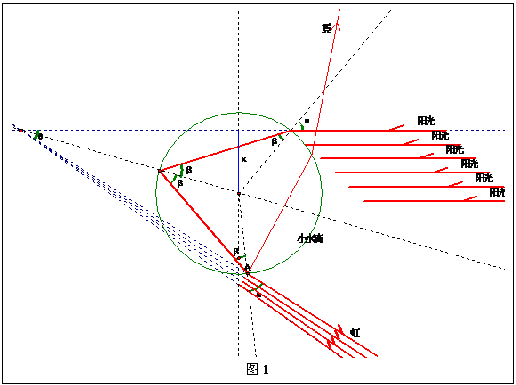
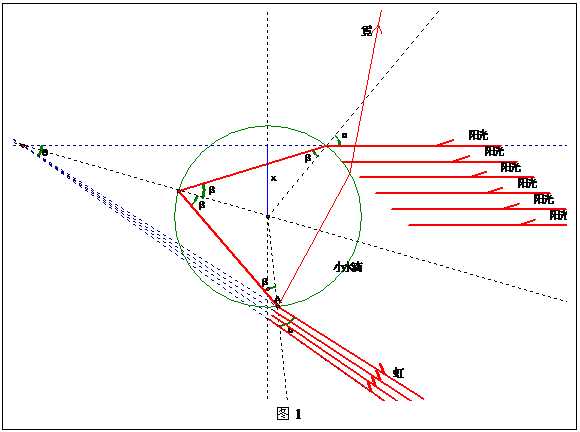
As shown in Figure 1: let the angle of incidence be α, the angle of refraction be β, the angle by which sunlight is deflected be θ, and the radius of the water droplet be 1.
After two refractions and one reflection, the rainbow can be seen at the angle where the emerging light is strongest. assumption
The refractive index of red light in water relative to air, n21, is about 1.33. empirical fact
There is:  ①
①
Let the distance from the center of the sphere to the incident ray be x, x=sinα ②
In the cross-sectional plane shown in Figure 1, because sunlight is a uniform bundle of parallel rays, the intensity of the incident light per unit length perpendicular to the direction of incidence is the same.
When x changes to x+Δx, the intensity of the incident light almost does not change. Let the incident light intensity be Pin, and the outgoing light intensity be Pout.
Let Pout=A(α)·Pin ,
A(α) is the attenuation rate of the ray after refraction and reflection, and it depends on α. However, when we consider the angle at which the outgoing light is most concentrated, α will vary only within a small range, so A(α) can be approximately treated as a constant. Thus, the main factor affecting the intensity of outgoing rays at a certain viewing angle is the density of the outgoing light. (Note: the refractive index and reflectance of electromagnetic waves between uniform media can be calculated by the Fresnel equations. If one considers s-waves and p-waves in natural light as each accounting for 50%, then this problem involves three refractions or reflections, and the calculation becomes extremely complicated. But, as noted above, the variation can be approximately ignored; I will not give a detailed proof here.)
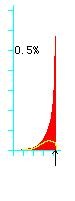 (Supplementary note: the previous annotation was merely a way of getting by. In fact, the way the reflectance of light intensity and the absorptance of light intensity vary with α cannot be so simply and so casually ignored. Consider that when α=0, the reflection inside the water droplet is the weakest, and the overwhelming majority of the incident light will pass through the droplet and emerge; whereas when α approaches 90°, although the loss due to internal reflection in the droplet is smallest because it approaches total reflection, the loss due to the two refractions is greatest, so most of the incident light will also be lost. The case of minimal light-intensity loss occurs somewhere between α=0 and 90°. Fortunately, the conclusion reached by ignoring this parameter agrees well enough with empirical observation; perhaps the case when θ is maximal is sufficiently close to the case of minimal light-intensity loss. However, to find the extreme values of the light-intensity refractive index and reflectance for three refractions or reflections requires taking into account polarization and dealing with cumbersome trigonometric expressions. I personally did not think of a good way to simplify it. The key point is that the cases of p-polarized light and s-polarized light are very different; see the figure on the right: the red area and the yellow line respectively indicate the relative light intensities of the two polarizations of red light, and the arrow points to the case where θ is around 42°. For a discussion of the relative intensity changes when the two electric-field directions of incident light are considered separately, see: http://www.phy.ntnu.edu.tw/oldjava/Rainbow/index.html, though I do not know how that page does its calculations, nor do I know whether its results are correct.)
When x changes by Δx, θ changes by Δθ. Since the intensity of light as x changes is uniform, when Δx is extremely small, the smaller the rate of change of Δθ, the denser the outgoing light rays.
Consider the differential of Δθ. When dθ/dx is 0, the outgoing rays are most concentrated.
(Note: this can also be explained from another angle—near the maximum of θ, the rate of change of θ with respect to x is the smallest; that is, when θ=4β-2α reaches its maximum, the rate at which θ changes with x is minimal. This is probably Descartes’ line of thought. However, when computing the extremum of θ mathematically rather than experimentally, one still needs to use the method of setting the derivative to zero, and both the process and the result are the same. The difference is that starting from the maximum outgoing angle is a more intuitive explanation; although easy to understand, it is difficult to further explain why the rate of change of θ is smallest near the extremum. By contrast, directly using differential calculus, although less intuitive, is a more direct explanation, because the differential method itself is used to describe “when Δx is extremely small, the rate of change of y is Δy/Δx.”)
Take the derivative: θ’:
From ① and ②, θ=4arcsin(x/n)–2arcsinx
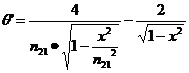
θ’= 0, that is 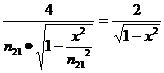 , yielding
  ③
③
Substituting the refractive index of red light n21=1.33 into this, we get x=0.86238
α=arcsin x = 59.5849°
β=arcsin(x/n21) = 40.4215°
θ=4β-2α=42.5182°
Therefore, in the region around the angle deflected from the incident light by 180°- 42.5182°=137.4818°, the red outgoing light is most concentrated. Conclusion 1
The refractive index of violet light in water relative to air, n21, is about 1.343. empirical fact
Substituting n21=1.343 into ③ gives α=58.8303°, β=39.5766°, θ=40.6469°.
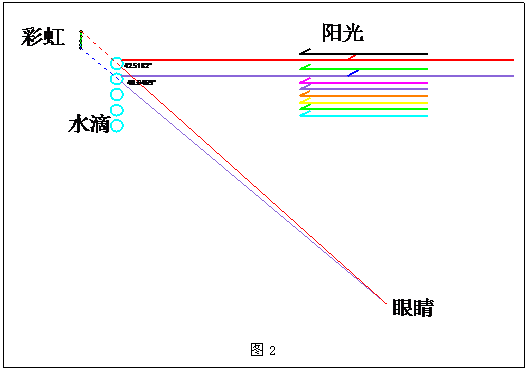
Since θviolet is smaller than θred, the rainbow always has red on the outer edge. See Figure 2: Conclusion 2
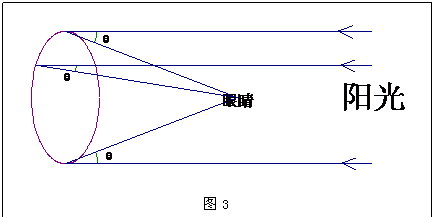
Since only at a viewing angle of around 42° relative to the incident light can one see the most concentrated backscattered rays, the viewing angle for looking up at a rainbow is always around 42°. Conclusion 3
Since the viewing angle of around 42° relative to the incident light is circular in form (a geometric inference; see Figure 3 for illustration), the rainbow is always an arc, and under suitable observing conditions it may also appear as a semicircle or even a full circle. Conclusion 4
Since before three o’clock in the afternoon, especially at noon, the sun is high in the sky (empirical fact), the angle between the incident rays and the horizontal plane is large, and the rainbow that may appear after a deflection of around 137 degrees will fall below the horizon, so rainbows are hard to see at noon. Conclusion 5
At the same time, the agreement between the above conclusions and observation “verifies” the reasonableness of the earlier “assumptions.”
As for the fainter “niji” outside the rainbow, it is formed by light undergoing two refractions and two reflections in a water droplet, and the method of argument is similar to that above:  , when
  we obtain
  , and obtain
  , so the niji is always outside the rainbow, and the violet light in the niji is always outside the red light. Conclusion 6
This explanation makes predictions that can be experimentally tested; for example, in a laboratory, as long as the light source and water mist are set up appropriately, one can observe a rainbow phenomenon at a specific viewing angle.
References:
http://www.phy.ntnu.edu.tw/oldjava/Rainbow/index.html
http://www.teach.ustc.edu.cn/jpkc/xiaoji/lx/qtzy/lxz.doc
http://www.nocsh.tpc.edu.tw/sct/content/1977/00100094/0006.htm
Translated from the Chinese original with AI assistance. The original text is authoritative.