
After this article was posted, the blog inexplicably crashed, and had to be restored several times…
The course “A General History of Technology” is about to end. Next week I will write a brief summary; for now, let me talk about the homework issue.
The assessment format for this course is rather innovative, consisting of 40% midterm assignments + 60% final exam.
As for the midterm assignment, I do not want to see students plagiarizing, or cobbling together a lousy paper and handing it in, so I proposed a flexible either-or scheme: students who are interested in, or capable of, writing a paper may still write a short essay of more than 6,000 Chinese characters, and I will give feedback according to the standards of an academic paper; but those who cannot write a paper, or simply do not want to, need not force themselves. They may instead submit one or more “reading notes,” with no fixed format for the notes: they can be loose jottings, or a book review. The total length just needs to be more than 6,000 characters.
As for the final exam, I am trying a “fully open-book” format. What does that mean? It means you can not only bring printed books and hard-copy materials, but also bring a computer to go online. You can search for resources anywhere! (But you may not use social media to communicate with anyone in real time, nor may you ask questions on Baidu Zhidao, Zhihu, forums, and the like on the spot. In short, apart from the search box, you may not send any information on the internet at all—this is only to ensure that the exam truly reflects the candidate’s own ability, and does not allow others to “take the exam from the cloud.”)
In my view, in the internet age, the skill of “being widely read and retaining a strong memory” is becoming less and less important. If an exam tests things that you can answer just by tapping your phone twice to search, then what is the point? In this era, the ability to retrieve information is more important than the ability to memorize it.
Nowadays smartphones have almost become an inseparable part of the human body. I would even wager that if many people had to choose between cutting off one of their hands and never using a smartphone for the rest of their lives, quite a lot of them would probably choose the smartphone. To put it another way, if you ask people to sever one arm as the price of taking an exam, can the result really reflect their true ability?
Therefore, I do not support closed-book exams, especially for a general education course of this kind. Of course, a better way might be to skip the exam altogether and replace it with a short paper, but that brings us back to the previous problem: many students cannot write papers, or plagiarize, or cobble things together, and the actual effect is often poor. This is especially true for general education courses open to students across the humanities, sciences, and engineering. Students’ academic abilities vary widely. Rather than having them write papers at home, it is better to keep the exam open-book and set a few open-ended essay questions, which in a sense is equivalent to asking students to write a paper on the spot, and the effect may be even better. Of course, this is the first attempt, so we shall see how it goes.
Of course, if the exam takes this form, the questions will necessarily be the kind that are hard to search for, or have no standard answer at all. Open-ended essay questions are the main type.
Whether it is an exam or homework, there are only two layers of meaning. The first layer is the most direct: it is to assess students’ learning outcomes in a relatively fair way. In other words, what I hope students will learn in this course is what I should test. If I hope students to memorize more, then of course a closed-book exam is better; whereas if I hope students to be able to read and think independently, then I assign reading notes and open-ended questions.
But there is also a second layer of meaning, namely: as a teacher, what do I most hope to see in students’ assignments and answers? Do I hope to see uniform parroting? Do I hope to see agreement and praise for me? Or do I hope to see something more interesting?
Some teachers say that “teaching and learning promote each other” is a beautiful illusion; in fact, teaching does not promote research. There is some truth to this, especially when engineering and science faculty members are assigned to teach foundational courses: often they really are simply contributing without expecting returns, because their foundational courses are usually stable bodies of knowledge honed over a long period, while frontier research is too specialized, and the content of teaching is far removed from the content of research.
But in the specific field of the history and philosophy of technology, I believe that teaching and learning can obviously reinforce each other, because the disciplinary paradigm as a whole is not mature, let alone stable. Although there is always a certain path from introductory to advanced study, the boundary between foundational knowledge and frontier research is not so clear. In particular, many problems involve interdisciplinary crossings and syntheses—for example, dimensions such as philosophy, history, religion, sociology, and so on are all embedded in the study of the history of technology. Yet we cannot be experts in every field. So the best students from different departments may all be able to offer us help and inspiration in their respective areas.
To take a step back, even if students cannot help my academic research, at least they can always be of some benefit to the course itself. The general education courses we offer are far less stable in structure than the foundational courses in science and engineering departments; they are all still being explored, and next year’s version will definitely be somewhat different. Even after the course has been offered for several years, it will still need constant adjustment. Students taking this course can at least always provide the teacher with some help regarding how the course might be taught better.
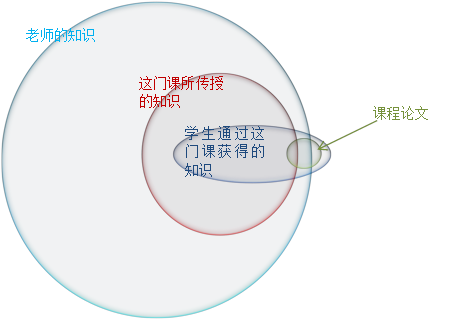
(A diagram I drew before)
For me, these two layers of meaning are completely unified. First of all, what I hope students learn in this course is not the kind of rigid knowledge that needs to be memorized and parroted, but rather that this rich and interesting course, as I myself hope it to be, can stimulate students’ independent desire to know, encourage them to read and think on their own, understand history, and ultimately understand themselves. So how do we measure the effectiveness of students’ independent reading and thinking? One very simple dimension is whether they add something to the course.
That is why I repeatedly supplemented and explained the homework requirements in class. I said that, first, everyone should choose the format of their assignment and the texts they read according to their own interests; there is no mandatory requirement. As long as you read seriously and write seriously, you cannot fail. But on the premise of passing, there will still be a certain tendency as to “what kind of assignment is better,” and my tendency is this: first, it should be related to the course; second, the best assignment is one from which I can learn something.
For papers, the topic is “of your own choosing”; for reading notes, the bibliography is “of your own choosing.” So many students asked: does this count as meeting the requirements? I then gave an additional explanation, proposing the tendency of “at least related to the course, and preferably able to teach me something,” and unexpectedly, a few students became even more confused. Of course, some students’ follow-up questions were out of excessive caution, but some of the questions did make me feel frustrated. In particular, the other day someone told me: I can only discuss “technology and the humanities, technology and the environment, the autonomy of technology, and so on,” and cannot “discuss the history of technology by itself,” and asked me how one could “discuss the history of technology by itself.” In response to that email, I replied with great anger (perhaps my wording was heated; I ask the relevant student to forgive me), but on second thought I also felt somewhat discouraged. This means that my course has not been taught very successfully yet.
I deliberately suspended the question “what is technology” or “what is the history of technology,” and did not predefine the boundary of “A General History of Technology.” This is not cheating. Just as cultural history, economic history, religious history, history of science, art history, and so on are all much the same, the scope may be roughly clear, but if you look closely, their boundaries are actually quite ambiguous. In my view, “history of technology” is more like a kind of “meta-historiography,” or rather a “historiographical perspective.” Any historical topic can be viewed from the perspective of the history of technology, and any topic can be connected to the history of technology.
But being able to connect it is one thing; whether you have actually made the connection is another. For example, if a student writes a reading note on the Scientific Revolution and the whole text does not even mention the word technology once, then of course I would find it hard to be satisfied.
So what, then, can satisfy me? Of course, my mind is not easy to read, but what students can more easily evaluate is: what can make themselves satisfied? In other words, as a student in a course called “A General History of Technology,” what do you hope to hear in this class? If I were to insert a certain passage of material or a certain discussion into the middle of this course, would you be satisfied listening to it? The things you discuss—if they were discussed in our classroom—would you feel they fit in naturally and harmoniously, or would you feel they were jarring and off-topic? Thinking in this way makes it very easy to judge whether your assignment is on topic.
If, in a course called A General History of Technology, I spent a lot of time talking only about science or politics, I’m afraid you would not be satisfied either, would you? Of course I will talk about the Scientific Revolution, but always by tying it to technology—for example, by focusing on experimental science, or on the impact of the mathematically oriented way of thinking that accompanied the Scientific Revolution on the Industrial Revolution. Of course, I may also go off track and do a poor job of it; in that case, your assignment can criticize me, correct me, or make up for my deficiencies, and that would be a better assignment. In any case, your own assignment should first of all be something that can satisfy yourself—you are willing to hear in a course on the general history of technology the kind of content related to your assignment.
Translated from the Chinese original with AI assistance. The original text is authoritative.