
This was a commissioned piece for our museum, Read the Exhibition | Hu Yilin: “The Name of ‘Computer’”—Starting from the Relationship between Computer and Calculator. The title I originally gave when I submitted it was later changed by me to “Who Is the Computer?”, but when it was published the original title remained. That’s basically the same thing.
Nowadays we distinguish between “computer” and “calculator”: the former corresponds to the English Computer, meaning a general-purpose electronic computer, while the latter corresponds to the English Calculator, usually meaning a small tool designed specifically for arithmetic. Looking further back, we also call Pascal’s adding machine and similar calculating machines “calculators.”
But in fact, in Chinese the meanings of the characters “机” and “器” are more or less the same; in English too, compute and calculate mean more or less the same thing. And literally speaking, neither Computer nor Calculator contains the meaning of “machine”; taken straightforwardly, both simply mean “computer,” or “one who calculates.”
It is therefore clear that the formation and differentiation of these two words cannot be understood merely at the level of literal meaning; one must trace them back to their relevant social background.
As their morphology suggests, Calculator and Computer originally both referred to “computers,” that is, human beings who were skilled at calculation or engaged in it. For example, one group of scholastic philosophers active in the 14th century were called the “Oxford Calculators”; they were famous for using mathematical methods to study kinematics, and were precursors of Galileo.
Pascal’s adding machine, invented in 1642, opened the age of the “calculator.” Early mechanical calculators did not have a standardized name: some were called adders, some reckoners, and later came the arithmometer, comptometer, and so on. From the 19th to the 20th century, Calculator gradually became the most common general term.
Mechanical calculators did not replace “computers”; they merely assisted computers in carrying out calculation. But machines lowered the threshold for being a “computer.” A computer no longer had to be some exceptional person gifted with extraordinary calculation skills; anyone could get the hang of it with a little familiarity.
In antiquity, people who were good at calculation were often rare talents, even uncanny figures. For example, in ancient China, the image of a “computer” was either that of a strategist who “planned and calculated from within the command tent” (运筹帷幄), or that of a magician who “estimated fate and destiny”; even a mere “bookkeeper” could still be addressed as “sir.”
The Dao De Jing says, “Those skilled in counting need not use counting rods” (善数不用筹策), meaning that people who are good at calculation do not need to borrow tools. Someone who needs counting rods in order to calculate is already a notch below the accomplished calculator. But what about someone who needs tools even to add a few numbers? Do they still count as a computer?
From the beginning, mechanical calculators were not meant to assist those “skilled in counting,” but to help people who were not good at calculation at all to carry out calculations. This was closely tied to the social conditions of Europe since the 17th century. On the one hand, with the rise of capitalism, the circulation of capital became increasingly active, and political and economic life generated more and more tasks that required calculation—tedious and boring tasks at that.
Pascal’s father was a tax official, and Pascal designed the adding machine initially to help his father handle messy accounts more quickly. But because the adding machine had to be operated by turning gears one notch at a time, it was in fact no faster than any person who was good at calculation. With Pascal’s mathematical talent, he would certainly have been much faster doing mental arithmetic himself than using a calculator. Yet no matter how fast Pascal could calculate, he was still only one person; the advantage of the adding machine was its “foolproof” mode of operation. You could bring in any diligent and dependable slave; so long as he could recognize numbers, he could do the calculation.
The combination of capitalism’s demand for calculation and colonialism’s supply of slaves gave the foolproof mechanical calculator a place to be used. Leibniz, who invented the multiplying machine, once said, “To waste the time of an excellent man, like a slave, in laborious calculations is not worthwhile. And once a machine is employed, this labor can be safely entrusted to just anybody.”[1]
The work formerly done by the Calculator was now jointly done by “human + machine,” but the “human” in this arrangement was anonymous, a “just anybody,” a laborer or even a slave. Thus the name Calculator naturally came to be attached to those calculating machines.
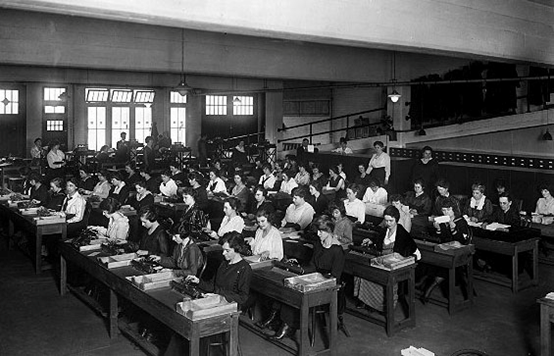

By the early 20th century, society’s demand for “calculation” had become increasingly broad. Beyond commercial activity, science and technology generated even greater and more numerous calculation needs. For example, in military and aerospace fields, complex and high-precision calculations were often required.
Thus those anonymous human calculators who used machines began to form a new profession, and in that sense they regained a “name.”
This profession was called Computer, a new term distinguished from the Calculator in their hands. A Computer was a person whose occupation was to operate a Calculator in order to perform calculations.
I say “their” because the overwhelming majority in this profession were women. Although slavery was gradually disintegrating, the people who worked with calculating machines were still those most despised in society. This was always work that required neither intelligence nor strong physical strength, only routine and patience in the face of tedious tasks. Many institutions set up dedicated calculation rooms, breaking down and aggregating calculation tasks much like an assembly line. Sometimes the calculation work would even be assigned to high schools, with a group of high school girls managed to complete it.
Ultimately, after 1950, the profession of Computer was gradually replaced by the electronic computer. In the early days of electronic computers, those who actually tended these calculating machines and handled the tedious input and output work were still mainly women, who often appeared as anonymous background figures in photographs of early computers.
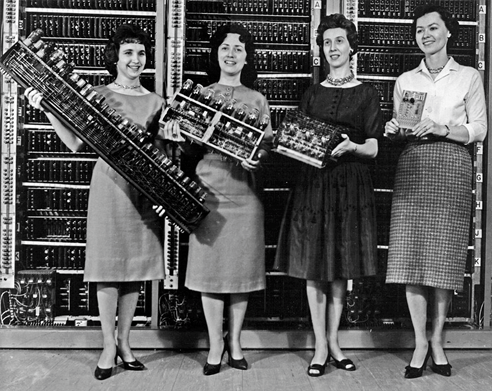
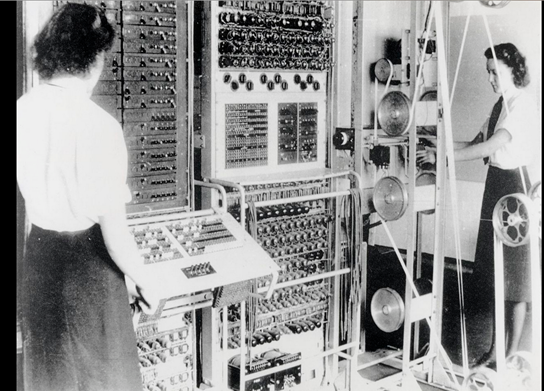
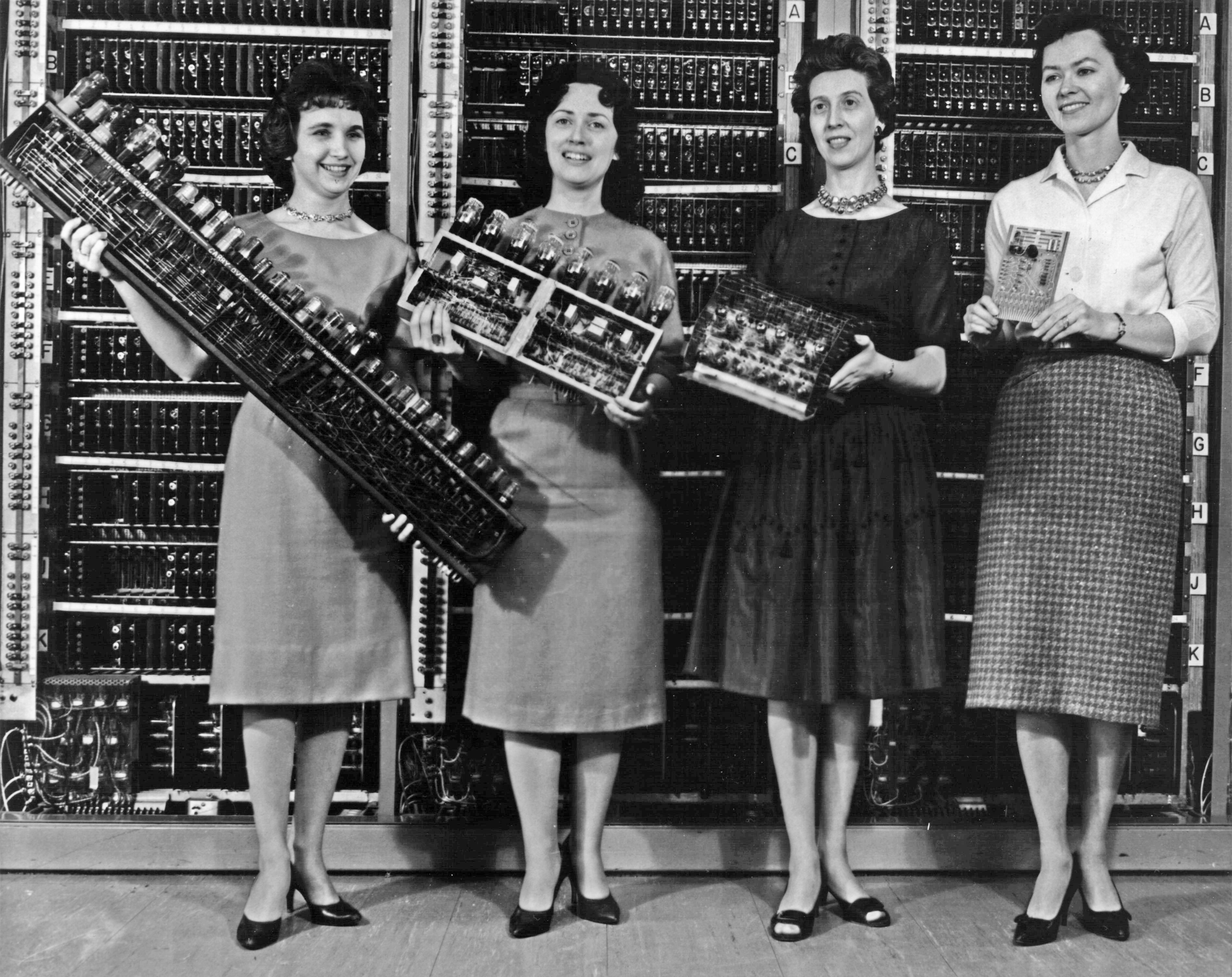
Later, as is well known, the women computers who had already been anonymous from the start were completely erased from the history of computing. UNIVAC I, released in 1951, was an important milestone. It was the first to use magnetic tape instead of punched cards to transfer data between machines. This no longer required people to sort and carry cards back and forth between machines at all times, thereby advancing the automation of the entire calculation process. Some scholars have argued: “Users regarded UNIVAC as an information-processing system rather than a calculator. Thus it not only replaced the existing calculating machines, but simultaneously replaced the people who tended them.”[2]
In the era of operations research, calculating devices were tools subordinate to the computer; in the era of mechanical calculators, the computer became labor subordinate to the calculator; and finally both were unified within the electronic computer. The computer was no longer an elite, nor was it a slave; it had become a machine.
[1] Smith, David Eugene (1929). A Source Book in Mathematics. New York and London: McGraw-Hill Book Company, Inc. pp. 180–181. Cited in the Wikipedia entry “Mechanical calculator.”
[2] Paul E. Ceruzzi. A History of Modern Computing, 2nd Edition[M]. MIT Press, 2003. p. 30.
Translated from the Chinese original with AI assistance. The original text is authoritative.