
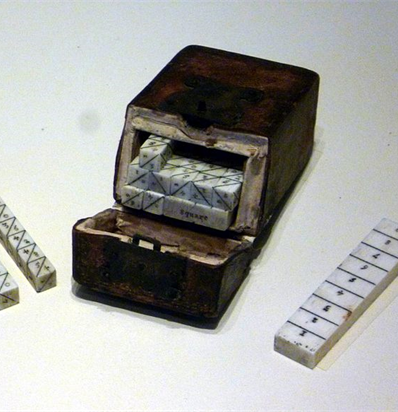
This is still written for the Science and Technology Museum, and the piece “Xiang: Made in Advance — Napier’s Rods and the Common Logic of Logarithms.”
John Napier (1550–1617) was born into a prominent Scottish noble family. He inherited the family fortune and managed his own castle and estate. He ran his lands with a researcher’s attitude, conducting experiments and analyses on matters such as fertilizer. He was also a devout Protestant, and in order to push back against Catholicism he took an active part in the religious controversies of the time and wrote influential theological works. He was also a wizard: he carefully fed a magical black rooster, and when he went out he often carried a black spider with him. And in order to fight the Spaniards, he also designed military equipment such as cannon and war chariots…
Research in astronomy, astrology, and mathematics was only a small part of this estate owner’s hobbies, yet it had the greatest impact on posterity. For this reason he is hailed as one of the greatest Scottish mathematicians in history.
Napier’s greatest achievement in mathematics was the invention of “logarithms.” At the same time, he also made contributions to trigonometric functions and spherical trigonometry, and he standardized the notation for the decimal point. In addition, his “Napier’s rods,” as an auxiliary tool for multiplication, are also regarded as a precursor of modern mechanical calculators.
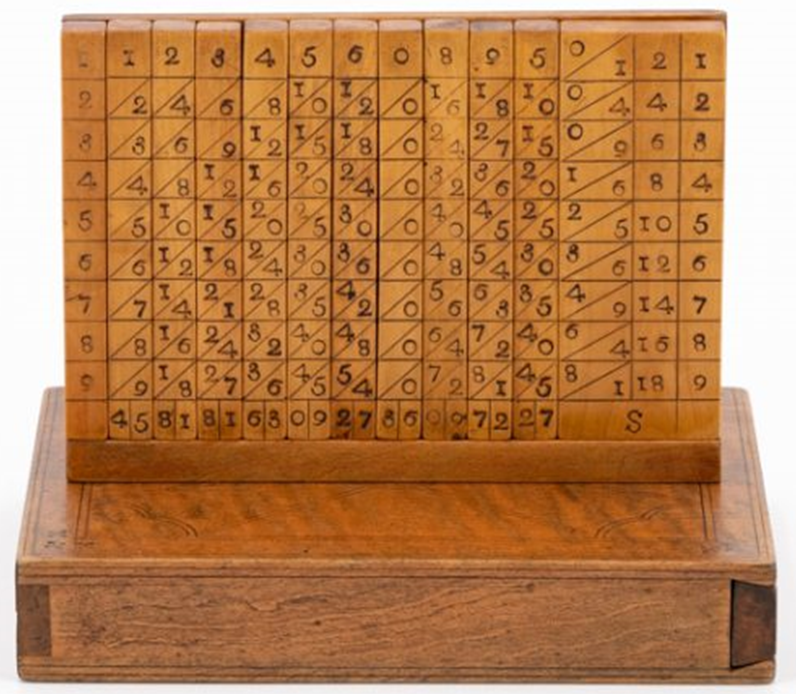
“Napier’s bones” (Napier’s Bone) is literally “Napier’s bones,” so called because in its early form this counting rod was often made of ivory. The principle behind this counting device is not complicated; it comes from the so-called “lattice multiplication.”
Lattice multiplication most likely originated in India. It had already spread among the Arabs in the Middle Ages, and later entered Europe and China. In Ming-dynasty China it was called “pudi jin” (铺地锦). In essence, it is nothing more than a technique of written calculation, as follows:
Write the multiplier and the multiplicand horizontally across the top and vertically along the right side, respectively. Each digit corresponds to one cell. Draw a rectangle made up of square cells with diagonal lines in them, and then decompose the multiplication of a multi-digit number into several one-digit multiplications. For example, in 135 × 79, calculate 1 × 7, 3 × 7, 5 × 7, 1 × 9, 3 × 9, and 5 × 9 separately, and fill them into the corresponding cells determined by the vertical and horizontal coordinates. One-digit multiplication only requires memorizing the multiplication tables, and the result will not exceed two digits, so the tens digit is entered in the upper-left triangle divided by the diagonal, and the ones digit is entered in the lower-right triangle divided by the diagonal (left image). Then add along the diagonals, summing the numbers on each diagonal from upper right to lower left—just as in ordinary vertical addition, carrying must be handled—and fill in the result at the end. In this way, the final sum is the desired product.
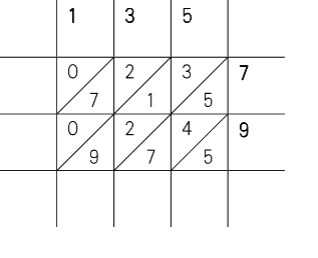
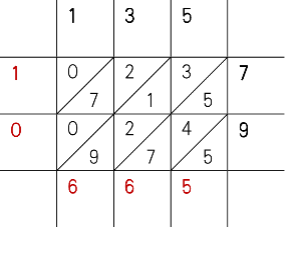
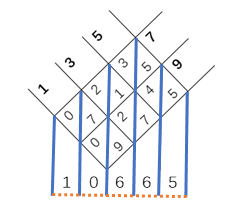
Simply put, the essence of lattice multiplication is to break the problem of multi-digit multiplication into a number of one-digit multiplication and addition problems. With a slightly more elaborate method, one can use a similar approach to compute division, exponentiation, and extraction of roots as well. So where exactly does Napier’s rods improve on lattice multiplication? As our exhibit introduction says: “Napier did nothing more than prepare in advance the work of filling in the lattice multiplication cells.”
Napier’s rods have already prefilled the results of one-digit multiplication in the corresponding positions, so that when dealing with simple multi-digit-by-one-digit multiplication, one can almost do without written calculation and directly read off and write down the answer. When calculating multi-digit-by-multi-digit multiplication, one can also reduce the frequency of writing and avoid simple copying errors.
But do not underestimate the significance of this “preparing in advance.” This is the significance of Napier’s rods, and it is also the key to why Napier invented logarithms.
What is a logarithm? Today we all know that a logarithm is the inverse operation of exponentiation. For example, if ax = N, then loga N = x. But Napier did not understand logarithms in this way. In fact, this is rather miraculous in the history of mathematics: logarithms were invented before exponents.
It was not until more than twenty years after Napier’s death that Descartes defined exponentiation in a relatively modern way, and it was not until a full one hundred and fifty years later that Euler clearly demonstrated the inverse relationship between exponents and logarithms.
So modern readers inevitably wonder: before the concept of exponentiation had been established, what on earth was the logarithm that Napier invented?
First we must understand why exponents were recognized so late. The reason is that in the eyes of ancient mathematicians, multiplication always ought to have some geometric meaning. For example, if a and b are two “numbers,” then a × b represents the total number in a rows and b columns; if a and b are two “magnitudes,” then a × b represents the area of a rectangle of length a and width b. Similarly, “squaring” represents the area of a square, and “cubing” represents the volume of a cube. But for higher powers, or if the power is negative or fractional, there is simply no proper way to express them, nor any reasonable physical or geometric meaning.
The invention and acceptance of exponent notation depended on a fundamental transformation that was maturing throughout early modern mathematics: the abstraction of symbols. Modern mathematicians no longer require mathematical symbols to have some definite referent, nor do they require mathematical expressions to have a real meaning. The meaning of symbols is entirely conferred by their rules of operation, rather than being attached to any worldly image. In this way, modern mathematical concepts such as irrational numbers, negative numbers, imaginary numbers, and infinitesimals, including exponents, became easier to accept.
Descartes played a key role in this process of symbolic abstraction and neutralization. His analytic geometry ultimately reversed the ancient relationship between algebra and geometry, thereby making it possible for higher exponents to be detached from geometric meaning.
But Napier’s invention of logarithms did not unfold under this line of symbolic abstraction. Napier’s logarithms were, in essence, a technique or means of assisting calculation.
In his writings introducing logarithms, Napier begins by discussing his motivation. He says: “In mathematical practice, nothing is more troublesome than calculations such as multiplication, division, squaring, or cubing of large numbers, and apart from wasting time in dull tedium, one also often slips and calculates incorrectly. So I began to think that one might eliminate these troubles by means of certain and ready art.”
From Napier’s 1614 work Mirifici logarithmorum canonis descriptio, cited via https://mathshistory.st-andrews.ac.uk/Biographies/Napier/
We can see that this motivation is shared by both logarithms and counting rods, and we may equally well understand Napier’s rods as the “ready art” he invented in order to solve problems such as large-number multiplication and division.
For Napier, logarithms simply referred to the correspondence between two sequences of numbers, for example:
| 2 | 4 | 8 | 16 | 32 | 64 | 128 | …… |
| 1 | 2 | 3 | 4 | 5 | 6 | 7 | …… |
Between these two rows of numbers there is a one-to-one correspondence, and at the same time, the multiplication and division in the first row correspond exactly to addition and subtraction in the second row. For example, in the first row, if we multiply the two numbers in column 2 and column 3, we get the number in column 5 (4×8=32), while in the second row, if we likewise find the two numbers in column 2 and column 3 and add them together, we will likewise get the number in column 5 (2+3=5).
In constructing these two rows of number sequences, it is not necessarily required to have the concept of exponents; one can instead, entirely through a step-by-step method in which each subsequent number is the previous number multiplied by 2, practically precompute a very large table of numbers. Then Napier did not regard these two sequences as discontinuous integers, but as continuous “quantities”; yet the one-to-one correspondence between the values in the first row and the values in the second row, as well as the relation whereby multiplication corresponds to addition, remained unchanged.
What comes next is simply to “do in advance” a sufficiently long “sequence,” filling in a sufficiently large number of “values,” so that when we want to perform multiplication or division on two large numbers, we first find these two values in the first row, then find the corresponding much smaller values in the second row, perform addition and subtraction on the two values in the second row, find the result of that addition or subtraction in the second row, and then find the corresponding value in the first row—that is the result of the desired multiplication or division.
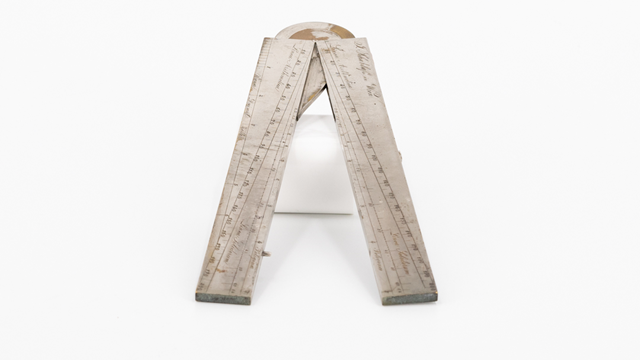
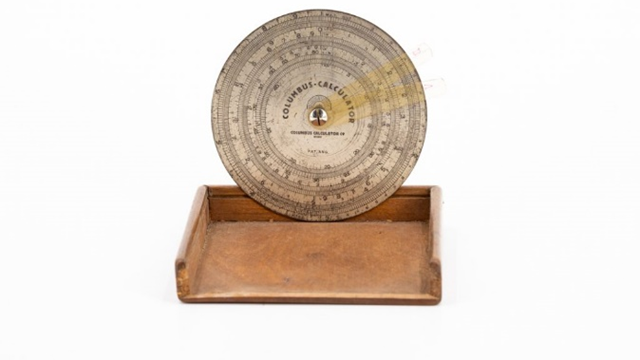
“Logarithms,” this “prepared art” that uses the value correspondences “done in advance” to assist large-number calculations, quickly became popular and was embraced by scientists and calculators struggling with numerical computation. The various “slide rules” and “proportional compasses” that later emerged were all tools based on logarithms and their underlying ideas. Even some early electronic calculators still relied on logarithms to carry out multiplication and division, which is why results such as 2×2=3.99999… would sometimes appear.
This way of thinking, of “doing things in advance,” guided the entire development of modern Western calculating devices. Just as logarithms preceded exponents, in the driving forces behind the development of modern technology, practical needs were often more important than the establishment of concepts. Modern mathematicians partially adopted the attitude of merchants, thereby breaking the Greek mathematicians’ stubborn attachment to the world of ideas and promoting the alliance between mathematics and mechanics.
Translated from the Chinese original with AI assistance. The original text is authoritative.