
“Metaverse” was last year’s big buzzword. I also discussed it a great deal on Weibo, in class, and in conversation, but unfortunately no media outlet ever invited me to write about it, so I never got around to writing anything systematic. Perhaps I could consider turning it into an academic paper, but then I’m always lazy. In any case, since I have a bit of inclination these past couple of days, let me first write an essay on it. (I will still turn this article into an NFT through Opensea, but in this era when the copyright consensus around NFTs is still far from mature, I nonetheless welcome reprints by any traditional means.)
“Metaverse” is not a very good term; translating it as “meta-world” also sounds awkward. But I don’t have any better solution, so in general I will still continue using the word “Metaverse.”
If I had the chance to change the popular translation, I would, however, like to propose a new one: “superreality.”
The prefix “meta-” means “after, beyond, super-,” and “meta-A” can be understood as “A about A.” For example, “metalanguage” is language about language, and “metadata” is data about data. “Metaphysics” studies the principles of principles, the origin of origins.
In general, what is translated as “meta” can also be understood as “super,” that is, entering a transcendent dimension in order to refer back to oneself. Or, in other words, such self-reference always requires entering a “detached” perspective.
The universe is all things, or rather, it is just reality itself. In this sense, translating Metaverse as “superreality” makes sense — “reality about reality.”
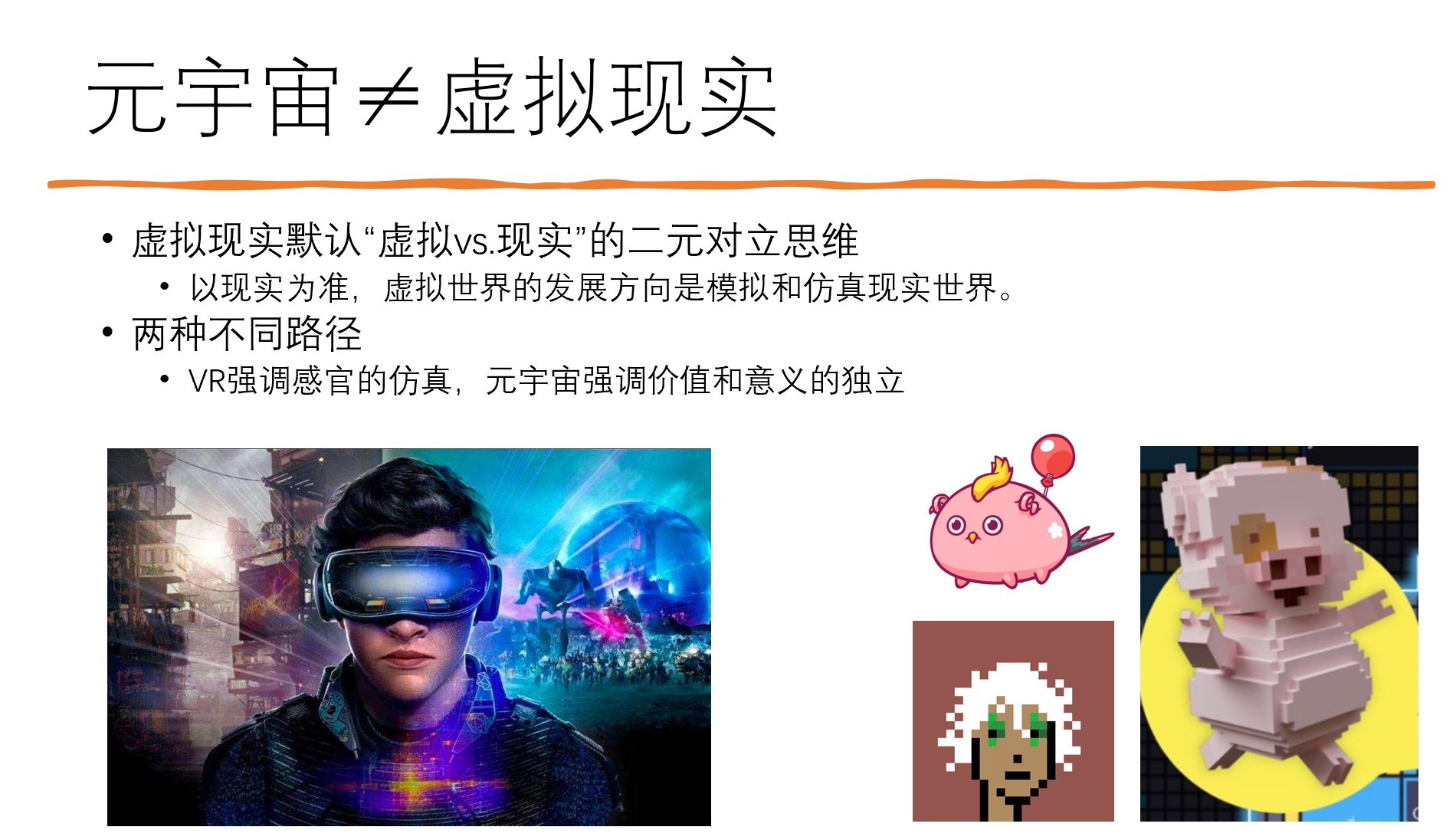
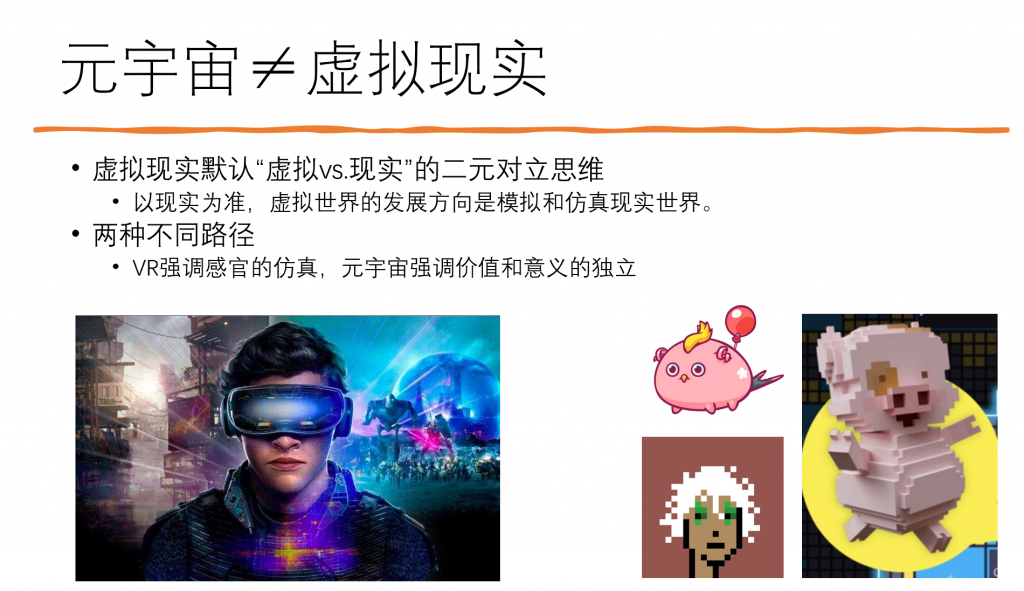
The most obvious advantage of the word “superreality” is that it makes clear its opposition to “virtual reality.” Many people, including the fashion-chasing original Facebook, regard Metaverse and virtual reality as the same thing. Even if they do not quite take them as synonyms, they still see them as moving in the same direction. More importantly, when many people understand Metaverse and VR, what they emphasize is “virtual”: some stress that, after all, these things are virtual and the real world is still more meaningful; others stress how the combination of virtual and real will work, and so on.
All of these views place the “virtual” beneath the “real.” The virtual world is a simulation of the real world, and only the real world is meaningful and valuable. Some people believe that the virtual world has value only when it submits to reality and contributes to the real world. Others believe that only by becoming indistinguishable from reality can the virtual world attract people into obsession.
So the route of “virtual reality” is always to take the real world as the highest standard, to simulate, imitate, and flatter the real world, and by every possible means to make people feel “realness.”
But “Metaverse” did not honestly proceed along the route of “virtual reality.” The word “Metaverse” may be understood in countless ways, but since it has become popular, that at least proves one thing is common ground among all those who like to use this new term: they are tired of the ready-made phrase “virtual reality.” So, if one thousand readers can have one thousand kinds of “Metaverse,” “Metaverse” can mean anything, except “virtual reality”.
In fact, the binary way of thinking that opposes virtual and real is questionable. What is “real,” anyway? Real life is already mixed with so-called “virtual” things. For example, in the morning I attend class and do exercises, carrying out mathematical calculations that include fictional objects such as infinitely long lines and infinitesimals; I do Chinese reading exercises that include fictional stories like Yu Gong moving mountains and Ye Gong’s fondness for dragons. At noon I chat with classmates about everything under the sun, speaking in hypothetical terms about what I would do if I won the lottery. In the afternoon I do research, drawing blueprints for a machine that has not yet been produced. At night I go online, ordering tomorrow’s food through cyberspace, and then communicating with colleagues all over the world through a virtual conference room… We find that throughout “real life,” the so-called “virtual” elements are interwoven into every part of life. In face-to-face conversation, we talk about virtual objects; in virtual settings, we are busy with real affairs. The so-called “real” and “virtual” can sometimes be distinguished, but we cannot draw a hard boundary so that one side is entirely “real” and the other entirely “virtual.”
More importantly, if “reality” refers to this objective material world, then it has never naturally occupied the high ground of meaning or value. For example, a national flag is meaningful, but in terms of “reality,” it is nothing more than a piece of cloth dyed with pigments; money is valuable, but in terms of “reality,” it is nothing more than a sheet of paper printed with patterns. Human beings are not, after all, animals; human meaning has always been entrusted to some dimension “above reality.”
Today, the reason many people overlook this dimension “above reality” is not that they have already found a home for meaning in reality, but that they have completely fallen into a crisis of meaning and can no longer find meaning anywhere. For example, a 996 employee gets up early and works late every day; an assembly-line worker repeatedly performs mechanical motions. These activities are very “real,” but also very “empty.” The only thing that gives a person a slight sense of fulfillment is the meager wage. But money itself has long since been virtualized. How could the working masses, looking at the wealth of the rich or the financial oligarchs measured in the hundreds of millions, not feel a sense of unreality? This feeling of unreality is not brought about by blockchain or the Metaverse; it has already become the “reality” of this era.
Under the “reality” of this era, to grandly proclaim slogans like “only reality has meaning, the virtual is merely virtual” is what is truly illusory and unreal. It sounds as if people can all find a fulfilling meaning in this real world. In fact, meaning always has to be entrusted to some dimension “above reality.”
This dimension “above reality” does not necessarily have to be called the so-called “virtual,” because “virtual” sits beneath “reality” and takes reality as the highest standard. On the contrary, reality itself still needs to be measured against something higher before reality can be meaningful.
This higher thing is still reality, just as language about language is still language, and data that records data is still data. That which enables reality to become full and substantial is still reality: reality above reality — superreality.
But “Metaverse” contains one more layer of meaning than “superreality”: namely, that this transcendent dimension is now “closing in on itself,” forming an independent kingdom corresponding to the “real world.”
To understand this trend, we still have to trace human history back to the first cave painting.
Cave paintings and gardens mark the beginning of humanity consciously shaping its own “environment.” Human beings no longer wander about in the natural environment; they gradually build a living environment for themselves. Settled life appeared together with primitive religious and aesthetic activities, followed by the rise of agriculture. Agriculture was the first “protective membrane” human beings established between themselves and nature. From then on, human beings no longer dealt directly with the “wild environment,” but with a relatively controllable agricultural environment. Of course, the agricultural environment has always remained embedded within the environment of nature; fundamentally speaking, human survival still means dealing with nature. But this layer of “buffer” is crucial. The existence of agriculture guaranteed the stability of settled life, and human beings no longer needed to migrate constantly in pursuit of food.
Within this layer of protective membrane, new circles gradually emerged. For example, “the city” is another layer of protective membrane. The city established a protective membrane between urban residents and the agricultural environment, so that urban residents no longer needed to deal directly with the agricultural environment, but could instead enjoy the products of agriculture more safely through commercial and political institutions. Of course, urban residents were then even farther removed from wild natural environments.
Industrial civilization strengthened the city and further diminished the status of agriculture. In the pre-industrial era, although cities were safe and independent, the rules sustaining the whole human world were still based on agriculture; land and cultivation were the center of all commercial and political institutions. But in the industrial era, the industrial world established a new set of rules that, in turn, governed the operation of the agricultural circle.
Cities can never exist apart from the countryside, just as the countryside can never break free from nature’s rule. But through the establishment of layer upon layer of protective membranes between human living spaces and the natural environment, humanity has formed successive buffers. Agriculture still depends on the natural environment, but it tries to make capricious natural forces stable and safe. Industry still depends on the nourishment of agriculture, but it replaces agriculture’s seasonal rhythm with its own assembly-line steadiness and precision.
The so-called “real world” that many people so relish talking about today is no longer that wild jungle world, nor is it the agricultural life of men plowing and women weaving; it is this modern city life already wrapped within a new environment created by industrial technology.
In the history of human technology, the two greatest transformations were probably the Agricultural Revolution and the Industrial Revolution. Both of these “revolutions” established new “protective membranes.” Agriculture did not imitate nature; it established new rules that, in turn, governed nature. Industry did not imitate agriculture; it established a new order that, in turn, controlled agriculture. In a similar sense, if there is also an “information revolution,” then this “information world” is not an imitation of urban life in the industrial era either, but rather the establishment of a new world order within an even newer, smaller, and safer protective membrane, and then, in turn, the influence of that order on the operation of the industrial world.
The germ of this new world did not appear only when the concept of “Metaverse” became popular last year. In fact, the so-called “information revolution” from computers to the internet had already revealed this trend long ago. In the history-of-technology survey class I taught two years ago (in spring 2020), I summarized this trend as “the great tendency of information breaking free from the material entity to form an independent kingdom,” creating a “virtual world” that is “more real than reality.” That virtual world more real than reality I summarized back then is precisely the “Metaverse” or “superreality” we are now talking about.
Through the lens of technological history, we can easily avoid some overly simplistic ways of commenting, such as dismissing the significance of the Metaverse with the line “people always have to eat.” The same line could also be used to belittle the significance of the Industrial Revolution — because people have to eat, and without agriculture no one can survive, so industry must after all be a secondary matter, and the industrial system can never possess any independence. But the facts are plainly not like that. What the Industrial Revolution overturned was precisely the relationship in status between industry and agriculture. Under the new order of the industrial age, the countryside instead became dependent on the city, not the other way around.
Nor will the information revolution of course abolish industry and agriculture; on the contrary, it will ultimately promote their development. But if it really is a revolution, then we should expect this reorganization of order and this reversal of status.
Although the trend of the information revolution had already emerged long ago, it is no accident that the Metaverse only began to catch fire last year. Because every revolution ultimately requires a great transfer of wealth and power. Capitalists and industrialists had to first accumulate wealth, then seize power, and only then could they overturn the old order controlled by monarchs and landlords. If power were still measured by land rather than by capital, then industrialists would never be able to overthrow the power of landlords. Correspondingly, the information revolution also needs, in the end, to establish a standard for wealth and power that can be controlled by forces within the new protective membrane.
As I said in yesterday’s article, From Bitcoin to NFT, this new order has finally found the substrate to which it can adhere.
Translated from the Chinese original with AI assistance. The original text is authoritative.