
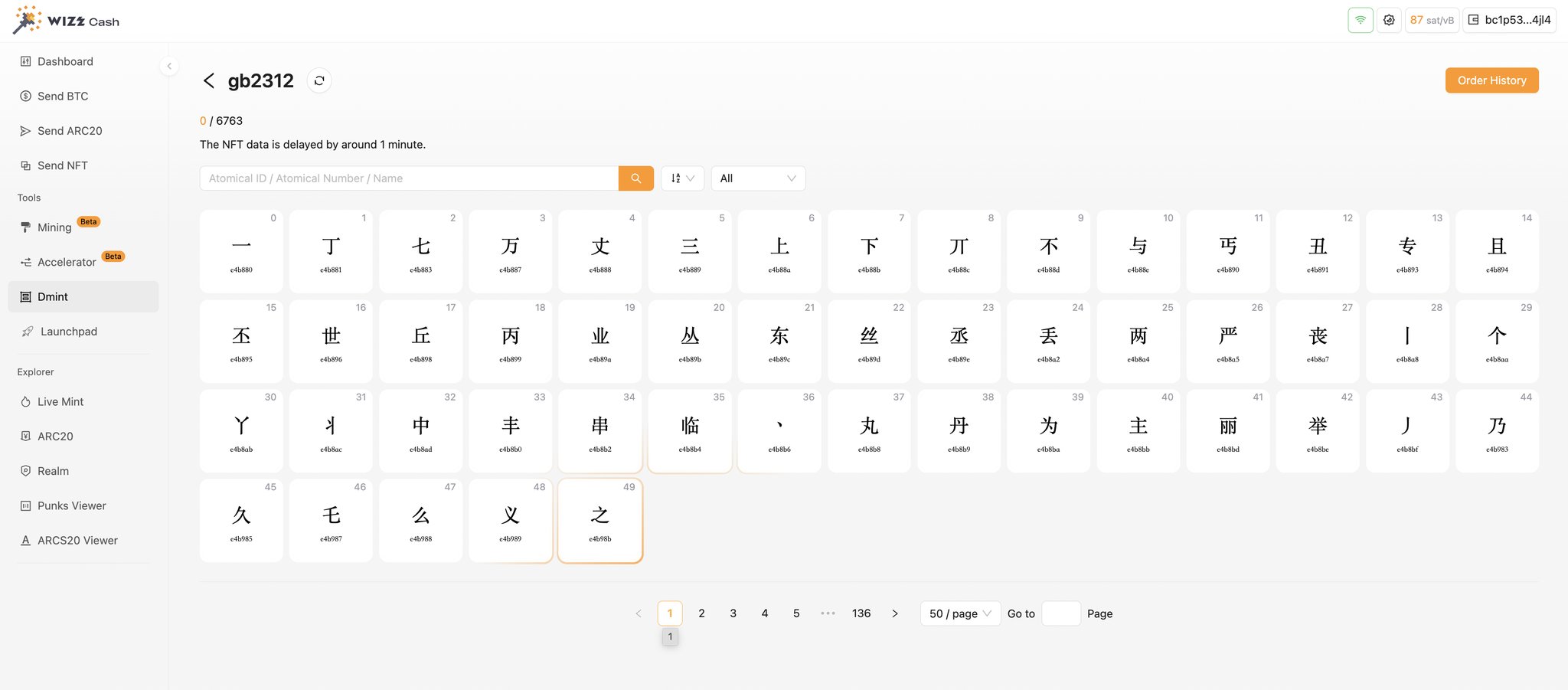
See @epr510 on Twitter for details
Let us proudly inscribe Chinese writing into blockchain history! (Tutorial in a follow-up tweet https://twitter.com/epr510/status/1746151703915725284?s=19) We have launched two sets of Chinese-character inscriptions, classical and modern: the classical version is the Thousand Character Classic, containing one thousand unique traditional characters, forming a beautiful rhymed prose—“Heaven and Earth dark and yellow, the universe vast and ancient…” This is a foundational textbook that every scholar in ancient China had to read, and it is also the main way of sorting sequences by character count. This set of characters is positioned to attract some cultural elites from the humanities, arts, and technology fields to join in reviving Chinese culture on web3. The dmint difficulty for this set is relatively high (one character may take several hours to mine), and since we also hope to use it as a gift for inscription newcomers, helping people cross circles and connect, our founding team began minting early and has already pre-mined a small amount. Of course, it should still count as a kind of semi-fair launch, and everyone is welcome to dmint as well. After getting the Thousand Character Classic, you can leave me a message and follow me back, and we can continue discussing the possibilities of advancing various cultural and artistic activities. For the modern version, I chose the GB2312 character set. As I said before (https://twitter.com/epr510/status/1745121870406648263?s=19), it symbolizes the open and enterprising attitude with which Chinese people threw themselves into the information revolution in the 1980s. This character set includes 6,763 Chinese characters, covering 99.99% of usage in everyday simplified Chinese contexts. Although it lacks many obscure characters often used in personal names, it is obviously already rich enough. The modern Chinese-character set is much easier to dmint than the Thousand Character Classic; one character can be mined in dozens of minutes or even just a few minutes. There is no longer any differentiation in difficulty within the character set: every character is equal, though perhaps everyone will judge scarcity according to the meaning of the character itself? The modern Chinese characters are a completely fair launch, with the launch time set at BTC network block height 826308; minting after that point is the only valid minting. According to estimates, that was around 15:07 Beijing time on 2024-01-18. For now everyone can first look at the tutorial and get ready, or start mining the Thousand Character Classic first. Other NFTs are for use as avatars; our Chinese-character inscriptions can even be used as usernames. For example, we could agree that the Thousand Character Classic series can use the hollow square brackets 『』, while the modern Chinese-character series can use the square brackets 「」 to mark nicknames or bios, creating a community-recognition effect? (We can slowly figure out exactly how to play with this.)
Some other related recent tweets
Memes like “Nasdaq trader” and “Wall Street analyst” show that crypto people actually care about identity too. But perhaps because the crypto world has been misunderstood so much, many crypto players have nearly given up on themselves, and have simply accepted being labeled as dumb speculators. Since ETFs have vindicated Bitcoin’s legitimacy (though it wasn’t necessary), we Chinese crypto players should also stand up straight and hold ourselves with dignity. Proudly play with coins, proudly inscribe Chinese, proudly pan for gold in the new world
Back then, people liked to call unwavering Bitcoin believers the “Bitcoin cult,” though over the past two years that name doesn’t seem to be used much. There was also the “18k cult,” meaning those who believed Bitcoin would rise to 18,000 yuan within a few years; many people found that incomprehensible and therefore treated them as fanatics. But what was once dismissed as superstition now seems to have been merely a matter of too-small horizons. I wonder how those self-styled rational investors see it today. Back then, being bullish on Bitcoin was not faith at all; it was just knowledge monetization. Anyway, I think that if you understand the history of technology and the philosophy of technology, you can understand Bitcoin’s future. On the contrary, I feel that only today have we truly reached the point where faith needs to be discussed—meaning, what kind of future do we actually hope for? Is it a financial and monetary market regulated and managed by the U.S. government that is better, or is a more decentralized but more chaotic market better? This is not a purely rational judgment; it carries faith. Ten years ago, believing in Bitcoin was like believing that if you plant rice seedlings in the field and patiently wait, you will be able to eat more later—that was not faith but knowledge. Those speculators who grabbed the grain and ate it all before leaving were not rational but short-sighted. And now, Bitcoin has long since borne flowers and fruit; the old controversies have already gone out of date. But the new choice is like this: say you have a chance to be a servant, but you can live in comfort and never worry about food or clothing, whereas being a free citizen may mean instability and a life of drifting and hardship— which path would you choose? Those who insist on freedom need faith as well as rationality.
Around 1980, China had just come through catastrophe, and everything needed rebuilding. But farsighted people had already seen the importance of information technology, and they strove to ensure that Chinese people would not miss this technological revolution. In particular, information technology in its early days was obviously more suitable for alphabetic scripts, so the mission of bringing Chinese characters into the digital world was especially arduous. But our predecessors were not content merely to catch up; they even dared to lead the world: Wang Xuan’s laser typesetting technology was just such a case, achieving leapfrog progress in typesetting technology, taking the lead in the world, and of course perfectly compatible with the Chinese-character system as well. In addition, in 1980 China introduced the national standard GB2312 for Chinese character sets; of course, it drew on Japanese kanji sets, but its promotion as a national standard was ahead of the world. Taiwan’s BIG5 code came later, and Singapore even directly adopted GB2312 for a time. The Wubi input method, the WPS Chinese word-processing system, and so on were also inventions of the 1980s. Although they came somewhat later than their counterparts in Taiwan, they too were able to overtake from behind and help Chinese characters better integrate into the information age. On September 20, 1987, the first email sent from Beijing to the outside world went out: “Across the Great Wall we can reach every corner in the world. (越过长城,走向世界)” It showed the open and enterprising spirit with which that generation greeted the tide of the information revolution. As everyone knows, the open and enterprising momentum of the 1980s gradually faded, but the efforts of that generation ultimately ensured that Chinese people did not miss the Web1.0 era. And, as everyone also knows, in the Web2.0 era, “openness” was gone, but the spirit of enterprise remained; Chinese people created a distinctive Web2.0 and in turn influenced the world. So then, in the Web3.0 era, with what kind of posture can Chinese people join in? I hope it will be a revival of the spirit of the 1980s: open, enterprising, learning from the world and daring to move to the frontier. Not licking and fawning all the time—if you want to make money, you look for foreigners to lead the way; if you want to start a business, you pretend to be a foreigner. That is not who we should be. Cross the Great Wall and head for the stars and the sea of possibilities!
I want to work on “Huawendao” for many complicated intellectual reasons. But the original impulse was actually very simple: “to inscribe the names of Chinese people in blockchain history,” and to hope that Chinese people and their culture should not be absent from this great social transformation. I believe that the inscription movement is a positive and progressive link in the blockchain revolution; since this movement is led by Chinese people, we should be proud and self-confident, not sneaking around. “Proudly inscribe Chinese characters!”
What “postures” are there for participating in the crypto movement? The most classic is to “play,” or the punk spirit VB always yearns for—world-weary nonchalance. Second is to “stockpile,” hodl; third is to “build,” buldl; and finally to “speculate,” because speculating on coins is of course also perfectly justified and nothing to be ashamed of. The worst posture is to “lick and fawn”: licking VB, licking VCs, licking KOLs, licking project teams—this is not what the crypto world should look like. It is time to return to the original intention of the crypto movement.
Rather than saying that Ethereum should become crypto-punk again, it is better to say that the crypto movement itself should become punk again. In this process, Ethereum, especially Vitalik, is precisely an obstacle. Vitalik keeps strengthening his own position as leader, wanting to be Qin Shihuang, yet also preaching decentralization—wanting both this and that. It would be better to use the inscription trend to break away from the Ethereum ecosystem and return to Bitcoin as the base layer.
I am optimistic about the rise of the inscription ecosystem; this movement marks a threefold great crypto renaissance: the revival of Bitcoin as the base layer (denominated in satoshis), the revival of the decentralized revolution (fair launch), and the revival of Chinese culture (Chinese people standing up straight in the crypto world). I am trying to restart the “Huawendao” project, which had been on hold for more than a year, in the inscription ecosystem. New and old friends from all walks of life are warmly welcome to follow and join ੭ ᐕ)੭*⁾⁾
Translated from the Chinese original with AI assistance. The original text is authoritative.