

This is the introductory reading I prepared for the Mediasphere Alliance. The transcript was roughly organized by Feng Guangneng and then polished by me, though I tried to preserve the conversational style as much as possible. It has already been posted on the Mediasphere Alliance WeChat public account; here I am reposting the original draft.
1.1 Opening
Wu Jingwei: Hello to all our friends online, and to all the book lovers who have long followed the Mediasphere Alliance reading group! Today we are very honored to have Teacher Hu Yilin from our Department of History of Science join us to lead us through Wiener’s very important classic, The Human Use of Human Beings. I believe everyone is already very familiar with cybernetics, especially in today’s age of highly developed ChatGPT and artificial intelligence. In fact, everyone has long been very interested in what the relationship between humans and technology really is. It is a classic topic that has been discussed for a long time. So, cybernetics has in the present day also become a core and important theory for discussing the relationship between humans and machines.
Last year, we invited Teacher Hui Yuk from City University of Hong Kong to lead us in reading Recursivity and Contingency, and Teacher Hui Yuk also said that Recursivity and Contingency is in fact discussing cybernetics. So today, we are also making a very important echo, and it is especially fitting that we can use Wiener’s The Human Use of Human Beings to discuss this core issue within cybernetics.
What is worth noting is that it is the companion volume to Cybernetics. The earlier volume, Cybernetics, contains many formulas, which are very difficult for students and scholars with a humanities background to understand. So, in order to help everyone interpret cybernetics from a social or cultural perspective, Wiener wrote The Human Use of Human Beings after writing Cybernetics.
So today we are also very fortunate to have Teacher Hu Yilin from the Department of History of Science here to share and explain this for us. Teacher Hu, I believe everyone is already very familiar with you. Some of you may previously have read your The Strong Program of Media History. Teacher Hu Yilin also teaches media history-related courses at Tsinghua University, and is an interdisciplinary scholar spanning the fields of history of science and journalism and communication. Teacher Hu has also published many works in journals in our field of journalism and media studies, and I believe everyone has paid some attention to them. Let me also briefly introduce Teacher Hu’s background. He received both his bachelor’s and doctorate degrees in philosophy from Peking University, and is now an associate professor in the Department of History of Science at Tsinghua University. His main research interests are history of technology and philosophy of technology. So the Strong Program of Media History that everyone is familiar with, as well as What Is Technology and An Introduction to the Philosophy of Technology, are all works very familiar to everyone. Today we are also very much looking forward to Teacher Hu leading us in interpreting cybernetics-related issues from a sociological perspective. And we also hope that everyone today, during this holiday, can follow a thinker like Teacher Hu in reading through the classics of the masters. All right, let us now give the floor to Teacher Hu.

1.2 Wiener’s Life
Hu Yilin: Okay, thank you for the invitation, Teacher Wu. I’m just here to make an exhibition of my inadequacy before experts, because everyone is surely at least somewhat familiar with cybernetics. I can’t claim to be extremely familiar with it either; I’ll just discuss it together with everyone.
This book, as Teacher Wu just introduced, is a companion volume, written by Wiener after he finished Cybernetics. You could say it is an introductory version, or a popularized version. But in a certain sense, it is actually not about popularizing cybernetics; rather, it is the more fundamental intellectual background of cybernetics. I’ll discuss this in what follows. In a sense, the foundation of cybernetics is not a purely technical or mathematical matter; its foundation actually comes from philosophy and the social sciences.
As for Wiener, everyone should also be quite familiar with him. We say that in the whole of information science, or computer science, there were several very important masters who propelled their development, and Wiener certainly counts as one of them. But compared with Turing, Shannon, von Neumann, and several others, Wiener’s status, or rather his contribution, is considered to have been underestimated. For example, in China there is a big Wiener fan—Teacher Wang Feiyue. He often promotes Wiener’s contributions, and he believes that Wiener’s work directly helped four people win three Nobel Prizes, including Born, Heisenberg, Watson, and Crick. Von Neumann said that the pattern of the first von Neumann machine was in fact Wiener’s idea, essentially integrating Wiener’s principles. And Shannon’s information theory is very impressive, but it is said that Shannon merely changed Wiener’s signs from positive to negative, and that information theory owes a great deal to Wiener’s philosophy. Also, why are Indians so strong in the software industry? Besides their strong English, there are also certain educational foundations, and according to Teacher Wang Feiyue, these were also laid by Wiener. In his later years, Wiener was in India for a long time, promoting popular education in information science. This biography says that he was a hidden hero of the information age, a “dark hero,” which in Chinese means something like a behind-the-scenes boss. Of course, these are all one person’s opinions; Wiener may not have been quite that formidable after all, but he was certainly very important.

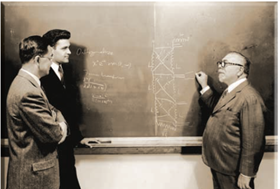
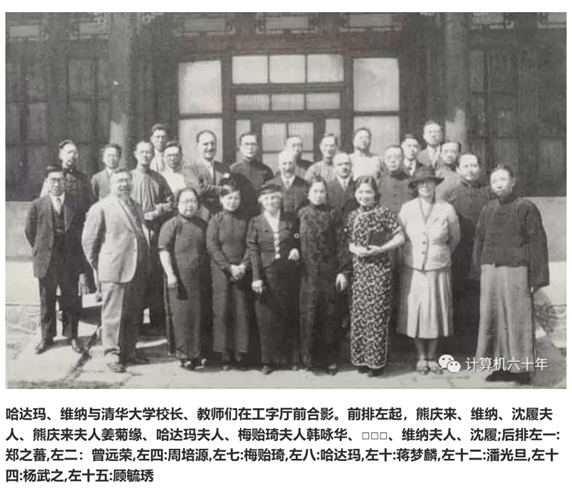
Before we get into the book, let’s warm things up a bit and talk some gossip: Wiener’s ties to China, especially to Tsinghua, were very deep. Wiener had a prized student named Li Yurong. This photo shows Wiener and Li Yurong: the one on the far left is Li Yurong, the one on the right is Wiener, and in the middle is Bose, Li Yurong’s student, who is the founder of Bose headphones.
Later, Li Yurong returned to teach at Tsinghua and invited Wiener to Tsinghua to lecture as a visiting scholar. Wiener actually had the chance to spend a longer period of time in China, and he even wrote to von Neumann strongly urging him to come to China. But then the Japanese invasion of China began, the situation became unsafe, and these exchanges came to nothing. At the time, he brought his whole family with him; his daughter attended elementary school in Beijing. For Wiener himself, Tsinghua was also a very important experience. In his own recollection, he said, “In my professional career, if there is a dividing line marking the transition from a scientific apprentice to, to some extent, an independent master, then I think it was my trip to China in 1935.” He and Li Yurong collaborated at Tsinghua University on research into an all-electronic analog computer. Although this research was not successful, it did accumulate many important experiences. Of course, Li Yurong was also very important, but Li Yurong later went to North America and died in Canada, so in the history of science and technology in our country he has also not been given enough attention.
Let me hurry on and finish with one last bit of gossip about Wiener himself. He was a child prodigy from an early age, and was already in the newspapers as a child. The news reports at the time said that the young prodigy Wiener, at less than six years old, did not read fairy tales like other children. What did he read? Plato and Darwin. Look at what he is standing on in the newspaper photo: the prodigy Wiener is standing on On the Origin of Species.
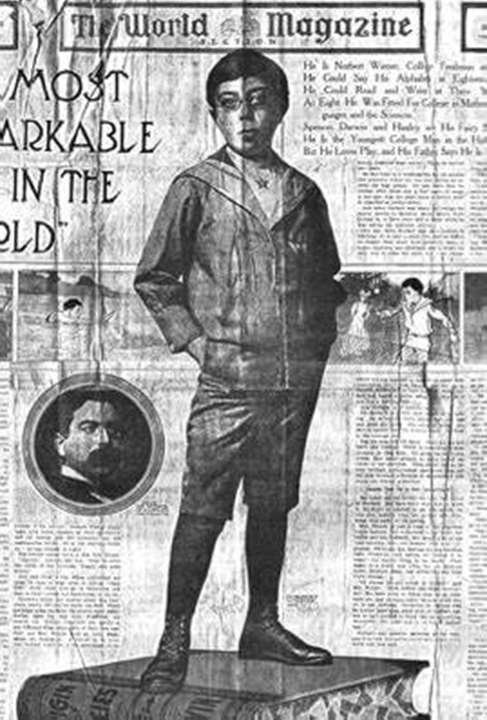
On the Origin of Species is extremely important! I’ll explain below that cybernetics, in a certain sense, comes to a very large extent from evolutionary theory; evolutionary theory is one of the foundations of cybernetics. From university through graduate school, Wiener also studied in an interdisciplinary way: first mathematics, then zoology after mathematics, and then philosophy after zoology. These three disciplines are basically also the three dimensions of Wiener’s thought, the three sides of cybernetics: one is the mathematical part; one is biology and evolutionary theory, neuroscience—that is, the zoological part; and one is the philosophical part. You can see a miniature version of this in his educational background.
So his ultimate degree was actually in philosophy. His philosophical training was also thoroughly orthodox and formal: he studied with Russell, then went to Göttingen, where he studied both mathematics and philosophy, and also had contact with Husserl. Then Wiener’s first teaching position was at Harvard, where he taught philosophy. After that, during the First World War, he began research in ballistics. Later on, he still continued researching philosophy. In 1943, Wiener published a paper in philosophy of science titled “Behavior, Purpose and Teleology,” an essay on teleology. What it sought to elucidate was the behavioral patterns of human animals and machines. In that paper, core cybernetic concepts such as feedback and causal circularity had already appeared.
Wiener then joined forces with von Neumann to organize a team and form a society. At first this society was called the “Teleological Society,” and you can see how strong the philosophical flavor is. After that came the famous Macy Conferences, a series of meetings that began in 1945, in which Wiener was always absolutely central—the spiritual leader and the center of discussion. The final theme of the Macy Conferences was “cybernetics,” but in fact the themes in the first few years were not called cybernetics. In the early years, the title was “Conference on Feedback Mechanisms and Circular Causal Systems in Biological and Social Sciences.” So before the term “cybernetics” was finally settled upon, what were they actually discussing? They were not centering their discussions on information engineering, electronics, or electronic technology. The center of their discussions was first philosophy—the issues of teleology and causality, which are classic questions in philosophy of science. Then there was another center: biology, zoology, plus the social sciences; all of these were written right into the title. So what I just said earlier is that The Human Use of Human Beings, whose subtitle is “Cybernetics and Society,” has this “society” not as an extension of cybernetics, but as the very starting point of cybernetics.
It is not that cybernetics came first and was then extended into philosophy and the social sciences. Quite the opposite: the root of cybernetics lies within the social sciences. Wiener took the cybernetics already present in the social sciences and developed it in reverse into a more comprehensive, more systematic, and more mathematized system. For example, at the Macy Conferences, which scholars participated and which papers were presented? The range was extremely broad. We can look at the conference content: psychology, social science, logic, ethics, linguistics, brain science, and computer science… computer science was only a small part of it. Such a conference—what we now see as very interdisciplinary, encompassing the humanities, the sciences, and the social sciences—was very rare. And all of these fields ultimately converged in Wiener’s thought. That is why we say Wiener really was a prodigy. We often say: who was the “last universal scholar”? Sometimes people mention Poincaré or Hilbert. In my view, Wiener also counts as one of the last universal scholars.
All right, enough gossip—we return to this book. This book is called The Human Use of Human Beings, which is a Chinese title open to discussion.
1.3 The Problem of Translating the Title
This book’s English title is The Human Use of Human Beings:Cybernetics And Society, which even has a bit of rhyme to it, doesn’t it? In Chinese, that flavor just cannot be brought over…
As for this book, actually it was already discussed before on Gaoshan Scientific Classics, which was hosted by Professor Wu Guosheng. After that talk, Professor Wu offered a suggestion: the original Chinese translated title of this book wasn’t very good; it was baffling, and you couldn’t tell what it was talking about. He suggested that we translate it as “Putting People as People” would be better.
I think that’s pretty good. Though it’s a bit of free translation, it actually captures the book’s meaning more accurately. “Putting people as people”—once you hear it, you basically understand. What does it mean to put people as people? It means not to treat people as “non-people.” What does it mean not to “not treat people as people”? In many fields today, people are used without being treated as people—for example, we often say shouzhu 对吧, we’re made to work like oxen and horses. That is, people are treated as oxen, as horses, right; treated as screws, as gears, and now there’s even talk of consumables, mineral resources… None of these are people, right? None of these is treating people as people! So when he says that human beings have human use, or that people should be treated as people, what he really means at the core is: one should properly bring out human value. That, in fact, is one of the spiritual meanings of this book. So in a certain sense, in our present era, this book still has very real significance; we’ll discuss that later.

Earlier I said: don’t treat people like beasts; don’t treat people like screws; don’t treat people like minerals. We didn’t say: don’t treat people like machines. Rather strangely, Wiener wants to treat people as machines—that is, in a certain sense, humans are a special kind of machine, a unique kind of machine. Those are Wiener’s own words! Wiener says: “All communication systems have machines as their terminals, but the ordinary language system has a special kind of machine as its terminal, and this machine is called a human being. Human beings, as terminal machines, have a communication network” (the quotations are mostly from the Chinese translation of The Human Use of Human Beings)
So Wiener says we should treat people as people, but look at the content: how is it that he turns around and treats people as machines? That is a very strange question.
1.4 Two Views of Machines (Philosophical Background)
This question has to be understood through Wiener’s theoretical contribution—cybernetics—which precisely starts from treating human beings as a kind of machine. Indeed, Wiener also thought that human beings are machines, and that humans can be regarded as a special machine, an exceptional machine. But the real question is: what is a machine? In other words, there is nothing wrong in itself with treating human beings as machines; the problem lies with some people’s view of machines. Their understanding of “machine” is too narrow.
When we talk about treating people as machines, we often immediately think of the entire modern mechanical tradition, right? For example, there is a book called L’homme machine, written by La Mettrie. This represents an entire worldview, a conception under the mechanical tradition from Descartes to Newton, with Newtonian mechanics as its emblem. This conception has continued to the present, and now it has taken on some new forms—for example, computationalism and dataism, the idea that human beings are nothing but computers. Of course, these ideas have their reasons. When we say humans are robots, humans are computers, these ideas are all fine—but you have to pay attention to what, exactly, are the characteristics of a machine?

In this book, Wiener actually keeps drawing a distinction between two things: there are two conceptions and two kinds of machines. The first is what we can call the mechanical conception, a more traditional Newtonian mechanical conception; the second is Wiener’s own modern cybernetic view of machines. Correspondingly, there are two kinds of machines: one is a machine that conforms to Newtonian mechanics, such as the Leibniz calculator designed by Leibniz. This kind of machine, and this kind of conception, both have a basic characteristic: the whole world is deterministic, a world full of certainty. The earlier idea that humans are computer programs is, in a certain sense, also meant this way, because it is highly determinate: you give it an initial set of data, and it can produce a definite result. Wiener, by contrast, emphasizes uncertainty. The typical machine that has uncertainty is a learning machine. In fact, the most typical form had not yet been fully built in Wiener’s time; what we see now—artificial intelligence, machine learning, deep learning—has, in a certain sense, already fairly fully realized the learning machine Wiener was talking about. We’ll discuss this later.
These two kinds of machines are very different. The learning machine represents uncertainty; it must adapt to circumstances, continuously interact with the external world, and keep receiving feedback, thereby being able to “grow.” It is not a dead machine sitting there, but a machine that can grow, a machine that learns and grows. With these two conceptions, these two views of machines in mind, let us continue sorting through Wiener’s writings.
1.4.1 A Critique of Preestablished Harmony
I just mentioned Leibniz. He is also frequently brought up in Wiener’s book, often as a somewhat negative figure. Leibniz’s cosmology is very distinctive and very famous, and his calculator was also extremely important in history. Among his cosmological ideas, the one Wiener particularly mentions is monadology.
Of course, Leibniz also shared the mechanical worldview from Descartes to Newton. He pushed the mechanical worldview to its extreme, and that extreme took the form of a very peculiar atomism, called monadology. What does that mean? The basic elements, or indivisible basic units, of this world are “monads.” These monads are “windowless,” which is a fundamental concept in Leibniz’s philosophy. What does “windowless” mean? It means that monads are completely closed; there is in fact no communication between one monad and another—that is, no exchange or transmission. Monads are entirely isolated from one another. But isn’t our world full of connections? I tap here, and over there something moves—how can one say there is absolutely no exchange between them? Leibniz would say: this is called preestablished harmony. What is preestablished harmony? It means that each monad has, internally, a set of—speaking in very plain modern terms—what is almost like a program. Each monad has a program inside it that tells you when you will feel that something has happened. But the operation of this program was all set in place at the very beginning, when God created the world. God wrote the program for every monad, or every person, every human soul. After that, they no longer communicate; they operate according to the established program. For example, there is no communication between Professor Wu and me. Even when we speak face to face, there is actually no communication. But why do I feel that we are communicating? Because our program was already written; from the very beginning, God had already written all those programs, making you feel that, at certain times, communication occurs. That is, at a certain moment I feel that I am communicating with Professor Wu, and at a certain moment Professor Wu feels that she is communicating with me, but in fact we are not communicating at all. It is only because we both feel that communication is happening that the world seems full of connections. This is a very peculiar philosophical theory; I won’t go into his philosophy in detail.
According to Wiener, the calculators invented by Leibniz, including the earlier Pascal calculator and then later mechanical calculators, are all variations on the same theme. This monadology still sounds quite abstruse on the philosophical level, but the machine he actually made gives you an example—his machine is a monad. What does that mean? This machine is a closed machine. Once you input it—just like God creating the world—you enter a datum, and then with a flurry of hand-cranking. I think I’ve mentioned this calculator before when I took part in the Media Domain Reading Club, right? It’s this kind of hand-cranked calculator: say you want to calculate something like n times m, you enter the operation and these two numbers, adjust those gears a bit, and once they’re set you start cranking the calculator, crank crank crank… and with a “click” it stops, and then you can read out the result. You have to crank for quite a while to get the result, but the result was actually determined before you even started cranking. Right? Everyone can understand that this is what is called a “preestablished” result, because the moment you enter the expression into the calculator, what result it will produce has already been decided.
It’s just that it still needs a process to be realized—actually, to be realized by turning the handle with your hand, which takes time. So this is called a preestablished calculator, right? That is to say, after all that hand-cranking, the output result does not change. You don’t get one result if you crank faster, or another result if you crank slower. The result has nothing to do with the cranking process. Throughout the whole process, this calculating machine and the outside world are actually not exchanging information; there is no communication. It is merely completing the task of displaying a result that was already there.
So the windowless monad and this closed, sealed calculator have some basic things in common. The first is determinacy. It does not face uncertainty; it does not face probability. Its result is preestablished. Of course, “preestablished harmony” is the term often used in philosophy when translating monadology. In this book’s translation, it is rendered as “predetermined harmony”—pretty much the same meaning: the result was already predetermined beforehand.
How does Wiener comment on this? He says that “Leibniz took the consistency of clocks adjusted to show the same time at the same moment as a model of the predestined harmony of monads.” Under this worldview, under this mechanical view, Wiener gives a metaphor: the movements of the little figures dancing on a music box. They move according to this pattern, a pattern that was arranged in advance. And this music box, apart from being wound up by you so that it can move, shows no trace of communication with the outside world; those little figures are “both deaf and mute.”

1.4.2 Mastering Contingency
Just now we said that humans are machines, and Wiener also says that humans are machines, but Wiener certainly wants to emphasize that human beings are not this kind of machine, right? We absolutely must not think of people as this kind of music-box little-figure machine. This kind of machine is the picture produced by Leibniz’s mechanical view—that human beings are completely predetermined, and that those things which appear so rich, bouncing around and dancing and singing, are in fact all just carrying out trajectories that were already predetermined long ago. From the moment this universe was first set up, everything had already been decided. So what Wiener emphasizes is: “We must never imagine the music box as the typical example of all machine behavior.” A music box is not the typical machine.
There is a difference here at the level of cosmology, or a basic philosophical and ontological difference—that is, what is the world essentially like? Under the worldview of Newton, Leibniz, and their ilk, the universe is deterministic. As we said earlier, it is preestablished, predetermined; as long as you know the initial conditions, there are no surprises. This idea is precisely what Wiener is trying to oppose. That is why, in the preface to The Human Use of Human Beings, the subtitle is “A New View of Contingency.” So we can see that the whole of Wiener’s philosophy, or the whole of Wiener’s cybernetics, is founded on overturning the Newtonian worldview and establishing a new worldview filled with contingency.
He begins by saying, “Newtonian physics had ruled from the late seventeenth century to the end of the nineteenth century, with scarcely a dissenting voice. The universe it described was one in which all things occurred precisely according to laws; it was a universe finely and rigorously organized, in which all future events strictly depended on all past events…… Now, this view no longer holds the dominant position in physics, and the people who have done the most to overthrow it are the German Boltzmann and the American Gibbs.”
Newtonian physics ruled from the late seventeenth century through the nineteenth century, with almost no opposition, but now this physics has been overturned. The hallmark of Newtonian physics is that all future events are strictly dependent on the totality of past events—a deterministic world. Of course, what Wiener emphasizes is actually the contribution of statistical mechanics, namely Boltzmann and the American Gibbs; he was especially enthusiastic about Americans, and he speaks a bit more about Gibbs. Boltzmann and Gibbs made some very important advances in statistical mechanics. However, when Wiener was writing this, the science of chaos and complexity that we will talk about later had not yet become popular; later, as chaos science and complexity science gradually became popular, they actually continued to confirm Wiener’s judgment. Wiener also mentions some other fields, including quantum mechanics—quantum mechanics, too, replaces determinism with contingency and probability, both ontologically and in its cosmology. So Wiener develops his cybernetics, or rather his information science, from the standpoint of contingency. Then what is one basic thing that his information science needs to do?
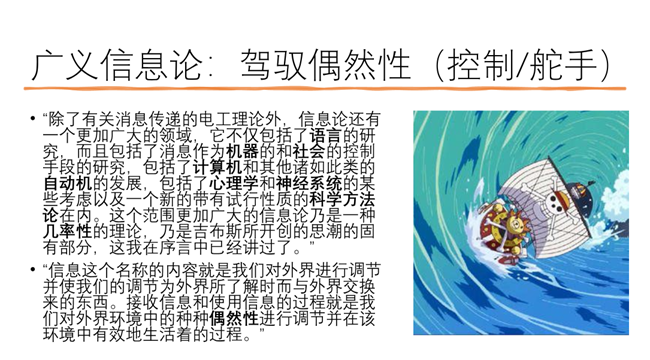
It is to master contingency. In a sense, the revised edition of his Cybernetics: Or Control and Communication in the Animal and the Machine was published in 1954, by which time Shannon’s information theory had already appeared. Wiener gladly accepted it; he did not say anything like Shannon stole my idea or anything of the sort. But he wanted to stress that information theory is not limited to electronic science, not limited to electrical engineering theory. After Wiener, information theory was in fact often narrowed; it increasingly became just information technology, and information science became a matter of electronics and engineering. Returning to Wiener, he emphasized that information theory is not a question of electronic technology, but mainly a much broader field. This field includes the study of language, the study of machine and social means of control, and the study of computers, automata, psychology, the nervous system, methodology of science, and so on. All of these should be included within information theory and information science. And the central core idea is that information theory is meant to solve a probabilistic theory—that is, the problem of probability and contingency. Later he asks what information actually is. Information, in Shannon’s case, is also defined by entropy, and in Wiener’s case as well. The difference is that Wiener stresses its contingency more strongly: “The process of receiving and using information is the process of our adjusting to the contingencies of the outer environment and of our effective living in that environment.”
So what problem is information science trying to solve? The problem it solves is that the world is contingent, right? We have already talked about the switching of worldviews above, but we cannot go into it in too much depth. Let us first simply accept that the worldview has already shifted, that Newton has become outdated, and that we now have a new worldview of contingency. But the worldview of contingency is by no means a nihilistic one—oh, the world is so unpredictable, then let’s not bother with anything, since nothing is fixed anyway, right? Not like that. This world is full of contingency, and precisely because of that, it needs science even more in order to respond to it. What is science for? Science is for “mastering contingency.”
What does it mean to master contingency? A typical example is navigation. In seas where wind and waves are unpredictable and the weather changes in an instant. If you want to steer a ship, what must you do? What you do is certainly not something like this: before departure, I have already written out the program, and everything is fixed—at what hour and minute to turn left, at what hour and minute to turn right. That is not it. You have to observe in real time. What do you do when the wind rises? What do you do when big waves come? So you must constantly observe the changes in this world of unpredictable weather, interact with it in real time, and continuously receive feedback.
So the term “cybernetics” that Wiener coined is actually, by borrowing the Greek word for the helmsman, the one who holds the rudder, the invention of the word cybernetics—it is in fact a core metaphor: control means to steer. Steer what? Precisely because the world is contingent, because the world is unpredictable. So let us return to the two worldviews and the two models of machines I mentioned earlier.
Back to the two machines and two worldviews. One is monadology, the other is Wiener’s cybernetics—cybernetics is about mastering contingency. Monadology is something predetermined and closed. So what the monadology, or mechanism, or the cosmology it represents means is that God has input the first push, and after that it is closed; then the whole world is closed, an absolutely determinate thing. Under the guidance of such a conception, what kind of machine is produced? For example, a mechanical clock—how does this clock run? It runs completely by its own internal rhythm; through an escapement mechanism, it has to eliminate external contingency. Then there is the calculator, Leibniz’s hand-cranked calculator, and the music box, right? These are typical closed machines: once you input one thing in a single direction, it operates in a closed loop. Its result is also predetermined in advance.
And under this “windowed,” or rather cybernetic, perspective, what is a living being, or a human being, like? One very important point is that human beings have senses. Wiener emphasizes very strongly that saying human beings are machines does not mean that human beings have no senses. Earlier mechanists completely belittled human senses and human emotions, thinking that the essence of human beings is rational and logical, and paying relatively more attention to these things. But Wiener would emphasize that one very important thing about human beings is that they have senses. But this does not mean that human beings are not machines, because machines should also have senses, and having senses is extremely important.
What are the senses for? The senses are the “window” of the monad—it is not a monad; it is interconnected with the outside world. It must interact with the outside world in two directions in real time. Then, on the basis of this interaction, it dynamically changes its own interior; that is, its interior must keep changing as the external environment changes, while the external environment also changes according to your actions, your interaction with the outside world. You are changing the environment, and the environment is changing you. This is the characteristic of human beings, or rather the characteristic of life in general. Life in general also includes life in the broad sense, broadly understood organisms—such as a society, a community, a nation, a group. These too are organisms in the broad sense; they must necessarily have a process of interaction with the outside world.
And under such a conception, what kind of machine is manufactured? Machines made in this way also have senses, so he says that modern automata have senses; they must interact bidirectionally with the outside world, and they must also change dynamically. This is Wiener’s own wording: “The older machines…… in fact were built on the basis of the closed-type clock. But modern automatic machines, such as guided missiles…… are equipped with sense organs, that is, receivers for receiving messages from the external world.” In this sense, life and machines are exactly the same: “The physiological functioning of the living individual and the operation of some of the newer communication machines are completely comparable in their similar attempt to control entropy through feedback.”
1.5 From Machine View to Life View (Zoological Background)
1.5.1 Heredity and Adaptation
At this point, we can actually see that Wiener has always been moving back and forth between two questions: “What is life?” and “What is a machine?” In the end, he finds that the two sides are consistent: what kind of view of life corresponds to what kind of view of the machine. So let us return to the question of the view of life. The establishment of the modern view of life, to a large extent, still requires us to talk about Darwinism.
The Origin of Species that the six-year-old Wiener had literally stepped underfoot, indeed Wiener had digested it thoroughly. He asks: what is the core of Darwin? What exactly was Darwin’s contribution?
Wiener says: “From Malthus to Darwin, the line of intellectual succession is clear. Darwin’s great innovation in evolutionary theory was to recognize that evolution is not a Lamarckian process of spontaneous ascent from higher to higher, better to better, but rather a phenomenon in which living organisms exhibit: (a) a spontaneous tendency toward development in many directions and (b) a tendency to preserve the pattern of their ancestors. The combination of these two effects has swept away the hodgepodge of developments in nature and, through the process of ‘natural selection,’ eliminated those organisms unable to adapt to their surroundings. What this elimination leaves behind is the residual pattern of life forms that are in some measure adapted to their environment. In Darwin’s view, this residual pattern is the manifestation of universal teleology.”
What was Darwin’s great innovation in evolutionary theory? Unlike Lamarck’s one-way process of advance, the first characteristic of Darwin’s theory of evolution is blindness, that is, a spontaneous tendency toward development in many directions. Dawkins also has a book called The Blind Watchmaker, meaning that the evolution of living organisms has no definite purpose; it is diverse, and its heredity is random. This probability—what we talked about earlier as contingency and indeterminacy—appears right here: life has no definite direction of development, and the development of life is not spontaneous; it is determined only gradually through interaction with the environment.
Another point is that life has memory—that is, heredity; it is the tendency to preserve the pattern of one’s ancestors. In other words, on the one hand it has a certain degree of determinacy, a certain degree of determinacy in hereditary memory, but this preservation is not a rigid, unchanged preservation. There is probability-based mutation, right? I won’t introduce Darwin in detail; everyone is familiar with him. There are mutations, and then after mutation one adapts to the environment—that is, one must continuously interact with the environment, and different mutations will interact differently with the environment. In the end, one sees which kind of interaction is most suited to the environment, while other mutation patterns that are not suited to the environment are eliminated, right? Survival of the fittest, that is. This is what I call the “residual pattern”: what remains is the best of what can remain. But there is no absolute yardstick for “best”; rather, the standard is constantly dynamic and relative, because the environment is constantly changing.
So the key points are “randomness” and “memory.” And through continuous random splitting and random exploration, memory is continuously revised; external environment, in turn, revises memory. So, in a sense, Darwin’s contribution was to discover the mechanism of “two-way communication” between organisms, populations, species, and the environment—that is Wiener’s understanding of Darwin. So within this, there is such a process; in a sense, this process is the process of learning. But for ordinary species, it requires several generations, countless generations, generation after generation of genetic transmission in order to “learn.” So The Origin of Species is talking about species learning—not individual species learning, but the species as a whole. Through continuous accumulation and continuous feedback, it learns to adapt to the environment and grow.
1.5.2 Learning Is Feedback

But for human beings, human beings are a unique kind of animal; this unique characteristic of human beings is actually learning. And the mechanism Wiener wants to emphasize—this cybernetic mechanism of two-way interaction—is the mechanism of feedback. Feedback falls into two kinds: some feedback is simple feedback, and some feedback is complex feedback.
What, then, is simple feedback? Simple feedback is nothing more than taking some simple, relatively crude data from the environment, feeding it back, absorbing it, and incorporating it into the next solution. It is some kind of recursion, or rather iteration. Simple iterations—for example, the Fibonacci sequence—can also be called a feedback mechanism: you take the result of an addition and put it back into one of the addends, then continue adding. That is a kind of feedback. But this kind of feedback is not called learning; it is still something even a music box can do. So what is complex feedback? It means that what comes back is not merely raw data, but information capable of adjusting a pattern. This information has to make adjustments to the basic pattern; the music box, for instance, would have to keep adjusting its entire internal structure, its entire form, through the feedback process. It is dynamic. Only then can it be called a process of learning. Such a process is also a capacity developed in the course of interacting with an environment full of uncertainty. That is, I interact with the environment in a certain way, and after receiving feedback, I change the strategy of my interaction itself according to that feedback. This strategy itself has to change; that is, your inner state changes, and then you interact again, receive feedback further, and keep distinguishing, among different feedbacks, what the best strategy is. Find the best strategy, and then promote it—this is one mode of evolution.1.5.3 The Difference Between Humans and Animals
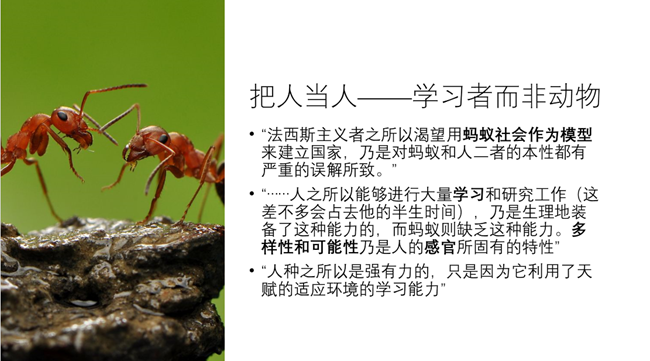
1.6 Asking Further for the Ideal Society
1.6.1 A Society of Learning
A society that treats humans as human must necessarily be a society of learning. We said earlier that Wiener’s thought keeps jumping back and forth between biology and machines, right? That is, seeing what machines are like, and asking how we should regard living beings; and seeing what living beings are like, and asking how we should regard machines. Now we see that, for human beings, learning is a very important part of human nature. So, conversely, what should machines be like? Machines should also be learning machines—a typical machine should not be a music box; a music box does not learn. Yes, a good machine must be able to learn. What kind of machine is that? “The concept of the residual pattern was reintroduced in the work of Dr. Ashby. He used it to explain the learning of machines. …… In Ashby’s machine, as in Darwin’s natural world, we see purposiveness in a system not intentionally constructed,”—Wiener credits Ashby with the idea of machine learning. I am not very familiar with this person either, but in any case, machine learning is like Darwin’s way of animals adapting to nature: one sees purposiveness emerging within a system not built out of purpose. This emphasizes the emergence of purpose. Similar to Darwin’s theory of evolution, which is itself blind, purposeless, and adapted to contingency, within the adaptation to contingency there emerges a kind of purpose, as if each species occupies its own place, its own ecological niche, and finds its own pattern. So the emergence of purpose within purposelessness is an insight in the Darwinian developmental process. Wiener says that to design a learning machine means, too, to make purposiveness emerge within purposelessness. This was, in fact, extremely forward-looking. We know that the reason this wave of artificial intelligence has become popular now is basically deep learning, right? What is deep learning? In fact, it is exactly Wiener’s idea—completely the same: applying Darwinian evolution to machine learning. That is, train it; let it operate randomly, tweak the parameters, and let it run. After the results come out, see which one is better, and then feed that back, saying that the parameters should be adjusted further and corrected further. So present-day machine learning is basically about how to face contingency: random mutation plus a feedback mechanism. Feedback is necessary, so that the best mutation can be preserved, and further mutation can proceed on the basis of that good mutation. That is the mechanism of machine learning. So these ideas of machine learning had already been clearly pointed out in Wiener’s work, and in that sense later artificial intelligence took a long detour for a very long time, following the route of logicism—that is, still a path of pre-established harmony, or preordained harmony, right? In fact, when we now look back at neural networks and deep learning, we see a return to cybernetics. “Certain kinds of machines and certain living beings, especially the more advanced ones, can alter their modes of behavior on the basis of past experience…… In other words, organisms are not, like Leibnizian clockwork monads, in pre-established harmony with the universe; rather, they seek new equilibria with the universe and with its future contingencies, according to actual circumstances…… Learning, like simpler forms of feedback, is also a process that looks differently from the future toward the past and from the past toward the future. The whole concept of the apparently purposive organism, whether that concept be mechanical, biological, or social, is a flying arrow with a specific direction in the stream of time……” This kind of “learning” pattern is universal. In mechanics, biology, and social science, there is actually the same kind of pattern, and this pattern is irreversible—irreversible in the flow of time. What does that mean? We say that in Newton’s worldview, there is actually no direction of time. In Newton’s worldview, moving forward in time and moving backward in time are exactly the same, right? For example, if a rigid body is rotating clockwise, then if you reverse time and play it backward, it simply becomes counterclockwise, right? It is exactly the same; the laws of physics, the patterns of motion, and so on are all exactly the same. Precisely because of this deterministic mechanism, it is something like pre-established harmony, because the whole thing is static. According to Newtonian mechanics, the whole world becomes a “four-dimensional manifold”; this four-dimensional manifold has already been determined from antiquity to the present, because antiquity and the present are nothing but a reversible time parameter. This worldview was overturned by the key introduction of the concept of entropy. Entropy represents an irreversible direction. What Wiener wants to emphasize is that we must adapt to such an irreversible direction. Why irreversible? Because both contingency and learning are irreversible directions. When you look at it in the forward direction, it is a process of constantly facing contingency, constantly learning, constantly solidifying. But when you look at it in reverse, it becomes forgetting. Learning and forgetting are not inverse to each other, are they? Clockwise rotation and counterclockwise rotation are inverse to each other; the law is exactly the same. But the law of learning, when played back in reverse time, is irreversible. So we must acknowledge the contingency of the world, acknowledge the temporality of the world, acknowledge the irreversibility of time. Then we must emphasize that all things—including machinery, machines, living beings, and society—must adapt to change and must govern this world full of contingency. Then we need to learn. So Wiener’s development of the concept of machine learning was extremely advanced and very far-sighted.1.6.2 The Necessity of the Feedback Mechanism
We said earlier that humans are human, and human nature is to learn. The ideal for machines is to learn; society also needs to learn. So Wiener’s ideals regarding social politics, his social vision, are also that our society needs to learn, politics also needs to change, and a society that does not respect change is a despotic society. What is a despotic society? For example, the fascist society mentioned earlier. It should be noted that a despotic society is not necessarily even a fascist society; even the modern American society Wiener speaks of may also be a despotic society. In Wiener’s view, American society, though it publicly champions democracy, is in fact despotic in many domains. For example, factories and enterprises are all governed in a despotic way. And what is the characteristic of democracy? It is uncertainty. Rich, diverse, and indeterminate forms are democratic. And what is despotism? Despotism is as if it can control everything in advance and decide everything in advance. That is why despotic development will inevitably involve things like planned economy and similar modes of operation: it tries to determine everything beforehand, to place all things in advance on a fixed social track assigned to them, right? Wiener says: “But this democracy, with its many restrictions and its indeterminate forms, is still considered by many people who take efficiency as the highest ideal to be too anarchic. These worshipers of efficiency like to have every person, from childhood on, function on the appointed social track, carrying out the social function that binds him as slaves are bound to the soil. In the social landscape of the United States there are these tendencies, there is this denial of the opportunities contained in an unknown future, and that is shameful. …… The businessman surrounds himself with a pack of obedient people, thereby isolating himself and his employees from one another; or the head of a large research institute assigns each subordinate a research topic, but gives him no right to independent thought…… The orderly state they long for, in which everyone’s social function is pre-assigned, calls to mind Leibniz’s automaton, which, in its approach to a future of contingency, would not provide irreversible activity, though such activity is the true condition of human life.” The target of criticism in this passage is not fascism, but America. That is to say, for many Americans, their supposed love of democracy is actually like Ye Gong’s love of dragons—they only talk about loving democracy, but in fact they prefer despotism. Why? Because they all like “efficiency,” efficiency above all. What does efficiency above all look like? It means arranging each person in the position that suits them best, and then, like an assembly line, once you sit in that position, you do not move, right? You just carry on step by step, mechanically, doing your own thing, operating along a fixed track, turning the whole society into an assembly-line factory. That way efficiency is highest and certainty is greatest, right? What each person does, what each person produces, is all within a predetermined social track. So, they are bound like slaves and assigned a predetermined social function. Thus there are certain tendencies on the American social landscape—namely, a denial of the unknown future and of the various chances opened up by contingency; they fear uncertainty. Wiener says this is shameful. He says the same is true of businessmen, the same is true of the leaders of large research institutes, the same is true of the academic oligarchy, the same is true of specialization: everyone is assigned a theme, and they go off to research the predesignated topic they aspire to. So he mentions Leibniz again: “It is reminiscent of Leibniz’s automaton, which, when moving toward a future of contingency, does not offer irreversible activity, and yet such activity is the true condition of human life.” That is to say, American politics and fascist politics are six of one and half a dozen of the other: neither truly embraces uncertainty, neither truly embraces chance or possibility. So how, then, do we embrace this possibility, how do we master possibility? Society must learn as well. What society must first learn is this: we have to admit that progress is a myth. We must break the myth of progress, break the superstition of progress. Wiener is criticizing many earlier people, especially Americans, for their superstition of progress. What is this superstition of progress really a superstition of? In fact, it is a superstition in the intrinsic logic of technology itself. They think that once you set technology free, technology will develop on its own, like Moore’s law: it seems capable of advancing step by step, developing step by step, gradually becoming advanced according to its own pace (what humans need to do is merely, so to speak, wind up the music box or crank the calculator by hand with all their might, just pushing forward the predetermined pace of technology). Americans trust this model of technology itself, so they do not think about their own responsibility, they do not think about feedback; they are simply superstitious about progress: set technology free, then expand its power, and that’s the end of it. Everything is also one-way, not receiving feedback—for example, “conquering nature” and destroying the environment. What is wrong with being single-minded about conquering nature? In fact, it is that one has not considered the feedback from the environment; we only consider how we will unilaterally transform it. A despotic society likewise does not consider feedback: it is one-way, issuing orders from the top down, and it cannot hear the feedback of the people. So this is a society that does not learn, a Leibnizian society. As for the society in Wiener’s ideal, it is one that admits uncertainty. First of all, it cannot be superstitious about progress; it recognizes that progress has limits, that the future is diversified and uncertain. So what we must rely on is not some plan already decided in advance, nor some norm already predetermined. We cannot rely entirely on these predesigned things; rather, we must continually receive feedback, and this feedback mechanism is the most important thing. What is called a feedback mechanism is precisely the continual discovery of changes in the environment, allowing those changes to continuously influence our policies and our ideas. Wiener then says: in our age—that is, in Wiener’s own age—one extremely important thing is that our environment has been completely, enormously transformed, but our society has not yet caught on. This is the biggest problem. “We have so thoroughly transformed our environment that we must now transform ourselves in order to survive in this new environment; we can no longer survive in the old environment.” So the old environment, the old traditions, all need to be rethought and changed. Here Wiener is still focusing on criticizing America, because he himself is American, and Americans of course should criticize America. Many old American ideas still seemed to Wiener to be highly problematic. So what is the American tradition? Wiener says it is that “everything can be bought and sold,” meaning everything is measured by market price, a superstition of the market, a superstition of price. He says: “In the American environment of life, all questions of information are evaluated according to the standard American view: the value of a thing lies in the way it enters the open market as a commodity. This is the official orthodoxy, … In the typical American world, the destiny of information becomes something that can be bought and sold.” The idea that everything can be bought and sold is not exactly wrong, but it is a characteristic of an older era—it was still applicable in the industrial age. This American value system is best suited to analyzing trade in industrial products; those industrial products are of course commodities, right? The wool sweaters produced on an industrial assembly line, these things are of course commodities, and the mines and resources can also be bought and sold. So this notion that everything can be bought and sold is suited to the industrial age, or rather, to the First Industrial Revolution. In Wiener’s view, by the new age, by the information age, under a new environment, this idea of regarding everything as something that can be bought and sold should already be obsolete and should receive new adjustment. Why? Because information is not a commodity. Information is not something produced on a factory assembly line. He says, “Information and entropy are neither conserved, and are equally unsuited to being treated as commodities.” Because if something is simply sitting there, it is still “one,” whereas a piece of information can be copied; it is a piece of information and can be shared again and again. Wiener gave a typical example: a work of art. He said the value of a work of art cannot be measured in money. The value of a loaf of bread can be nearly equivalent to its commodity value; you can look at how much it sold for in the market and say that the value of that loaf of bread is probably five yuan, or perhaps ten yuan. But a painting is different. How much is its value? We seem able to measure it now too—for instance, this work fetched 40,000, 4 million, 40 million at auction—but the auction price does not measure the value of the artwork, does it? Why not? Because when you are looking at a work of art, when you are appreciating it in a museum, you are not spending money! You spend not a penny, yet you go into the museum and stand before the artwork; when you appreciate the artwork, its value is already on display. Right? The value of the artwork is most fully revealed precisely when you appreciate it in the museum without spending a penny. By contrast, if you spend 40 million to buy the painting and then hide it away in your home or cellar, where no one can see it, then the value of that artwork is precisely not being revealed. So that 40 million is not the value of the artwork. Where, then, does the value of a work of art lie? It lies in its publicity, in its ability to be seen by more people! And the way more people can see it is through reproducible information! Put it in a museum and you can let 10,000 people see it; put it on the internet and you can let 1 million people see it, right? And this is difficult to quantify; it is impossible to measure the value of a work of art by the method used to measure commodities. In the information age, in the world of information, what matters more are those creations. Things created and disseminated in the world of information, things on the internet, can no longer be measured by the same means used to measure the circulation of commodities in the commodity market. Because those things are substantively entirely different from bread and sweaters and the like; they are reproducible. So in that informational world, in Wiener’s view, “in a world in constant flux, the idea that one can store information and yet prevent it from suffering serious depreciation is absurd.” Even traditionally, one might still say that if you cache away a painting, perhaps twenty years later I can take it out and look at it, and it will have appreciated in value. But in the internet age, one increasingly cannot think that way. I lock up the information, I keep it secret, I leave it on my computer, not letting anyone see it, and I think that makes it valuable. Wiener says your measure is wrong; the value of information should not be measured that way. So he emphasizes very strongly that the old system, including the centralized assembly-line system mentioned earlier, was suited to the steam engine revolution. The steam engine is a large machine; using a steam engine can improve efficiency, but steam engines are not suitable for small workshops, they are suited to centralized use. So in order to adapt to this technological medium of the steam engine, to adapt to this new technology, we have no choice but to attach ourselves to centralization, to the despotic factory system. But times have changed. What is the dominant technology of this era now? It is information technology. To adapt to information technology, we need to make adjustments. We cannot continue to adapt to information technology in the same way we adapted to the steam engine. So Wiener strongly emphasizes a system of free sharing; he believes that mechanisms of freedom and sharing are more suited to information technology. So if Wiener were alive today, he would surely be a supporter of the open-source movement, right? ### 1.6.3 Recognizing the Position of the Machine We said earlier: do not treat human beings as inhuman; we must treat humans as human. One key point here is that we must properly regard the machine. Since human beings are a unique kind of machine, if you do not properly recognize the position of machines and put machines in their right place, then by the same token you will also be unable to put human beings in their right place. Wiener would criticize a typical tendency: that is, to treat machines as a mere kind of slave. What is a slave? A slave is something that can be bought and sold, as in the idea based on buying and selling discussed earlier. My slave is a commodity; he is not a person, he is not a subject, he is a commodity. The value of a slave lies in the labor power he can sell, right? You buy this slave, which is equivalent to paying a lump sum and then buying a steady stream of labor power, right? That is the logic. In Wiener’s view, we now seem to have a tendency to treat machines, especially automatic machines, as slaves. But Wiener says: “Let us remember that whatever view we take of the emotional question concerning automata, economically it is entirely equivalent to the labor of slaves. …” — you see, this is very forward-looking, right? He thinks that first of all, whether we discuss whether machines have feelings is a worthwhile topic, but it is not the most important one. Whether or not it has feelings, how do you treat it economically? That is what matters. The labor of machines is economically entirely equivalent to the labor of slaves. This belongs to a mode of “treating as,” but not the mode Wiener advocates. If you treat it as a slave, then, Wiener goes on, “any labor competing with slave labor must accept the economic conditions of slave labor.” What does that mean? It means that when you treat machines as slaves, you will discover what human beings are being treated as. Because machines are doing human work, machines are competing with humans for jobs, right? We now already see machines constantly competing with humans for jobs. If you treat machines as slaves, then what is the person who competes with slaves for work? What is the person who cannot even outcompete slaves in the competition for work? Wouldn’t that person become a slave to slaves? Wouldn’t he be inferior even to slaves? If you measure the value of machines simply by the standard of slavery, then would not labor that is even less valuable than machines, human beings who are even less valuable than machines, end up becoming slaves to slaves? Wouldn’t you then be cheaper than slaves? So whether or not machines have feelings, treating machines as slaves is bad, or rather, dangerous. I excerpted a passage from the preface to Cybernetics: “Machines will need to … demand that we understand them as we understand human beings. Otherwise we shall become their slaves.” In light of what was said earlier, this passage does not mean that machines will surely awaken self-awareness and then in turn enslave human beings; it is not only that. Wiener saw that even if machines have no feelings, even if machines have not awakened into self-aware individuals like human beings, they can still enslave human beings, because if your system itself is built on the notion that both humans and machines are commodities to be bought and sold, both are sellers of labor power, if both humans and machines are treated in the manner of labor power, then ultimately, if we look at the problem within such a social system and such an economic system, the conclusion must be that humans are the slaves of machines, that humans are working for machines. In fact, in some sense this has already become the case. When we speak of “the person in the system,” isn’t that exactly it? Those Meituan couriers are working for that “system,” in a certain sense that is exactly what is happening. This is not to say that Meituan’s delivery system has already awakened self-awareness. Even before it has decided on self-awareness, you are already working for it, already serving it as a slave, right? This is the sort of danger Wiener saw. So Wiener emphasizes that to treat humans as human has another important point: only humans can be responsible for their own actions; machines cannot bear responsibility. No matter how intelligent those machines are, no matter how cybernetic and feedback-driven they may be, they still cannot replace the human characteristic of being responsible, so one cannot shift one’s own responsibility onto machines! So when he talks about machines, he also says that he is talking about humans; humans, too, cannot shirk responsibility onto one another. Human beings must assume responsibility as individual beings, as independent individuals. All right, my introductory reading ends here for today, because this book is indeed very rich, so I have only given a simple introduction; there are many omissions, and everyone is welcome to correct me! Many thanks!
1.7.1 Can machines be held responsible?
Wu Jingwei: Just now Professor Hu used a very clear and concise line of thought to introduce us to Wiener’s entire cybernetics, especially making a striking comparison with Leibniz’s mechanistic view, and specifically highlighting how important such a feedback and learning mechanism is. This mechanism is precisely the characteristic of a cybernetic machine, or of society in such a cybernetic context. What everyone actually sees in Wiener’s overall perspective is not merely the machines we have been talking about; he also brings into consideration the kind of system, or rather society, in which human beings live, thinking about cybernetics as such an integrated question. Including the statement that left the deepest impression on me, which Professor Hu also just specially explained: Wiener’s cybernetics does not come from machines; it already exists in the mechanisms of social operation itself.
So I believe today we will have many such reflections, especially in the context of the ChatGPT era today, or in the process of transition from weak AI to strong AI. To think again about machines, including the question of whether machines will replace such labor, is of great significance. And many of Wiener’s ideas, as Professor Hu said, were ahead of their time. Although he was living in that society of the 1950s and 1960s, he had in fact already resonated with the overall development and trend of technology after the 1970s and 1980s. I believe everyone also has many questions. I myself, after listening to Professor Hu and reading the book, also have some questions, so let me first exercise the right of the moderator. I myself am very fond of Wiener’s cybernetics, so when reading it I also had many thoughts. Could we first have a discussion with Professor Hu, and then afterward we will hand the floor over to everyone for questions?
Just now Professor Hu actually mentioned that both machines and humans have senses. Human beings are animals with senses. At this point it makes us think of the present: within such intelligent systems, one very important and highly relied-upon technology is the sensing system, including the internet today, and including what we call artificial intelligence in the future. A very important issue is in fact the need to construct a machine’s sensory system to replace the human sensory system, or even, like Musk, to implant so-called chips into the human brain and carry out a combination of brain and machine. In this process today, what we actually see is that since humans and machines both possess this sensory function, does the future mean that, if we follow this logic, humans and machines can in fact become indistinguishable? Even after the advent of the cyborg, the human senses and the mechanical senses cannot be told apart; then where exactly lies the essential difference between humans and technology, or between humans and machines?
Hu Yilin: I think that according to Wiener’s final formulation, it ultimately comes down to the question of responsibility. That is to say, a machine can have senses, or can make some decisions, but the machine’s decisions are still decisions entrusted to it by humans. When you entrust an Other to make decisions, that Other does not necessarily have to be a machine, right? The Other can be another person, or it can be a machine. But you can entrust the Other in the sense that: this matter I leave to you to judge; help me do this thing.
But you can entrust a task to it; you cannot entrust all of your responsibility to it. That is, when it botches things, you, as the one who entrusted it, need to be responsible; you also need to bear the responsibility. So, the point is this: a machine can serve as the entrusted party, but a machine cannot serve as the entrusting party. As the entrusted party, it means it cannot shoulder the responsibility of initiating something at a fundamental level. Only human beings can shoulder that responsibility.
(At least in the short term) machines and human beings cannot possibly be exactly the same. Why is that? Because machines are reproducible, or rather, their reproducibility is extremely strong. For example, suppose there is such a machine, a digital Musk or a digital whoever. Once you have one, you can have two; once you have two, you can have four, then infinitely many. And every time it carries out its calculations, it is also constantly splitting itself, constantly receiving feedback, and can at any moment be cut apart, right? So in this way, it is very difficult for a machine to be held responsible. Which version, exactly, is to take responsibility? Right?
For instance, if I ask a person to be responsible, we can execute this person, or sentence them to twenty years in prison, right? But what about a machine? If you “execute” a program, it can immediately be copied, and its mirror image or backup restored. If I lock up this artificial intelligence, there are still backups elsewhere. So these things are not easy to make equivalent for humans and for machines. A certain internet joke, I think, has some validity: AI cannot go to prison.
Another very important point is that human beings still have to step forward and take responsibility. In all the processes of using machines, the one who ultimately remains responsible is still human beings.
Wu Jingwei: Actually, just now you mentioned that because it is a problem of replication, and because it has such a mechanism of learning and feedback, this process is in fact irreversible and always moving forward. So does that mean that, because of such a feedback mechanism, the ability to learn will become stronger and stronger, and since technology is constantly advancing, is there a possibility—although the starting point is human control over machines—that if we speak in terms of the evolution of machine autonomy, machines might also, through constant self-improvement, become highly adapted to their environment, and increasingly develop an autonomy of self-circulation and self-optimization?
Hu Yilin: From Wiener’s point of view, that may also be part of the superstition of progress. That is, Wiener emphasizes learning through continuous feedback, but he never says that the capacity for learning is infinite. For example, as human beings, we all know that the capacity to learn is very limited. My own learning capacity is much weaker now than it was thirty years ago, right? When we were young, our learning capacity was very strong, wasn’t it? Whether it was a brand-new phone placed in front of us or a new language, children can pick it up very easily. Now we are not so good at it. Perhaps thirty years from now we too will have become old relics. So this learning capacity declines; it is not necessarily something that will keep getting stronger.
The same goes for machines. A machine’s adaptation may also run into a dead end. For example, although it is constantly receiving feedback, along the way it may go through a vicious circle, or a closed loop, from which it cannot break out. It may very well go down a blind alley. We cannot be superstitious about machines, just as we cannot be superstitious about human beings, right? In this respect, human beings and machines are still the same. You cannot say, ah, look how capable this person is, this is our wise leader, so let us hand everything over to him—that won’t do. That person can go bad, you know. Perhaps he really was wise before, but after he seized power, a few years later he may become corrupt. So we cannot pin everything on a strongman. Likewise, we cannot pin everything on machines either, nor place our hopes on machines inevitably developing in a good direction. So we also need real-time interaction, and that interaction is plural: interaction between humans and machines, between different machines, between different people, all constantly interacting and feeding back into one another. You cannot expect everything to automatically develop in a good direction.
Wu Jingwei: Thank you very much, Professor Hu. Today, of course, there is a bit of regret here on site. Originally, we could have gone to the place where Wiener once worked—the old building that used to belong to the former Department of Electrical Engineering before the School of Journalism and Communication at Tsinghua University. Wiener’s office was originally on the third floor. Unfortunately, it is all under renovation now, and the third floor has already been dismantled to the point of being completely different from before, so today we can only livestream from another location. That leaves us with a small regret. Once the building has been restored, everyone can go to that site. Since today we have a combination of online and offline participation, we also have an audience present here, and we have all of you online as well. Let’s see whether there are any related questions. Let’s give priority to the audience on site first!
1.7.2 Is interactive feedback harmony possible?
Feng Guangneng: Today’s criticism is built on Leibniz’s concept of “pre-established harmony.” But in fact, what Professor Hu is mainly criticizing is the pre-established part, not the harmony. Leibniz’s thought itself is also quite complex. In fact, our society always seeks harmony. That is to say, in the process whereby people continuously interact with their environment, continuously exchange information in a complex environment, and learn through feedback, there may be no purpose at first. But Professor Hu also said that under such complex circumstances, a kind of purposiveness may eventually emerge. In such a context, what I am most concerned about is harmony: is it possible? How is it possible? Or should we say that harmony is not necessarily the best goal of society; even so, as human beings, we ultimately still have social ideals.
Hu Yilin: Yes, but Leibniz’s harmony is a false harmony. What sort of harmony is Leibniz’s harmony? It merely sounds harmonious. For example, like a music box: inside a music box there can be several musical pieces, right? For instance, one is the piano, one is the violin, one is something else, and together they can produce a harmonious sound. But in fact they do not interact with one another; they are all arranged in advance. After a few seconds the piano sounds, after a few seconds the violin sounds; the violin is left to the violin, the piano is left to the piano, and they are even completely independent of one another. But when you put them together, you can hear what seems to be a harmonious sound—that is called pre-established harmony. But what is actual harmony? Take, for example, the conductor at a concert. A concert needs a conductor precisely because everyone is constantly giving feedback. What the conductor is doing, in fact, is a back-and-forth process of feedback. That is to say: ah, this side is too fast, so perhaps let this side slow down a bit. How is this side doing? How is the atmosphere on site? He may need to adjust things in real time. That is why the conductor is so important in a concert. Many laypeople simply cannot understand it—what do you need a conductor for? Isn’t it enough for everyone to just play according to the score? If each of you follows the score and plays your own part, that’s the end of it. In fact, if everyone plays separately, you can indeed still hear something; to the lay ear it may even sound pretty good. But whether there is a conductor or not has a very big impact on the music. The conductor plays a key role. He is not pre-established harmony, but a feedback-based, real-time-adjusting harmony. So the harmony Wiener has in mind should be a harmony with a conductor, and the performers should also be able to hear one another: when I am playing, I hear the violinist, I see the conductor, I even see the audience’s reactions. All these things are interrelated and interact within the entire field, and the harmony thus formed is a relatively ideal harmony. What Wiener opposes is assigning everything in advance, like a planned economy. That is also harmonious: you do your part, he does his part, and there is no need for communication between what he does and what you do, yet in the end it can still fit together, right? In the end it gets assembled. An assembly line is exactly the same as that music-box kind of harmony: I assemble mine, you assemble yours, and in the end it all comes together—ah, it’s put together, and out comes a car, right? That is the same thing as music-box harmony. So this thing is very rigid; it cannot adapt to change, but it can produce forever. If you were to produce the exact same car forever, that would be fine; you could do it that way, and efficiency would be highest. But the problem is that in real society you cannot keep producing the same car forever. Real society changes, and when that change occurs, you won’t be able to adapt in time. So Wiener says that in a society full of uncertainty, constantly changing and constantly developing, pre-established harmony won’t do; you need a “post-established harmony,” right? That is how it is. I wonder whether that answers your confusion?
Feng Guangneng: This has given me a great deal of inspiration, because the role of the music conductor is indeed especially important—this kind of feedback-based harmony. But a concert has professional players and a conductor; it is a professional ensemble, and it is limited. That is to say, for example, if you are going to conduct it, that itself is difficult. Conducting ten people and conducting 100 people or 1,000 people are different. So theoretically speaking, if every collective in our society—whether a factory, a steel mill, or an automobile production plant—could all, according to this model of conducting, achieve such feedback harmony at every local site, in every region, and in every specific workplace, then if the scope were expanded to society as a whole, what about that? For example, if the object of our study is not a specific workshop, not merely a specific workplace, but these various different and diverse venues of activity, do you think harmony among them would be possible?
Hu Yilin: Of course it is possible. Or rather, that is also Wiener’s ideal; Wiener’s ideal is exactly like that. Let me still explain according to Wiener’s line of thought: Wiener would study biological organisms, such as a person, a living being, how they form a whole. The formation of a whole in life actually means that its various parts are both relatively independent and yet integrated into one another. Some things are external, even something like mitochondria, which are external additions; some things are differentiated, and there is also specialization. Wiener would not completely oppose specialization. But after division of labor, you need a mechanism of connection. So an important part of Wiener’s cybernetics, which I did not talk about today, is neuroscience, right? A very large part of it is this. What the nerves do is to play a linking role within your body—bringing together different parts that each perform their own duties. They allow the parts to communicate with one another and to carry out real-time feedback. For example, when your hand hurts, your foot may need to react, right? You need to pull back. When your foot hurts, your eyes may need to react—what’s going on? That is a kind of coordination, a coordination carried out through a neural feedback mechanism. So he would think that if a society is to be healthy, it also needs some kind of nervous system. This nervous system is not a complete heap of loose sand; it has a center, right? Human beings have a brain, a center. But it is not wholly pre-established, not wholly rigid and top-down. It must constantly interact, constantly connect. That is Wiener’s ideal. Of course, exactly how to design such a society is not Wiener’s business; Wiener can only put forward some broad guiding principles in the realm of ideals.
1.7.3 Wiener’s distinctiveness
Student of Wu Laoshi: Just now we were also talking about society, talking about smashing the myth of progress, criticizing American despotism, emphasizing uncertainty. And earlier on, in fact, there was more talk about the theme of the human being—machines, certainty, stability—and then just now we also talked about musical ensemble. So can I understand it this way: this so-called view of the machine, or Wiener’s cybernetics, is in fact a kind of epistemology and method, in a philosophical sense, concerning human behavior?
Hu Yilin: Mm, no. Cybernetics does include epistemology and methodology in a philosophical sense, but it is not only philosophy. If you go look at Cybernetics, that book, it is mainly a mathematics book, right? It is an engineering book, a mathematics book, and a science book. It is just that what I am talking about today is mainly philosophical. In fact, some of Wiener’s concrete ideas are not exactly brand new—you cannot even say that about his own work, since he also cites others. His greatest contribution is still that he is a kind of synthesizer, a grand assembler. That is, he brings together the ideas of biology, neuroscience, sociology, philosophy… he gathers these fields together. In his lifetime, he was a bit like Newton in that position of a synthesizer. Looking at the concrete details, many things—including his philosophy, actually—are not new; others have them too. But he was able to sort them out together so systematically and holistically—that was Wiener’s strong suit.
1.7.4 Short-term cashing out and mechanisms for ensuring long-term responsibility
Guest in the audience: It’s like this, because I often work with people in technical fields. That is to say, if, according to what the teacher said, machines can all learn together. Are there any related studies about this issue of limits? For example, when machines and humans have learned to a certain limit, they may both produce some malignant things, or things that are uncontrollable—things that neither machines nor humans can control. In that case, has Wiener had any related imaginings about what kinds of situations would probably arise once we reached this limit? And how should we avoid them?
Hu Yilin: That question is a bit big, isn’t it? Mm… why don’t you first tell me what you think?
Guest in the audience: I feel that, actually, people are sometimes too obsessed with efficiency. After efficiency keeps getting higher and higher, it will also affect human society. For example, if machines are too efficient, then some jobs that people used to do become completely unnecessary, or some people’s social work and roles may also become unnecessary. For instance, the whole structure of work changes, some positions disappear, and that creates employment problems. If we keep pursuing endless improvements in efficiency, then perhaps all labor will eventually be in surplus, and what will society look like after that? We, I, would be more worried that some problems will emerge.
Hu Yilin: Right, Wiener was always talking about this employment problem. When I spoke before, I didn’t read this passage, but I should have quoted it—Wiener says that this new second industrial revolution will lead to a depression, right? It will lead to the unemployment problem. (Flips through slides)
“The adoption of automatons will bring about unemployment. Compared with the present industrial depression and even the crisis of the thirties, the latter are nothing but child’s play. This kind of crisis will do damage to many industrial sectors, and may even do damage to those sectors that make use of new potentials. On the other hand, our industrial tradition by no means prevents the industrialist from seizing quick and secure profits and then slipping away before his own personal bankruptcy.”
The harm mentioned here, in Wiener’s view, is bound up with one key problem: namely, an industrial tradition centered on buying and selling—only caring about money, only caring about efficiency, where efficiency in essence is also the rate of return, the appreciation of capital. The problem is not that making money is inherently wrong; rather, it is that capital itself lacks feedback.
Your question is a very good one. I went through this section too quickly earlier and didn’t explain it in detail. The so-called industrial tradition, or the American tradition centered on buying and selling, “by no means prevents the industrialist from seizing quick and secure profits and then slipping away before his own personal bankruptcy.” What does that mean? It means that technology is uncertain, and this uncertainty often shows up like this: in the short term, this technology can bring huge benefits, but in the long term it brings enormous harm to society—including, as you mentioned earlier, the unemployment problem, but also environmental pollution, ecological crisis, war crises, and so on. These things are long-term; many harms only become visible in the long run. But the problem is that, according to the American tradition, when the capitalist makes a profit in the short term, he cashes out, moves on to the next project, and then patters off with a flick of his backside: hey, I invested in this technology that changed the world, right? Amazing. I got rich. I went public. I cashed out. Once the company goes public, the shareholders are the ones who take on that risk, right? And then he himself may already have left. In the long run, he may even be dead, right? Those early beneficiaries have already come to the end of their lives. Fifty years later, these crises emerge, the harms emerge—whether unemployment or environmental pollution, they all erupt one by one—then who do you go find to take responsibility? No one takes responsibility. The people who should really be responsible have made a fortune and run off, while the people now are actually the unlucky ones. Shareholders buy that company’s stock while at the same time suffering that company’s oppression, right? Employees are exploited by it while also taking its money. You tell those employees to oppose it? You tell shareholders and employees to oppose that company? How could that be possible? They are victims on both sides, right?
So this is why Wiener says the system itself is problematic; the mechanism by which capitalists can so easily extricate themselves is problematic. In the end, it still comes back to the fact that humans have to be responsible—not just responsible for something once, either. Society also needs a long-term mechanism of responsibility. Even if you say that when the harms appear, the early people are already gone, you can still, through social organizations and social institutions, have people always watching, always able to stand up and take responsibility for the consequences of technology. Such a mechanism is even more important.
1.7.5 The problem of mind and cognition
Wu Jingwei: There is a criticism that, actually, Wiener still has some rather mechanical-sounding assertions. He may have touched on perception, but he did not touch on the deeper theme of mind and cognition.
Hu Yilin: Wiener does have some discussion of it—namely, what is the essence of the human being? He says that the essence of the human being is, in a certain sense, information too, but information in its form rather than in its substance. That is to say, what is so-called self-awareness? Wiener has more or less hinted at it. On this question, Wiener believes that the key is not to imagine some determinate endpoint; it is not as if some determinate endpoint is attached to your flesh, or attached to the depths of your brain, and that this endpoint determines your self-awareness. Your self-awareness is formed in interaction. Without interaction, there is no self-awareness. In other words, it is still the whole thing, the self-awareness that emerges within a feedback mechanism. So in this sense, Wiener says that human consciousness is, in essence, also digital. Of course, Wu Laoshi’s criticism here is reasonable—that is, he still remains relatively mechanistic, thinking that human beings are essentially replicable too. The difference between humans and machines is just that it is very difficult to replicate humans, and not yet possible at present, but in principle the underlying logic is still the same; humans are nothing more than data.
But one point also has to be emphasized: Wiener can say that human beings are essentially data, but he is still not quite the same as ordinary dataism, because he stresses that humans are data “flows.” He absolutely wants to emphasize dynamism, fluidity, and change—this sort of thing. A static piece of data is not a human being; what matters is that flowing process. That flowing process can all be datafied, and there is no problem with that, but the point is that this flowing process is dynamic; a human being is not a static thing. So he emphasizes the irreversibility of time and things like that. Therefore, human self-awareness may also be something implicit in, or emerging through, interaction with the outside world, rather than some determinate thing that is fixed in place and can be written out by a piece of code.
1.7.6 The question of the responsible subject
Wu Jingwei: I raised the question of whether machines have subjectivity. Actually, just now I also thought of this: who is responsible? In fact, Wiener throws this question out there, and in the conclusion he says that humans must be responsible for this matter. But actually he does not go further and explain in detail how humans are to be responsible once technology has developed to a certain degree. So when he often talks about responsibility, he seems also to be emphasizing a very anthropocentric, or human-subject-centered, topic: machines are still under human control, influence, or design, and in the end the responsible subject is still human; machines do not really have subjectivity. He seems to be presupposing an institution with human subjectivity at its center.
Hu Yilin: One point is important to note: what he emphasizes at the end is that when we say humans must be responsible, it definitely does not mean that a small number of people are responsible. For example, if we entrust everything to a tiny handful of people and let them bear the responsibility, that will not do. What he emphasizes is this: humans must not casually shift responsibility, and must not delegate it to machines; likewise, you also cannot casually shift responsibility onto others. What he means is not only that humans must be responsible, but that everyone must be responsible! Every person, as an individual, must be responsible for themselves. So what he is opposing is actually something at a very basic level. For instance, in our present factory system, our professional system, a worker on an assembly line does not need to be responsible for the product. Right? Because he just says, I’m here to get paid, I do the work, I sell my labor power.
Wiener thought this was also wrong. That worker himself should also be a person; you cannot casually delegate responsibility to others. So his critique is not only aimed at the matter of humans delegating responsibility to machines; it is also aimed at the matter of humans relinquishing their own responsibility. This point, in fact, resonates with ideas like Arendt’s “the banality of evil”—that is, “I am just a cog.” For example, Eichmann, whom Arendt criticized, was that Nazi war criminal; when he was tried in Jerusalem, he said, hey, I’m just a cog, a cog in that transmission apparatus. These mistakes weren’t made by me; the orders were issued by superiors and the executions carried out by subordinates. I’m just a transmission mechanism, that’s all. Right? Then in that case, is there actually anyone responsible? Are all the Nazi crimes then reduced to Hitler’s responsibility alone? But in fact, everyone must be responsible—even every ordinary person, every person involved in that social machine should take responsibility. And that is actually very hard to do, but Wiener put forward a rather idealistic view.
Wu Jingwei: Actually, just now you also mentioned one point. I’m still rather puzzled, because Wiener has always opposed this kind of assembly-line production, this kind of production with a clear pre-established structure. But at present, at least our production is still under such an assembly-line system. In Wiener’s vision, the best state should actually be a more diverse mechanism, a more humane kind of social mechanism or production mechanism. But at present we are still in a mechanical state. So when we come back to the question of who is responsible—like what you just said, “I’m just the person responsible for carrying out the operation on the assembly line”—then one faces the question of whether this person should be regarded as a human being or as a machine.
Hu Yilin: For Wiener, the question is not whether to regard a person as a machine, but that regarding a person as a component, a screw, or a gear is different from a machine. Wiener believes you can regard a person as a machine, but you cannot regard a person as a gear; you cannot regard a person as a component, because a component itself does not learn and is not responsible, right? You can regard a person as a machine—of course, a human being is a unique machine. The uniqueness lies in the fact that it can be responsible. In terms of general ability and social role, you can regard a person as a machine.
Then again, Wiener’s vision may be more forward-looking. I am now rather in favor of Web 3.0 and some related ideas, and I think these ideas may be more in line with the information age. Why is assembly-line production still dominant now? It is because industrial products are still dominant; digital products have not yet overtaken industrial products and become the main economic, political, and power-driving force in the world.
But this situation is changing. For example, the younger generation now, and actually our generation too, may prefer to enjoy themselves in the digital world rather than in real life. For example, in real life if you ask me to go out and look for lots of food and drink, I’d rather just stay at home and play a couple more games. When this idea changes, then gradually we may be able to break through the social organizational form dominated by industrialized production and enter a mode of production more suited to the information age. A mode of production more suited to the information age may, just as Wiener predicted, be shared—like open-source creation, or like what we now call crowdsourcing and collaborative innovation, and so on. These may be production models that are more suited to the information age.
The reason we have not yet switched to this new model is, on the one hand, that the overall technological environment and way of life have not yet fully shifted over; on the other hand, of course, it is also because we may still need effort, we need to act, and there need to be some people pushing these things forward. So re-reading Wiener now, and carrying forward Wiener anew, may still have a positive effect on the construction of our present society—and our future one as well.
1.8 Online Q&A
1.8.1 Does machine control over people require consciousness?
Hu Yilin: I see a lot of questions, and there are some recurring ones: many people are still wrestling with the issue of whether machines can be like people, or whether machines can dominate people and awaken. Some people also say that once a machine awakens, no problem—just pull the plug, and so on.
But these sorts of statements are precisely what Wiener wanted to transcend. I think Wiener goes beyond these simplistic lines of thought. In other words, you don’t need to consider first whether the machine has awakened. Right now, for example, the delivery guy is being squeezed by that system; you feel that Meituan’s system is terrible, or as an ordinary person, you are controlled by that information cocoon and feel that Douyin’s algorithm is terrible… We won’t discuss whether it is actually bad or good—some issues may be a matter of opinion. Let us simply assume: Douyin’s algorithm is bad, or Meituan’s algorithm is bad. Can you pull the plug? Who is going to pull it? It hasn’t awakened—it’s just an algorithm, just this dead machine, a machine without emotions, a machine without emotions. People ought to be able to control it, right? But who controls it, may I ask?
Isn’t it Meituan’s boss who is controlling it? It is not the people truly affected by it who control it. You say, ah, no worries, if the machine malfunctions, you can just pull the plug—who is going to do it? Now some things have already gone out of control, some things have already gone wrong: go ahead and pull the plug. Who is going to pull it? You can’t pull it. Why can’t you pull it? Because the entire social mechanism is protecting those machines. Those machines are not something you can just casually unplug.
Of course, if you say that anyone can casually unplug it, then such a society would descend into chaos too—anyone could casually pull the power plug on any machine, for example a machine that is functioning perfectly well. Suppose we are in class right now, and you think this class of mine is terrible, so you come and pull the plug. That wouldn’t be a good thing either. Right? It’s not that simple. We do not necessarily have to wait until artificial intelligence awakens before considering who should pull the plug. Right now you already can’t pull it! Right now you already can’t pull the plug—this is the issue. Right now those machines are already dominating humanity! Right now these machines are already replacing human labor, already causing unemployment. No awakening is needed! Maybe if they awakened, it would actually be better: if they awakened, I could still talk to them and bargain with them. Right now, precisely because they have not awakened, these problems are already occurring. So Wiener also says you need not consider whether machines have feelings; instead, you can already consider whether machines are slaves, whether machines have turned people into slaves.
These threats have already emerged, and the core of confronting them is not to pull the plug or anything like that, but to have a sound feedback mechanism, a changed social system. Even if you do want to pull the plug, it is only after changing the social system that you let the right person pull the plug, and let those who are not suited to pulling the plug not casually pull the plug—has such a social system been established? That is the core and most important question.
1.8.2 Should people learn from machines?
Hu Yilin: Machines surpass humans in certain respects, and afterward humans may need to learn from machines. Of course that is indeed the case. Within Wiener’s framework, you can actually just treat them all as humans or all as machines. People also need to learn from other people; people also need to learn from machines. To Wiener, these things may not make much difference.
But human responsibility is a big issue. Your being less capable than a machine does not mean that you can let the machine be responsible. The so-called “the greater the ability, the greater the responsibility” applies to those who are capable of taking responsibility. As for machines, they simply have no way of being responsible, so a system in which humans remain the主体 and take responsibility is still necessary. Of course, I can only say this is a guiding principle or an ideal; I have not made it clear, and Wiener did not make it clear either.
1.8.3 The food-delivery system problem
Hu Yilin: “The feedback mechanism of the food-delivery system instead squeezes the labor of riders, which clearly benefits the food-delivery company, but causes harm to the riders. Is this kind of feedback in the food-delivery system the kind of feedback Wiener advocated? How exactly can feedback promote democracy and liberation?” — Yes, that is a good question. The system that commands food-delivery riders is indeed a kind of feedback mechanism, but this feedback mechanism does not treat people as people; it does not regard the food-delivery rider as a human being, so the feedback it receives is in fact not the rider’s real wishes, nor anyone else’s real wishes, but simply feedback on efficiency, feedback on operational data.
Wu Jingwei: It’s possible that, in fact, the system itself has already shut off the riders’ feedback. The system mainly involves machines feeding back to machines; it does not need people to feed back to machines.
Hu Yilin: Yes, and moreover, its feedback is, in a sense, relatively simplified—that is, what it feeds back is actually just data. Wiener actually says that if all the feedback you get is just data, then it is actually relatively simple; it is not learning-based, nor cybernetic feedback. Cybernetic feedback requires changing the pattern. In many systems, in fact, the pattern itself has not been changed; what changes is only some data—just whether the dispatch time is 25 minutes or 24 minutes.
1.9 Closing remarks
Wu Jingwei: Many thanks to Professor Hu. In fact, in such a discussion, we can also see that in today’s society, such a discussion of an earlier prophetic work is very advanced and far-sighted. This also shows why cybernetics today, in such an information society—or even pre-information society, not yet fully entering an era of informationized production—has such immense charm. Of course, this includes some of the related literature we read earlier, including Recursivity and Contingency. And later there is another book, Professor Hui Yu’s Art and Cosmotechnics, which also returns to the question of how, under cybernetics, we understand the human or such a biotechnical viewpoint. Beyond this, there are today also many discussions of cybernetics. We can say that today is an era in which we fully think through our own subjectivity in the information age, the formation of human subjectivity, and the subjectivity of the relationship between humanity and technology. I believe Wiener’s cybernetics, as a forward-looking and pioneering theory, can provide even more inspiration for our future thinking and research. Once again we thank Professor Hu for his brilliant interpretation. Thank you, Professor Hu, thank you everyone!
Hu Yilin: Let me add one more thing. If I don’t answer some questions, it may also be because they are rather difficult questions, like doing exam problems. My own ability is limited; after all, I was here mainly to show off my amateur skills in front of masters, so I also cannot give every question a very good answer. Thank you all for your support! I wish everyone a happy May Day holiday!
Wu Jingwei: I also want to thank Professor Hu for bringing us this very important lecture on cybernetics. Professor Hu has always been our model worker, because two years ago, during the May Day holiday, he already hosted our online live exhibition “Marvelous Calculation.” Everyone can go back and take another look at what the Leibniz computer and Babbage’s computer, related to today’s lecture, are all about. The link has also been placed in today’s Tencent Meeting chat box, so everyone can continue to follow it. Including all the recordings from today, we will later upload them to Bilibili. I am once again very grateful to Professor Hu, and thank you all for your participation! Happy holidays, everyone!
Translated from the Chinese original with AI assistance. The original text is authoritative.