
Published in Jiemian Commentary, with the title changed to “A Prehistory of Garbage Sorting: Flush Toilets and the Disaster of Feces”; here I’ll still use the original title.
Recently, Shanghai’s push for garbage sorting has attracted the attention of the whole country. Add to that China’s earlier saying no to foreign garbage, and it shows that the national government has finally resolved to tackle the garbage problem with real determination.
In response to garbage sorting, some people feel there is no need to spend so much mental energy when throwing out trash: shouldn’t we just let the garbage collectors use their judgment carefully? We know that the trade of collecting junk and recyclables has a long history. In the old days, these people could do the job of sorting and recycling garbage very well. So why is it that now, with technology more advanced than ever, the collectors’ ability has instead declined?
The key lies in the fact that technological advancement is reflected not only in the technology for dealing with garbage, but also in the speed at which garbage is produced. Every new technology produces more and more new waste. For example, the faster electronic products are replaced, the faster electronic waste is generated; digital office work has not reduced paper use, but has instead greatly increased the proliferation of printed materials; shared bicycles generate large numbers of discarded bikes; online shopping and food delivery generate vast quantities of boxes and bags…
While we enjoy the rapid iteration of technology, the speed at which we produce garbage is also continually increasing, and the forms of garbage are constantly changing. By comparison, the technology we use to recycle and process garbage iterates extremely slowly.
At bottom, the way we deal with garbage now is not fundamentally different from what it was thousands of years ago. Apart from recycling, there is nothing to it but incineration and landfill. And compared with ancient garbage, modern garbage contains more toxic substances and nondegradable materials, making incineration and landfill even more difficult. If there is indeed continuous progress in garbage-recycling technology, it merely manages to barely offset the new troubles brought by new technology.
Many people pin their hopes on future generations—because technology is always progressing, we believe that garbage which is difficult to handle now can simply be set aside for the time being and will eventually be solved later. But the history of technology, at least up to now, has proved that this optimistic wish is unreliable.
First, as mentioned above, new technologies are always producing new garbage. Even if technological development partially solves old garbage problems, it will always create new ones; and given the accelerating exponential growth of technological progress, the new problems often outnumber the old ones.
Second, the processes of producing garbage and recycling garbage are not a symmetrical, reversible mirror image of each other. Once water has been spilled, it is hard to take it back; a mouse dropping in a soup pot is hard to get rid of; plastic deep in the ocean is also hard to retrieve. This asymmetry is a natural law determined by the second law of thermodynamics, beyond human power to resist, and thus dealing with garbage is always harder than producing it.
Finally, and most importantly, even if garbage can be “solved,” the key is whether the speed of that solution can keep up with the speed of production?
A typical example is feces, which may be the oldest kind of garbage. Human beings have inevitably faced the problem of handling feces since the dawn of civilization. And feces are indeed recyclable. Thousands of years ago, our ancestors already had mature recycling techniques: by composting, they could be transformed into fertilizer and become nourishment for farmland. Later still, biogas, a byproduct of the composting process, was also developed and put to use. Thus feces once ceased to be garbage and became a useful resource.
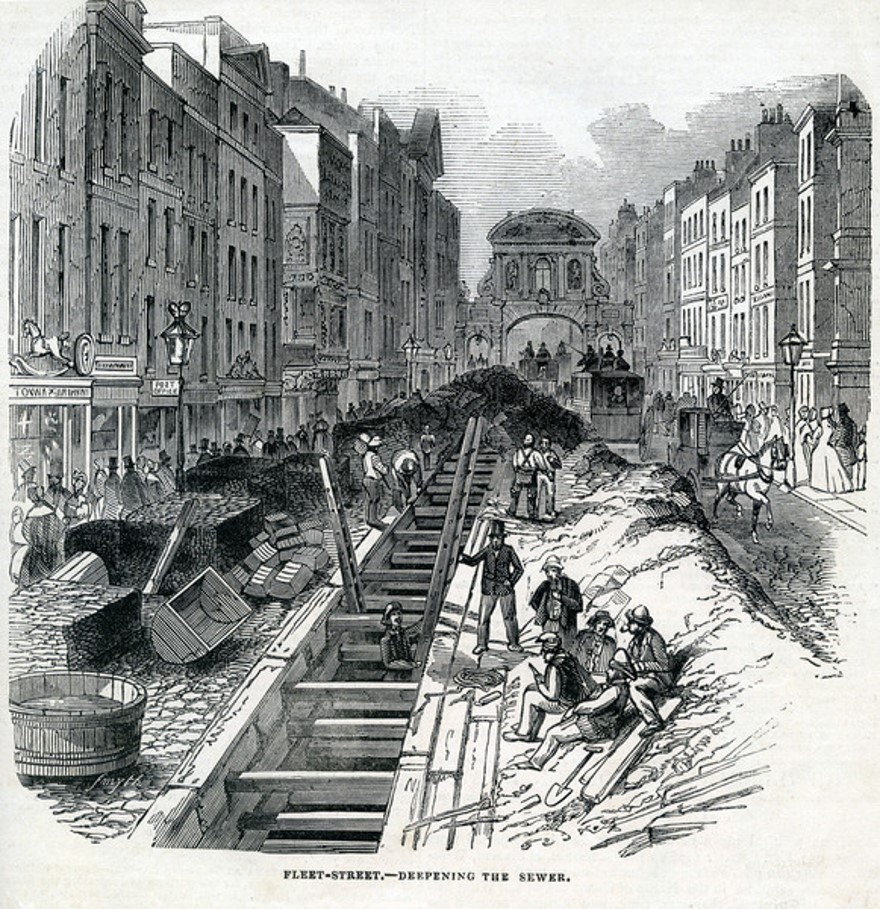
But in the industrial age, human beings suddenly became unable to deal with feces again. In 19th-century London, people suffered the backlash of feces. In July and August 1858, the Thames erupted in the event known as the “Great Stink,” with the whole city on the verge of paralysis. The meeting convened by Parliament to address the stench also had to be suspended halfway through because it was too foul. And before that, London had already suffered multiple large-scale cholera outbreaks,
How did it come to this? The broader background was the rapid expansion of city scale driven by industrialization, while the immediate trigger was a new technology: the invention of the flush toilet. After making a dazzling debut at the first World’s Fair in 1851, the flush toilet spread rapidly. But while it made toilets cleaner, it also greatly increased the volume of sewage. Feces diluted by large amounts of water quickly filled the limited cesspools, and the overflowing sewage could only be discharged into rivers, causing a rapid deterioration of the environment.
Of course, the “Great Stink” finally made the British government determined to act and push forward the construction of sewer systems. But the solution was nothing more than collecting the sewage and discharging it farther downstream. In the end, when even the cities all the way down to the estuary could no longer bear it, the method for dealing with sewage became dumping it into the open ocean or finding some uninhabited island to use as landfill. Even today it is still basically no different, at most with a slight improvement in dehydration technology.
So then, why did feces—something for which there was clearly already technology to recycle, and even economic value—also become a disaster? Because this is not a qualitative question of whether or not it can be recycled, but a question of speed. Feces produced in the city center do not immediately become fertilizer for farmland. First, there must be a lengthy composting process; then time is needed to transport it between the city and the countryside; only then can it finally be put to use. But city dwellers can’t wait, farmers can’t wait, and capitalists certainly can’t wait. So even when some rural areas still regard feces as a scarce resource, other cities have already come to see it as a huge nuisance.
This example tells us that even if our technology can turn all dry garbage, wet garbage, and hazardous garbage into “recyclables,” that still may not fundamentally solve the garbage problem. Because the speed of recycling always lags behind the speed of production, and as garbage production accelerates, even the speed of landfill may not be able to keep up.
The Thames is finite, and the accumulation of pollution over time will always incubate disaster. The whole Earth is also finite. We do not know when a global “Great Stink” or “Great Smog” will arrive, and by then whether humanity will still have time to remedy it.
Therefore, sorting garbage at the source—starting before the garbage is even thrown out—does make sense, because we have to race against the accumulation of garbage. Obviously, before throwing a lump of something into the soup, picking out the mouse droppings is far more time- and labor-saving than waiting until the mouse droppings have dissolved into the soup and only then trying to separate them.
Perhaps it should be the same for technological development as a whole: source control is always more effective than after-the-fact treatment. Can we manage to complete the corresponding garbage-recycling mechanism before every new technology is launched into the market? If a certain technology will generate garbage problems that are now difficult to handle properly, then we should not rush to unleash it. Only once we are confident that we can deal with the accompanying new garbage should we allow a new technology to enter the market. Wouldn’t that be better?
In that case, the speed of technological development may be constrained, but this is the only way to balance the speed of garbage processing with the speed of garbage production.
The key issue, once again, is “speed” — we have already found it hard to accept a slowdown in the pace of development. Citizens accustomed to “consuming ahead of time” cannot accept it, capitalists accustomed to “seizing the initiative” cannot accept it, and scientists and inventors accustomed to leading the world cannot accept it either.
But for the future of humanity, some things that we are unwilling to accept we nonetheless have to accept. Just as administrative regulations will punish citizens who refuse garbage sorting, natural laws will also punish humanity’s reckless development.
Translated from the Chinese original with AI assistance. The original text is authoritative.