
The Thickness of the Medium — Understanding Merleau-Ponty’s Schneider Case[1]
What I am dealing with is section 8 of the third chapter of Part One of *Phenomenology of Perception*: “‘Symbolic Function’ and the Existential Structure of Disease.”
From the title of the section alone, one can see that it occupies a very important position. In the preceding chapters, Merleau-Ponty introduced Schneider’s case and brought in two traditional explanatory approaches: mechanistic physiology tries to explain it in terms of damage to bodily functions, while intellectualist psychology tries to explain it at the level of consciousness. But Merleau-Ponty believes that neither can truly explain the possibility of pathology. So by this section, Merleau-Ponty is finally going to give his own explanation; here the structure of disease (rather than its cause) will be revealed, and this is at the same time a revelation of the existential structure of consciousness. This section is summarizing for the earlier chapters, and foundational for what follows.
What empiricist mechanistic physiology offers is a causal explanation, and such a causal explanation may be accurate, but it is not what we need in order to understand disease. For example, we can attribute the pathological result to a physical injury—the shell fragment damaged his flesh and injured certain parts of his brain involved in visual function. This explanation is unobjectionable, but it does not satisfy our question, namely: why does his disease manifest itself in just this way? His symptom is not a simple decline in vision, but a loss of abstract movement ability—he can see, he can hear, and he can control his body, but he simply cannot carry out an action according to an abstract command (more precisely, he cannot do so directly; he must complete the command by circuitous means such as preparatory movements and repeated attempts). Mechanistic physiology dissects the body into mutually independent functions or parts, but Schneider’s case does not present itself as the failure of a particular part; rather, it presents itself as a kind of holistic, spiritual障碍.
Understanding Schneider’s case must go beyond objective causal analysis and enter the level of consciousness for analysis; in this sense, “the intellectualist analysis of reflection goes beyond causal thinking and realism”109,145. Intellectualism no longer characterizes Schneider’s illness as the absence of some concrete bodily function, but instead traces it back to the “symbolic function” of consciousness, or the “projective capacity,” the “representational function,” which makes abstract movement possible.
“Abstract movement is not triggered by any actual object…… This unmotivated intentionality directs itself toward one’s own body, constituting one’s own body as an object rather than traversing the body in order to connect with objects through the body. Thus abstract movement implies an objectifying capacity, a symbolic function, a representational function, a projective capacity…… consciousness is this capacity itself. As long as there is consciousness, in order to be conscious, there must be something of which consciousness can be conscious, a consciousness-object. Only when consciousness can ‘de-realize’ itself and throw itself into the object…… can consciousness tend toward this object.”106,140-141 “This function of ‘projection’ or ‘summoning’ (in the sense in which a medium summons an absent person and makes him appear) is also what makes abstract movement possible.”106,140-141
That is to say, “consciousness” is not some substance, or a kind of subject standing opposite objects; it is not that consciousness, by means of some capacity, summons objects before itself, but rather that consciousness is this very capacity to summon, this mysterious “medium.” The intellectualism that Merleau-Ponty criticizes has already moved beyond Cartesian mind-body dualism, and is instead something like Kant’s a priori forms of sensibility or Husserl’s intentionality—consciousness is not an object, but what points toward objects, or rather the medium through which objects appear.
In fact, Merleau-Ponty is positive toward this intellectualist approach; what he aims to do is not to rebel against it, but to reflect on it more deeply and reveal its existential foundation. At the very beginning of this section Merleau-Ponty says that the problem with intellectualism “is less that it is false than that it is abstract”109,145. Intellectualism overcorrects, overly confines itself to the level of consciousness, and completely leaves aside the diverse objects of experience, cutting off the soil upon which abstract analysis is founded. Hence it is difficult to explain the diversity of experience and the various forms of consciousness (and pathology). Merleau-Ponty points out that we cannot wholly set aside the role played by the “body” in pathological phenomena—Schneider was not struck in his “symbolic consciousness” by the shell fragment; the shell fragment damaged his flesh, but of course Schneider’s illness is ultimately spiritual, “his spirit is harmed through vision.”110,146 In other words, we must reflect on Schneider’s case from the dimension of spirit, but without setting aside the body.
Merleau-Ponty has always tried to seek some “middle” path between spirit and body, between form and content, between realism and intellectualism, and Schneider’s case just happens to suggest some missing middle link between spirit and body—“What he lacks is neither motricity nor thought; we are forced to admit that, between movement as a third-person process and thought as the representation of movement, there is something else—some anticipation or grasp of the result of movement, guaranteed by the body itself as a capacity for movement, a ‘motor plan,’ a ‘motor intentionality’;…… the patient sometimes thinks the ideal form of the movement, sometimes makes blind attempts with his body; by contrast, in the normal person, every movement is at once movement and awareness of movement, the two being inseparable. We can express the same idea in the following way: in the normal person, every movement has a background, and movement and its background are ‘the elements of a single whole.’ The background of movement is not a representation externally attached to or associated with movement itself; it is internal to movement, it stimulates movement, and at every moment it sustains movement.”96,128
What the approaches of mechanistic physiology and intellectualist psychology have in common is that “both flatten behavior onto the same plane”108,144—either viewing behavior purely within the domain of “form,” or within the domain of “content.” But the problem is precisely that this split between the form and content of movement is itself the symptom of disease. In the normal person, “the medium is the message”: form and content, reflection and objectification, are internal to one and the same movement; whereas in Schneider, what is lacking what has gone wrong is not either of the two, but precisely the medium that tightly couples them together.
I have tried to use the concept of “the thickness of the medium” to interpret Merleau-Ponty’s line of thought.
What is called a medium can also be rendered as “milieu” (the word milieu that Merleau-Ponty often uses has both the meaning of environment and of middle or medium): objects appear through the medium, the medium is the background that brings objects out, or rather the “access” that points toward objects. But compared with concepts such as “environment” or “background,” the word “medium” more strongly foregrounds its intermediary character. A medium or background has transparency; when an object is accurately presented through the medium (in the background), the background seems dispensable, and we seem to see the object directly, while skipping over its background. Yet in fact that background or medium is the necessary path by which we are able to access the object. We will see that, in Merleau-Ponty’s view, “bodily space” is precisely such a medium: the body is neither thought nor object, but the intermediary connecting thought and object, and under its connection thought and object are wrapped into a whole—“Bodily space is distinct from external space: it can envelop rather than unfold its parts, because it is the interior dimness necessary to the clarity of the spectacle, the vague reserve of force and sleeping background necessary for action and its goal to stand out on it, the zone of non-being in front of which points, figures, and all precise existences can appear. In the last analysis, it is because my body can be a ‘figuration,’ because figures appear in front of the body, prior to their indifferent background, because the body has been polarized by its tasks, because it exists toward its tasks, because the body gathers itself into a unity in its pursuit of its aims, and because the ‘body schema’ is ultimately a way of expressing that ‘my body is in-the-world.’”87,117
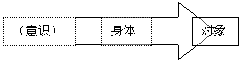
The intellectualist approach has already understood consciousness as a kind of medium, or rather as a ray whose end point is an “object.” But the problem is that it did not consider the “thickness” of this ray; that is to say, this ray has only one direction, from thought to object, and no internal space, so it cannot contain any blockage, nor can it provide any room for maneuver. Consciousness is either correctly directed or chaotically directed, and it is difficult to imagine some ambiguous condition of being directed “more or less.” Merleau-Ponty points out that this kind of consciousness as understood by intellectualism is “completely transparent; this intentionality admits no degrees of more or less.” If one starts from such a concept of consciousness, “everything that separates us from the real world—error, illness, madness, in short, all embodied activity—is reduced to merely superficial states.” “There is nothing in the diversity of consciousness that remains to be known and understood; the only thing that is intelligible is the pure essence of consciousness.”109,145 In other words, if intentionality has no thickness, then obstacles to consciousness can only be understood at the two ends of the medium, and thus we are fundamentally unable to understand the diversity of disease. Of course, we also cannot understand the diversity or historicity of ordinary perception, because only the object of intention is empirical, whereas the form of consciousness can only be a priori. A shell fragment did not strike Schneider’s symbolic function or “a priori form”; it damaged his actual flesh, but how could this damage affect his perceptual form (rather than his being unable to see content)? Merleau-Ponty’s understanding is that the form of consciousness, like its content, is real, actual, embodied—it is precisely this body, which is also an object, that participates in the presentation of objects; the body is both object and medium. The medium is not an a priori abstraction; it is at the same time something concrete. The message appears in the medium, but the medium itself is also an actual message: consciousness as a function of the brain and consciousness as intentionality are one and the same consciousness; the objectified body and the pre-objective body as medium are one and the same body. Merleau-Ponty seeks to “reconstruct a dialectic of form and content”112,147
Intellectualism finds it difficult to explain the relation between the “symbolic function” and bodily function; its theory does not even accommodate “intellect” (understanding) itself. Traditional intellectualism might perhaps think that intellectual capacity is the ability to abstract categories from concrete things, but the problem is that Schneider’s ability of this sort has not disappeared. Schneider’s deficiency does not lie in subsuming concrete sensory experience under a definite category (or subsuming different specimens under the same ideal type); on the contrary, “he can connect these materials only through a definite assignment”112,148. He cannot understand “analogy,” for example, “the relation of the eye to vision is equivalent to the relation of the ear to hearing.” A normal intellect can directly understand such analogies; by contrast, Schneider must go through some process of categorical, abstract clarification before he can understand analogy—for example, he might analyze it as follows: “The eye and the ear are both sense organs, therefore they should be able to produce something similar”113,149; guided by such analytical derivation, only then can he “understand” the analogical relation.
That is to say, the understanding of normal people in fact occurs in some chaotic, ambiguous space prior to “clarification” or “explication,” whereas categorical abstract analysis is merely an extremely specialized state within the process of understanding.
“That the normal subject can instantly understand the relation between the eye and vision as equivalent to that between the ear and hearing is because the eye and the ear are given to him at once as means of entering into the same world…… so much so that this equivalence and analogy can be experienced before it is conceived.…… The actual subject must first possess a world or exist in the world. That is to say, he should maintain around himself a system of meanings…… the correspondences, relations, and shared structures of this system of meanings can be used without being explicated. When I walk around at home, I can know at once, without any reasoning, that going toward the bathroom means passing through the bedroom, and that looking at the window means the fireplace is on my left……” 114,150
That world already faced as the medium of entering the world before the thing has been given a definite conception, or before the thing has become a sharply delimited “object,” is what is called bodily space. This ambiguous world is possible precisely because the body, as medium, contains thickness, or rather semitransparency.
When I “go toward the bathroom,” the “bathroom” is the object toward which my entire conscious activity is directed. However, this “direction” is by no means without reserve; between the bathroom and me there is still a bedroom as the necessary route. On the way to the bathroom, not only does my material body pass through the bathroom, but my consciousness also “passes through” the bathroom. In the structure “I—go toward/intent toward—bathroom,” the bedroom is not a dispensable accessory hanging outside the bathroom, but semitransparency internal to this dual medium of “going toward/intent toward” between me and the bathroom. I cannot directly approach the bathroom straightaway, without blockage or interval; for the bathroom to become an object of my consciousness rather than a potential background, it needs to be placed within another potential background. It is like viewing scenery through frosted glass: in general, my consciousness still penetrates that glass, but at the same time, my consciousness may be partly or wholly blocked there at any moment, and thus may incidentally notice, or be completely drawn to, the patterns on the glass. Schneider, by contrast, can only pass through the medium without reserve; he has no capacity to linger in the medium. When he is merely passing through a place rather than arriving there as a destination, he will completely fail to recognize the meaning of that place, unless he starts over from the beginning, performs preparatory movements again, and turns it into a new destination in order to understand it. Schneider’s medium allows only passage or interruption; it allows no muddled blockage and no ambiguous semitransparency.
This world, unfolded by virtue of the thickness of the medium, forms a system of meaning; the greater this circling space, the richer the meaning. For example, the purpose of writing is to convey words, but in the course of achieving that purpose it inevitably has to “drag mud and water along,” so in writing and reading we do not always present the words themselves with unreserved precision; we always have to linger on the page. And this lingering is even more muddy and water-laden, more diverse, in Chinese characters, and thus in China it may have given rise to such a rich art of calligraphy. The meaning-space of calligraphy lies neither in the paper and ink as the carrier materials themselves, nor in the words themselves to which those carrier materials point, but precisely in the activity of presenting words through paper and ink, within this intermediate circling space that functions as a “through.” And once the thickness of this medium is flattened, once we lose “room to retreat” before the object, Schneider’s obstacle will result—“The essence of consciousness is to prepare (provide) for itself one or several worlds, that is to say, to make its own thoughts appear before itself as various things. By presenting and at the same time relinquishing these appearances in an indivisible manner, consciousness proves its vitality. The structure of the world—the stage of sedimentation and emergence—lies at the center of consciousness; it is precisely through this flattening of the ‘world’ that we are finally able to understand at once Schneider’s intellectual障碍, perceptual障碍, and motor障碍…”115,152 Schneider’s “stage” turns into a monotonous plain; on the stage there are no longer rich sets and backdrops that might at any moment divert the viewer’s attention from the performer. The viewer, before the performer, has no room to retreat; either one can only stare at it, or one must bring on another actor. The scene itself no longer has shadow and diversity. Thus Schneider too becomes lacking in “interest,” lacking in freedom; he cannot play-act—“that is, to place oneself temporarily within an imagined situation, that is, to seek pleasure by changing the ‘environment/medium (milieu)’”119,,157
Schneider’s case is an extreme one. In his world of consciousness, the “medium” has almost entirely lost its thickness and has become completely flattened. But this is not the only form of illness; in some milder cases, the defect of the medium will appear in various concrete states, for example the “number blindness” mentioned by Merleau-Ponty: they can use numbers to count actual objects, but cannot, apart from actual objects, conceive the meaning of abstract numbers. “The thickness of the medium” can explain all kinds of such pathological or obstructive situations, yet without abolishing their diversity. The key is that what is called the “medium” is not merely an abstract metaphysical concept, but the concrete body of each concrete person, including his flesh and blood, as well as his experiences, experience, and training, including its extensions (tools, techniques, environment). All these “material” things are at the same time components of “consciousness.”
Finally, let me append some diagrams that may help understanding:
Everyday action (concrete movement): consciousness→→body→→object

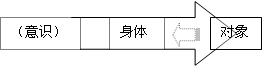
——In everyday action or concrete movement, consciousness passes directly through the body (the medium), much like Heidegger’s state of ready-to-hand. But it should be noted that in this ready-to-hand state, the medium never entirely withdraws, never becomes fully transparent, but always retains some kind of obstruction. For example, when I use a hammer to drive a nail, even if my consciousness passes through the hammer and focuses completely on the nail or the object to be repaired, the existence of the hammer has never completely disappeared from my world. The hammer presents itself as a certain obstruction when I operate on the nail: it is heavy, stiff, and I must swing it laboriously to drive the nail in. The more smoothly I hammer, the more the hammer hides itself, but it always lurks within my intentional activity. This is why, once the nail has not been driven properly, I can immediately adjust my grip on the hammer (or one can unconsciously push one’s glasses when trying to see an object clearly, or adjust a telescope while looking at a distant scene). I can at any time suspend the nail and swing it in the air to weigh it and rehearse. Sometimes I can also keep hammering away at the nail while weighing and adjusting my grip on the hammer… These shifts or fluctuations of intention often occur within the very same process of action. A medium, apart from presenting an object or appearing as an object, has a more basic state: existing within the intentional space as medium itself. This existence does not appear as an object of intention, but emerges, now visible now hidden, in the process of intention. The whole stream of intention is thus a circling space with thickness. Under an objectifying reflection, we designate one endpoint of this stream of intention as the “subject” or “consciousness,” and the other endpoint as the “object,” but these two endpoints are not already laid out in advance (and then a line drawn between them); rather, they are constituted precisely in this non-linear line.
Mechanistic science (body-in-itself): consciousness→→【body】

——Mechanistic science studies the body entirely as a natural object, much as taking off one’s glasses in order to observe the glasses objectively; at such a moment one often needs to change one’s mode of viewing or change to another pair of glasses, rather than continuing the behavior with those original glasses. In the reflection of mechanistic science, the body is no longer functioning as a medium, but of course it also cannot “directly” deal with the body; instead, whether intentionally or not, it introduces new media, such as scientific concepts, experimental data, and so on. The fundamental difficulty of research in mechanical science is that it is hard to provide genuine “understanding.”
Intellectualist psychology (consciousness-for-itself) consciousness→→【consciousness】

——The problem with intellectualist psychology is that it is too abstract; it sets aside the real object too early and rushes into the realm of consciousness. But it fails to notice that, in fact, the so-called realm of “consciousness” is nothing more than one endpoint in an unfolded intentional space, and if the whole intentional activity is set aside, then this endpoint has nowhere to stand and can only become an abstract fiction.
Phenomenological reflection (abstract movement): consciousness→→body↔↔(object)

——Phenomenological reflection is not something that stands in complete opposition to the natural attitude; in fact, in real life, the natural attitude and the reflective attitude often switch back and forth. Both are intentional activities directed toward objects, and both are intentional activities mediated by the medium; this intentional activity is always a “circling space” with thickness. Only in the natural attitude does the medium remain hidden or transparent, whereas in reflection we consciously or unconsciously virtualize the object (put it in brackets), or simply posit a fictitious object outright.
Schneider’s pathological concrete movement: consciousness→→body→→object

——Because of the flattening of the medium, the circling space is greatly compressed, and consciousness has “no road to retreat” before the object. Therefore Schneider not only cannot perform abstract movement; his concrete movement is in fact also different from that of ordinary people, having lost its vagueness and ambiguity, having lost “freedom.”
Schneider’s pathological reflective behavior:
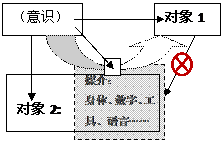
consciousness→→【object 1】
consciousness→→【object 2】
consciousness→→【the relation between object 1 and object 2】
——Schneider can only carry out objectifying reflection (or, one might say, repetition); he finds it hard to experience the existence of the medium as medium, and can only identify mediality as some kind of objective “relation.”
Why Schneider cannot understand analogy (for example, fur to cat is as feathers to bird):
Ordinary people:
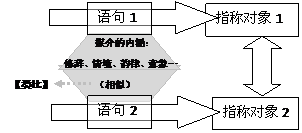
Schneider:
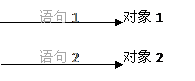
Schneider’s laborious analysis:

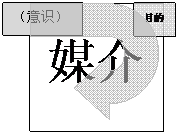
Play/acting (Schneider cannot play): consciousness→→【medium】→→purpose
[1] The quotation mainly uses Senior Brother Shengli’s translation, with slight adjustments, chiefly in the underlined parts.
Translated from the Chinese original with AI assistance. The original text is authoritative.