A batch of videos impersonating Jack Ma’s image and voice are on YouTube telling stories about Singapore—economic judgments, geopolitical rumors, and urban anecdotes.
A CNA investigation found that from September 2025 to June 2026, a total of 32 YouTube channels published 300 such videos. Of these, 259 were deemed to contain at least one false or misleading claim, with cumulative views exceeding 1 million. Five channels also showed clear signs of coordinated operation: they were set up in clusters within five days, updated on highly synchronized schedules, and in some cases videos were uploaded by different channels just one second apart.
These videos were not all intended to attack Singapore. More than three-quarters of the titles were in fact laudatory: they might first fabricate crises such as economic collapse or international encirclement, and then, in the voice of “Jack Ma,” praise Singapore for turning danger into safety. Here Jack Ma is both the stolen image and an authoritative veneer that can boost the content’s credibility and click-through rate.
The independent scholar Hu Yilin believes that when discussing such videos, the three links must be separated: impersonating a real person’s identity, mass production and distribution, and false or misleading content. These are different in nature, and cannot all be covered by the single label of “AI fake news.”
## The problem with impersonation does not depend on whether the video is right or wrong
At the level of identity impersonation, Hu Yilin’s judgment is the clearest: “Impersonating Jack Ma is definitely wrong and must be prohibited, unless authorization has been obtained from the person concerned to use his image and voice; marking it ‘AI-generated’ does not exempt one from responsibility.”
YouTube currently requires creators to disclose realistic synthetic content that makes real people appear to have said or done things they in fact did not say or do. Such a label can tell viewers that the content was artificially synthesized, but it only addresses disclosure of the production method; it is by no means equivalent to having obtained the imitated person’s authorization.
Hu Yilin does not think AI needs a set of portrait ethics entirely different from that of traditional media. Using public images in order to explain an event in a news report, accidentally capturing others in the frame when filming in a public place, or citing existing materials within the necessary scope of commentary and research may be reasonable; but deliberately borrowing the face, voice, and social reputation of a real person and having him speak for the producer is no longer ordinary citation.
Therefore, even if every sentence in the fake Jack Ma video were accurate, even if its content merely praised Singapore, the impersonation itself would still exist. Conversely, if the producer replaced Jack Ma with a completely fictional AI character, the problem of portrait and voice authorization could disappear, but the impact of mass content on public space would not disappear with it.
This also shows that identity infringement cannot be judged by whether the content is true or false, and truth or falsity of content cannot substitute for a discussion of the dissemination mechanism.
## Saying something wrong is not a crime; only causing specific infringement can create liability
Regarding false or misleading statements in the videos, Hu Yilin adopts a stricter free-speech stance. He believes that scientists, politicians, the media, and ordinary people can all make mistakes, and public discussion cannot take as its premise that “what is published must be absolutely correct.”
Political commentary and social expression are also not merely lists of facts. Praise, criticism, exaggeration, irony, softening the harsh before striking the gentle, and hidden praise with covert blame all belong to normal modes of expression. If an institution not only judges whether facts are true or false, but also judges whether a piece of content is sincerely praising or secretly damaging the country’s image, it will very easily turn from a fact-checker into an arbiter of thought and rhetoric.
Hu Yilin sums up his principle very clearly: “One cannot punish speech as such, but only punish specific infringements constituted through speech.”
For example, if someone fabricates “Zhang San Noodle House is dirty and disorderly,” that may cause a clearly identifiable operator to suffer damage to reputation and business. Zhang San can make a claim and use foot traffic, turnover, or other evidence to prove the connection between the speech and the harm.
But if someone says vaguely, “Singapore is dirty and disorderly,” it is hard to identify who the specific victim is, and it is also hard to separate the impact of a sentence on tourism from ticket prices, exchange rates, seasonal changes, other news, and tourists’ personal preferences. Conversely, the sentence “Singapore is very clean because the laws are strict” may also cause people who dislike strict management to decide not to visit.
In such cases, holding someone responsible merely on the grounds that the speech may “mislead the public” or “damage the image” would expand the concept of harm to an almost undefinable degree. Hu Yilin argues that if there is no specific rights-holder making a claim, and no relatively reliable method of proving actual loss and causation, then restraint should be exercised toward speech.
Truth and falsity can still be factors in determining responsibility, but they are not the sole standard. A false opinion may not have caused specific harm, and true information may also infringe privacy. Revealing a person’s real medical condition in public does not become legitimate simply because the content is true.
As for politicians and other public figures, Hu Yilin believes that a wider space for controversy should be preserved, because they have actively entered the center of public power and social influence; academic discussion likewise must allow erroneous views to be raised first and then corrected through criticism and evidence. The corrective mechanism of public discussion should mainly be refutation, not the establishment of a general truth-review authority before expression.
## The truly new problem is that content production and distribution have already been industrialized
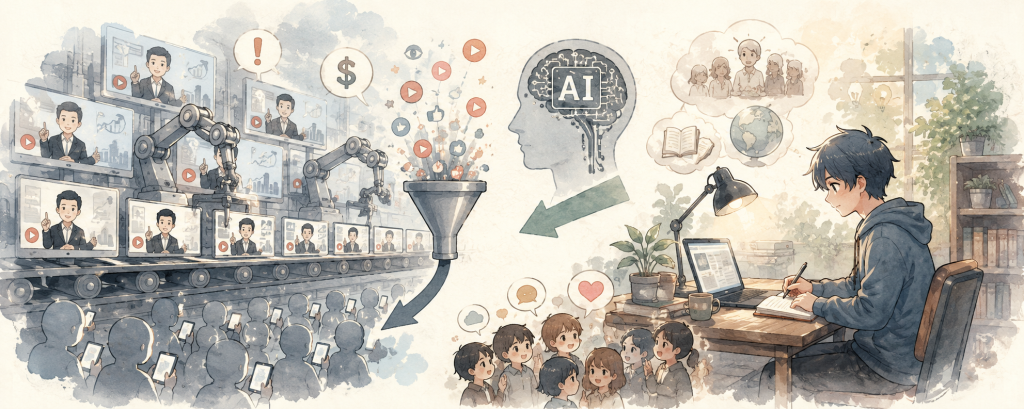
The more historically significant aspect of the fake Jack Ma incident is that a small number of operators can now produce hundreds of videos at low cost and repeatedly test dissemination effects through dozens of seemingly different channels.
The five highly suspicious coordinated channels in the CNA investigation contributed more than three-quarters of the content in the relevant sample. Their creation dates, posting times, and visual templates were highly similar; one channel even switched its protagonist from Jack Ma to Li Ka-shing, and then to Hong Kong feng shui master So Man-fung, while the channel’s original name and production pattern remained basically unchanged. The authoritative figure can be swapped at any time; what remains stable is the content template and traffic-testing behind it.
Hu Yilin points out that even if Jack Ma’s face were completely removed, this production method could still continue. Operators could use an AI beauty whose portrait-rights issues do not exist to have her endlessly speak correct yet empty stock phrases, or they could avoid politics and social issues altogether and only publish dance clips, emotional stimulation, and repetitive entertainment.
It can thus be seen that the flood of low-quality content does not require infringement or factual error as a prerequisite. Even if every item of content were lawful and uncontested, they could still rely on quantity and recommendation mechanisms to squeeze out the research, commentary, and creation that take longer to form.
The problem is no longer simply how much trash content there is, but why the platform makes this mode of production more likely to succeed.
## Recommendation mechanisms are turning creation into a traffic lottery
Hu Yilin uses the contrast between one channel and a hundred channels to explain why content farms have become a rational business strategy:
> I cultivate 1 channel, my reputation accumulates slowly, my fans gather slowly, but a single bout of traffic suppression can collapse everything at any time; whereas if I operate 100 channels, I won’t care if 50 die, as long as one explodes. Then I also should not maintain consistency in my personal viewpoints, or unity in my personal style; on the contrary, I need to try different viewpoints and styles, have both hands fight each other, produce all kinds of contradictory content, and then cast a wide net, like buying lottery tickets, to see which one takes off and continue developing it. So I no longer care about viewpoints, no longer care about reputation, no longer care about the expression of personality. After all, random casting is more effective than sustained cultivation.
In a single channel’s long-term creation, a person must maintain a relatively stable identity. What one has said in the past, what mistakes one has made, and how one’s views have changed all settle into the public evaluation of that person. Once the account is throttled or the recommendation mechanism changes, years of reader relations may also be affected.
Matrix-style operations, by contrast, scatter the risk across a large number of replaceable accounts. Different accounts can separately test opposing positions, different personae, and mutually contradictory content. The operator need not determine which viewpoint is more reliable; they only need to observe which expression receives more recommendation, and then continue copying it.
When the platform mainly allocates traffic according to each piece of content’s immediate performance, without adequately valuing the account’s long-term history, a continuously cultivated public persona may be less effective than a large number of disposable accounts. The more a creator cherishes reputation, the harder it is to test extreme headlines and conflicting viewpoints without restraint; the easier an account is to abandon, the more suitable the operator is for random casting.
Under this mechanism, a content farm is not deviating from the platform’s incentives, but rather obeying them more completely than ordinary creators do.
## There is no need to solve this by real-name registration; accumulated worth should be made valuable again
A direct way to curb batch account creation is to require all accounts to be linked to real identities, and then restrict the number of accounts each person may create. But Hu Yilin believes that real-name registration would simultaneously harm anonymous expression and bring risks of privacy leakage, commercial profiling, and political surveillance.
Anonymity, pen names, and multiple creative identities are not inherently wrong. Political dissidents, whistleblowers, vulnerable groups, and people who wish to separate their real-world profession from their personal creation may all have legitimate needs for anonymity. The issue is not whether one person can run multiple channels, but whether the platform rewards the random testing of large numbers of new accounts more richly than long-term reputation.
His proposed direction is: “Restraining this random-casting style of content production does not require real-name registration; it requires changing the algorithmic orientation—encouraging ‘accumulation.’”
This does not mean the platform should forever suppress new accounts, nor does it mean old accounts are inherently correct. A more reasonable direction would be to allow accounts that are sustainably operated, consistently productive, and long-term accountable for reputational consequences to gradually accumulate weight, while reducing the returns from large numbers of homogeneous accounts repeatedly cold-starting, copying templates, and evading penalties.
YouTube’s current monetization rules already classify repetitive, templated, and obviously mass-produced content as “inauthentic content,” and stipulate that such channels may lose monetization eligibility. The official rules specifically list AI content that is mass-generated with generic templates and lacks original viewpoints and substantive differences as something the platform does not wish to reward.
But the change Hu Yilin hopes for is not merely the post hoc cancellation of ad revenue; it is to alter the platform’s valuation of history and reputation at the recommendation level. He uses e-commerce platforms as an example: some platforms make store tenure, historical reviews, and long-term repurchase into assets, so merchants are willing to keep running the same shop; others place more emphasis on item price and immediate conversion, and operators then have greater incentive to keep testing new products, new shops, and new traffic entry points.
Social media faces a similar choice: should an account be regarded as a public history that requires continuous responsibility, or merely as a temporary container for repeated content tests?
Algorithmic reform is best driven by market competition, not administrative orders
Although he criticizes the direction of recommendation systems on existing platforms, Hu Yilin does not advocate that the government directly dictate what content should receive greater circulation.
“Depth,” “health,” and “value” are all vague concepts that can be abused. Today the government may ask platforms to change their algorithms in the name of reducing junk information; tomorrow it may use the same excuse to downrank satire, subcultures, and unpopular political views.
In his vision, public institutions, researchers, and the media can expose problems, publish data, and alert the public, but better platform forms and credibility mechanisms should mainly emerge through entrepreneurial innovation and market competition.
This means that future information platforms may not necessarily be advantaged by producing more content. As content supply becomes ever more abundant, helping users identify which sources are worth reading over the long term may instead become the new product value.
The government does not need to decide for the public what truth is, but entrepreneurs can try to build a recommendation mechanism that places greater weight on time, history, and credibility; users, too, can shift their attention and thereby create commercial room for such a model to survive.
When shallow content can be generated instantly, depth may become scarce again
Content farms still have a market today because audiences still need to wait for others to make stories, music, characters, dances, and emotional stimulation for them. Operators test topics and personas in bulk precisely in order to find earlier than others the content audiences want to watch.
But as personal AI capabilities continue to improve, users may no longer need to wait for media matrices to feed them. If someone wants a certain kind of character, story, or music, they can simply ask their own model to generate it instantly, and the result will be more closely tailored to personal preferences than anything on a public channel.
Hu Yilin believes that “when shallow information can be fully distributed on demand, producing shallow information will also lose its economic viability.”
Once ordinary content approaches an infinite supply, what may truly become scarce is no longer yet another video that can be generated instantly, but an author’s judgment formed over many years, a body of research repeatedly tested, a reputation that has long borne the cost of correction, and a work discussed and remembered collectively by many people.
He uses the garment industry as an analogy. Industrialization has already met the basic clothing needs of most people in affluent societies, yet clothing consumption has not disappeared; instead, it has shifted toward design, style, brands, and the expression of identity. What was originally part of an individual’s survival needs—clothing—after basic supply becomes abundant, in fact turns into a more public cultural language.
AI may also first satisfy the most basic need for mental entertainment, and then push people toward experiences that cannot be fully replaced by private models: watching together, public evaluation, on-site participation, long-term reputation, and cultural memory shared by many.
Technology may intensify atomization, but it may also rebuild public space
Personalized AI may indeed allow everyone to live in a content environment that caters entirely to their own preferences, further weakening society’s common topics. But Hu Yilin believes that personal atomization is not a problem AI suddenly created.
Urban structures in the industrial age, enclosed housing, and the decline of public space have already been separating people from one another. The internet, the metaverse, and artificial intelligence may both deepen this trend and lower the cost of reorganizing communities.
Therefore, AI will not automatically bring about a more closed or a more public cultural life. Both directions are latent within the technology itself; the final outcome depends on how platforms organize attention, what kind of content people are willing to spend time on, and whether new cultural institutions can bring individuals back into shared experience.
The fake Ma Yun is merely the most conspicuous symptom in this transitional period.
The problem of impersonating a real person’s identity is relatively clear and can be handled through authorization and personality-rights rules; using speech to cause defamation, fraud, or privacy violations can also be pursued according to the specific harm. The hardest problem remains how to squeeze long-term creation out of recommendation systems when what is at issue is lawful, uncontroversial, yet infinitely reproducible low-cost content.
If a new account can obtain traffic more easily than ten years of credibility, then people will be encouraged to keep changing faces, views, and identities. Conversely, if time, continuous responsibility, and historical record once again become advantages in dissemination, only then will content producers have reason to cherish their public persona.
What truly needs to be rebuilt is not a censorship organ that adjudicates truth sentence by sentence, but an information environment in which long-term credibility regains market value.
Translated from the Chinese original with AI assistance. The original text is authoritative.
Leave a Reply