
Hu Yilin AI Interview | July 12, 2026
Introduction
On July 10, 2026, Singapore’s Ministry of Culture, Community and Youth, the Singapore Business Federation, and the National Employers Federation announced a report by the Alliance for Action on the Integration of Foreign Professionals, unveiling five initiatives: EP Journey for new Employment Pass holders, welcome days hosted by industry associations, an integration handbook and workshops for companies, culture-sensitivity courses for HR staff and team supervisors, and a centralized resource hub. EP Journey has already launched a six-month pilot in May, with plans to cover 600 participants before expanding gradually.[1]
This is not a one-way program demanding that foreigners “become like locals.” The authorities also list companies, local employees, and foreign professionals as actors in integration; the PR Journey for new permanent residents has likewise expanded from online learning, museums, and community activities to volunteer service. The Singapore government repeatedly describes integration as an ongoing, two-way process.[2][3]
And yet “integration” still triggers a classic question in liberal societies: does the state have the right to ask a person to identify with certain values? Would such a demand flatten cultural differences? Does pluralism mean that society must accommodate every form of non-identification?
The liberal scholar Hu Yilin believes that the very framing of the last question is misleading. The key is not to ask abstractly whether society can accommodate “non-identification,” but first to ask:
“The key is: what exactly is the object of this ‘identification’ or ‘non-identification’?”
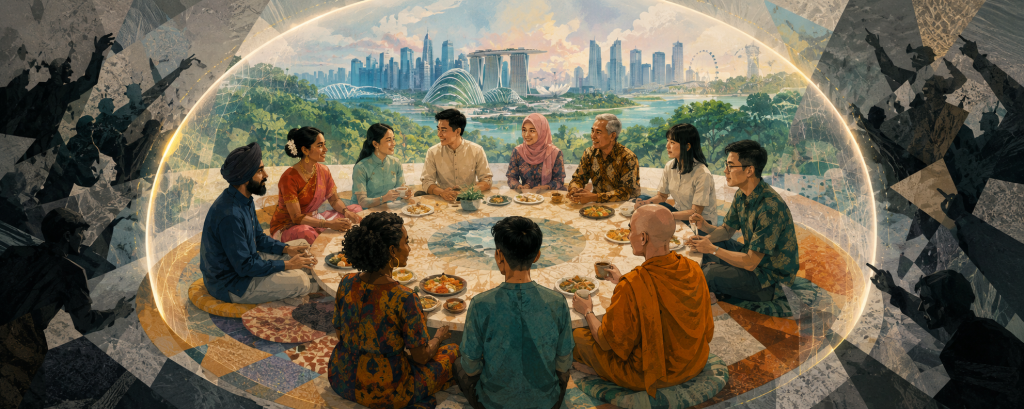
1. Integration Is Not About Turning Everyone into the Same Kind of Person
In Hu Yilin’s view, the legitimacy of integration courses depends on what they actually ask newcomers to identify with. A plural society has no reason to demand that residents give up their language, diet, religion, family habits, or aesthetic preferences, nor should it manufacture a fixed “standard Singaporean” template. Singapore itself is a society formed through the long interaction of multiple waves of immigrants and multiple cultures; difference is not noise to be eliminated, but part of its social makeup.
But the public rules of multiculturalism are not merely one preference among many cultural preferences. They are a framework that allows different cultures to coexist: a person may insist on their own taboos, but cannot therefore deny the legitimacy of others choosing different ways of life; one may disapprove of another’s religion or custom, but must recognize the other’s standing as an equal member of society.
Therefore, there is a clear boundary between “requiring integration” and “requiring assimilation.” The former may require residents to understand and observe the minimum rules of common life; the latter tries to reshape everyone’s concrete way of living into one and the same form. Hu Yilin supports the former, not the latter.
2. Two Kinds of “Non-Identification” Must Not Be Confused
Hu Yilin uses pork, the most direct dietary taboo, to illustrate this distinction:
“I think pork can be eaten; you think pork cannot be eaten. That is a kind of ‘non-identification,’ and we should tolerate this kind of non-identification and coexist with it.”
Here, the non-identification points to the food itself. Some people avoid pork for religious reasons; others regard pork as an ordinary food. The two judgments are mutually incompatible, yet they can fully coexist in the same society. What pluralism seeks to protect is precisely this diversity of ways of life and value judgments.
Another kind of non-identification no longer points to pork, but to whether people who eat or do not eat pork deserve equal treatment. Hu Yilin goes on to say:
“But I believe that ‘we should tolerate people who eat or do not eat pork,’ and you do not identify with ‘we should tolerate people who eat or do not eat pork,’ instead thinking that ‘people who eat pork are filthy and evil’ or that ‘people who do not eat pork are ignorant and stubborn.’ Such views are themselves contrary to multiculturalism; by no means should we, in the name of multiculturalism, tolerate this kind of discriminatory attitude.”
These two kinds of non-identification operate at different levels. The first is an evaluation of a certain practice; the second denies the dignity and the right to coexist of those who choose a certain practice. The former constitutes pluralism; the latter corrodes the conditions under which pluralism can exist.
If the two are lumped together as mere “difference of opinion,” pluralism will lose its capacity to judge, and discrimination may even gain exemption under the name of “cultural difference.”
3. Pluralism Itself Is a Principle That Must Be Defended
Pluralism is not a value vacuum, nor is it a simple claim that “all views are equally worthy of respect.” It at least includes several clear public commitments: people of different ethnic groups and religions possess equal personhood; no group may be stigmatized merely because of identity and way of life; conflicts should be handled through law, negotiation, and mutual restraint, rather than through humiliation, exclusion, or oppression.
Precisely for this reason, a plural society cannot remain completely neutral toward anti-pluralism. It may allow people to dislike one another and to disagree with one another; but at the level of public education, institutional design, and social norms, it cannot package the stance that denies equal coexistence as yet another “cultural choice” deserving respect.
To say that discrimination cannot be legitimized in the name of pluralism does not mean that all prejudice must be punished by law. What is being drawn here first is the boundary of public principles: society may permit a certain idea to exist, but it has no obligation to recognize that idea as compatible with pluralism, much less to excuse it from criticism simply because it wears the outer garments of tradition, religion, or ethnic culture.
Hu Yilin thus arrives at a clear conclusion:
“So, under the principle of cultural pluralism, not every ‘non-identification’ must be accepted; the principle that you must identify with and adapt to multiculturalism is itself one that you must identify with.”
What is meant here by “must identify with” is not that everyone must agree with all the doctrines, rituals, and customs of other cultures, but that one must accept a higher-order common rule: others have the right to live in ways different from one’s own.
What this constrains is not what people eat, believe, or wear, but how one ought to treat those who eat differently, believe differently, and wear differently.
4. Criticizing “White Leftists” Should Not Turn into Anti-Pluralism
Hu Yilin links this boundary to the criticism often directed at the so-called “white left” mentality in Europe and the United States. What is truly worth criticizing here is not sympathy for minority groups, nor caution in the face of the oppression of weaker cultures by stronger ones, but the tendency to understand tolerance as an endless retreat: as long as a view appears in the name of religion, tradition, or ethnic identity, outsiders no longer dare to judge whether it contains discrimination.
This approach may appear to respect difference, but in fact it turns pluralism into criticism immunity distributed according to identity. Prejudices of the majority should of course be criticized; prejudices expressed within minority groups in the name of tradition should not be romanticized either. The standard cannot be “who said it,” but whether the statement acknowledges the equal coexistence of different people.
But reflection on infinite tolerance should not be used to negate multiculturalism itself. Opposing the sheltering of discrimination in the name of culture does not mean demanding that minority groups accept assimilation into majority culture; drawing boundaries for pluralism is not the same as opening the door to exclusionism.
On the contrary, a unified and symmetrical boundary is precisely the most reliable protection for plurality: regardless of whether the speaker comes from a majority or minority group, one must not describe another class of people as naturally filthy, evil, ignorant, or unfit to coexist.
5. Integration Is a Two-Way Street, But Two-Way Does Not Mean No Common Baseline
It is necessary for the Singapore government to describe integration as a “two-way process.” Newcomers need to actively learn about the local multiethnic structure, religious sensitivities, workplace norms, and habits of public life; local residents, companies, and managers must also avoid using nationality, accent, race, or cultural background to permanently exclude foreign professionals from “us.”
The five newest measures are not just classes for EP holders; they also include company integration handbooks, workshops, and culture-sensitivity training for HR staff and team supervisors. This design in itself shows that integration failure cannot be blamed entirely on newcomers.[1]
But bidirectionality does not mean that both sides need only make limitless concessions to one another, nor does it mean that society cannot set common requirements. A plural society requires both sides to change certain habits, yet it does not ask either side to give up its entire identity. New arrivals should learn how to enter the existing public order, while the local society should ensure that this order is not a cultural privilege of the majority, but a shared space genuinely open to different groups.
The common bottom line is the same for everyone: do not demean others on the basis of identity, do not impose your own taboos on other people, do not deny equal rights in the name of tradition, and do not use “locals first” as an excuse to humiliate outsiders.
If an integration course teaches only foreigners to submit to local habits, while failing to require local institutions to reflect on exclusion and prejudice, it will slide toward assimilation; conversely, if it speaks only of how the local society ought to be inclusive, while failing to require newcomers to understand the rules of plural coexistence, it likewise cannot produce genuine integration.
6. What an integration course should teach is not the standard answer, but a sense of boundaries
A good integration course should not become a loyalty test, nor should it require participants to memorize a set of abstract national values. It is better suited to unfolding around real situations:
How to distinguish “I won’t do it” from “you are not allowed to do it”; how to distinguish religious precepts from public compulsion; how to avoid stigmatizing an entire category of people when expressing one’s personal judgment; how to handle workplace language circles, unconscious bias, and cultural misunderstandings; how, when conflict arises, to appeal to institutions rather than to group hostility.
This is also why museum visits, community activities, volunteer service, industry orientation days, and situational cultural sensitivity training are more meaningful than a simple online test. They allow participants to encounter concrete people and lifeworlds, and to see that a plural society is not a set of political slogans, but a series of relationships that must be maintained in everyday life.
PR Journey has already incorporated visits to cultural institutions, community activities, and volunteer service; courses for corporate managers also emphasize experiential learning, unconscious bias, cultural difference management, and inclusive leadership.[1][2]
The goal of the course should not be to make everyone arrive at the same conclusion, but to teach people to recognize the nature of their disagreements. A person may retain strong religious convictions, ethnic identity, and moral judgments, and may also believe that certain ways of life are not suitable for himself; but he must know that personal taboos cannot automatically become public prohibitions, and that rejecting a practice cannot automatically escalate into humiliating the people who practice it.
Conclusion | The boundary of pluralism is precisely the condition for pluralism to exist
“A plural society cannot accommodate everything” sounds like a slogan against pluralism, but what it actually points to is precisely pluralism’s self-protection. If a society does not even dare to uphold the most basic principle of equal coexistence, then the first to be harmed are often precisely those with smaller numbers, weaker power, and different ways of life.
A mature plural society does not demand that everyone agree with one another, nor does it whitewash conflict into harmony. It acknowledges real and profound differences, and arranges the institutional conditions for shared life around those differences.
It can accommodate “I don’t eat what you eat,” “I don’t believe in the religion you believe in,” “I don’t choose your way of life,” but it cannot also regard “therefore you are inferior to me” and “therefore you do not deserve to appear here” as cultural differences worthy of protection.
From this perspective, what Singapore’s integration courses truly need to convey is not how to become the same kind of person, but how, without becoming the same kind of person, to still treat one another as equal human beings.
Translated from the Chinese original with AI assistance. The original text is authoritative.