
Hu Yilin Interview | July 10, 2026
◆
Lead-in | In May 2026, an international medical conference held in Copenhagen was drawn into a suspected case of systemic academic fraud: several Indonesian participants were accused of falsifying institutional affiliations, impersonating real researchers, and smuggling dubious research into the conference. Indonesia’s higher-education authorities and national research institutions then launched an investigation. In July, Nature reported on “humanizing” tools that can erase the “AI tone” from academic text; another audit of 2.5 million biomedical papers found false citations in nearly 3,000 papers that could not be matched to real publications.[1][3][4]
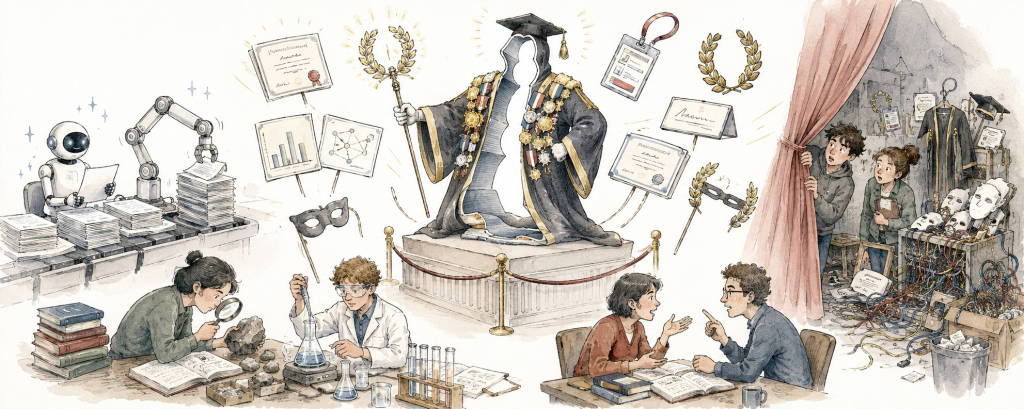
Fake scholars, fake authors, fake citations, AI cheating—these incidents all seem to be asking the same question: how can we prove that an academic achievement was “really done by a human”? But the freelance scholar Hu Yilin believes that this question still remains on the surface. The deeper crisis in academia right now is not that AI is making it hard to identify who someone is, but that many academic systems have long since stopped being good at judging knowledge itself, and instead only know how to rely on external labels such as authorship, titles, institutions, journals, and formatting to substitute for judgment.
Why could a fake scholar slip through layer after layer of review?
The Indonesian conference scandal is not an isolated case. In 2025, Guo Wei, formerly the “chief scientist” at Jiangsu University of Science and Technology, was found by the university to have committed serious academic misconduct; the school terminated his employment contract and reported the case to the public security authorities. Media investigations said that multiple entries in his resume contained obvious contradictions, and he was also accused of borrowing the achievements of a researcher with the same name; the university also admitted that its vetting of materials during talent recruitment had been lax. What is even more telling is that the resume review did not first uncover this academic packaging; rather, it was the students who actually interacted with Guo Wei—through the author photos on papers, professional exchanges, and everyday research activities—who gradually noticed the anomalies.[2]
Hu Yilin believes that this kind of wholesale fabrication of an academic identity is not some scammer who accidentally barges in from outside the evaluation system, but the extreme outcome of a long-term separation between “name” and “reality” in the evaluation system. So long as a person wears a sufficiently dazzling title, he may obtain a position, funding, students, housing, social prestige, and actual power within an organization; meanwhile, the situations that could truly test his academic ability have been pushed to the margins of the system.
“If we mainly evaluate scholars based on actual interaction—for example, how exactly he teaches students, how exactly he collaborates with scholars in the same department, how exactly he goes toe-to-toe with academic peers in criticism and debate, how exactly he gives talks and teaches—then in these situations, impostors are obviously more likely to be exposed.”
From public debates in the Greek agora, to the institutionalized disputation of the scholastic period, to the letter networks that spanned Europe in the early modern era, knowledge once took on the strong character of a communicative activity: for an idea to enter a community, it had to face questioning, rebuttal, revision, and re-interpretation. Modern papers are supposed to preserve this tradition of argument, but in many settings, paper-writing has become increasingly smooth and even-handed, with more mutual citation and polite affirmation among peers; academic conferences have become places for routine reports, exchanging business cards, and expanding one’s network, while truly intense academic disputes are rarely seen.
This change has also affected students’ choices. Teachers with real ability may not take teaching seriously, nor do they necessarily control resources; teachers with titles and administrative halos, however, may bring students projects, positions, networks, and hidden power. Thus, from students to peers to leaders, people may all rationally prefer “convertible halos” rather than genuine creativity and communicative ability.
“Everyone is abandoning the fundamental for the secondary, discarding substance in pursuit of emptiness; most people are ‘famous in name but lacking in reality,’ and these utterly ‘all name and no substance’ cases are just the most extreme situations.”
Whether AI wrote it should not be the final question for knowledge
Debates surrounding AI and academia often follow the same identity logic: people first ask who actually wrote a paper, how much AI it used, and whether “AI traces” can be detected, and only then consider whether what it says is correct. The newly emerged “academic humanizer” can make models imitate an author’s existing style and erase common AI sentence patterns, which further shows that trying to identify authorship by style easily falls into an endless cycle of detection and counter-detection. At the same time, the audit of false citations points to another, more solid path: there is no need to guess whether a reference was fabricated by a human or by AI; one only needs to verify whether it truly exists and whether it supports the corresponding claim.[3][4]
“Nowadays, if you don’t use AI, that’s what counts as academic misconduct. Using AI is only natural.” Hu Yilin said. He had already systematically laid out this position in “If Scholars Don’t Use AI, That Is Academic Corruption” and “Universities That Ban Students from Using AI to Write Papers Should Be Dissolved on the Spot”. These two older essays mainly respond to the debate over whether academia should use AI, but this position also leads to a more fundamental epistemological question: is academic evaluation actually judging knowledge, or is it judging authorship?
“As for checking and accountability and so on, of course they are necessary, but in fact they are not the main point. Academic pursuit is after knowledge, not reputation.” In Hu Yilin’s view, author responsibility is a procedural arrangement needed for the operation of academic organizations, but it is not the ultimate basis on which knowledge is established. Different kinds of knowledge have different internal modes of verification: mathematical propositions can be recalculated, experimental predictions can be tested again, philosophical arguments must withstand reflection and criticism, and works of art appeal to concrete sensory experience. The methods of judgment differ, but none of them should directly take the author’s halo as a substitute for truth.
He contrasts political information with mathematical knowledge: if someone says, “The United States is going to raise tariffs on Europe,” the listener must first look at who is saying it—a drunk speaking offhand and the president of the United States speaking with decision-making power have completely different political effects. But “whether it is a drunk, or Trump, or Hitler who says 1+1=2, that is still correct”; the truth of this proposition does not change with the speaker’s identity. What makes science unique is precisely that, at the very least, it takes transcending ad hominem appeals as its normative ideal.
“The more bothered people are by whether a certain paper was written by AI or by a human, the more ‘unscientific’ that field of knowledge is, and the closer it is to politics. If you cannot judge the quality of an academic achievement without resorting to ad hominem appeals, then something has gone wrong with that entire academic field.”
This is not to say that source, reputation, and responsibility are meaningless in real-world research. Highly specialized science cannot require every reader to immediately redo all experiments, and researchers still need to lower verification costs through author information, institutional reputation, experimental records, and disclosure of interests. But these can only be clues that enter into the verification process; they cannot replace the evidence chain itself. Whether AI was involved can be disclosed in the name of transparency; what truly needs final judgment is still data, reasoning, reproducibility, and explanatory power.
“AI-free exams” should only be basic training, not a universal test of authenticity
A recent exam controversy at Brown University in the United States has once again made “AI-free ability” a topic in higher education. The average score on a take-home midterm in an advanced mathematical economics course was 96, while the average score on the in-person final dropped to 48; on this basis, the professor alleged large-scale AI cheating and decided not to use take-home exams anymore. The difference in scores by itself cannot convict every individual case, but it is enough to show that when the goal of assessment is still the old-fashioned independent problem-solving, while the environment already allows instant access to large models, the take-home closed-book design is losing its practicality.[5]
Hu Yilin does not endorse drawing from this the conclusion that “universities must universally preserve the ability to work without AI.” In his view, AI-free assessment should not be a universal setting for all courses, but should only serve specific foundational training: “Actually, I think most fields do not need to preserve what is called ‘AI-free ability’; only when a field is in its basic introductory training do you need to preserve it.”
When elementary school students are learning the four operations, they should not rely on calculators from the very beginning, because the teaching goal is not to get the number as quickly as possible, but to understand what ‘calculation’ is; by high school, university, and real research, calculators and more complex software become the normal environment. University courses should make a similar distinction: if a course bears the responsibility of the most basic conceptual training in a field and aims to form an overall overview, discernment, and academic taste, then one can set up specially designed AI-free assessments; once one enters mature professional practice, assessments should default to the assumption that students can make use of contemporary tools.
Therefore, AI-free assessment should not be treated as a “lie detector” for identifying the real human being, but only as a training device with a clear pedagogical purpose. Nor can the question formats simply revert to memorization and timed writing; they should genuinely test whether students have formed a basic grasp of conceptual structure, problem sense, and standards of judgment. Beyond that, more general assessments should observe how students use AI to raise questions, organize materials, discover loopholes, and complete work that goes beyond the model’s average level.
Good scholarship is not afraid of being “publicly executed”; academic oversight needs more outside eyes
In the spring of 2026, the video blogger and former doctoral student “Student Geng” publicly pointed out data and image anomalies in multiple papers, prompting several universities to launch investigations and resulting in disciplinary action against several senior scholars. Almost simultaneously, the Association for Computing Machinery (ACM), faced with a backlog of academic misconduct allegations, began hiring a dedicated research integrity officer and planned to introduce more technical screening tools. These two developments represent two paths of oversight: one comes from public investigation outside academic institutions, the other from professionalized governance within publishing and professional organizations.[6][7]
Hu Yilin clearly supports expanding the former force. He believes that academic achievements should, in principle, be placed before public judgment; what researchers make public should not only be the polished final product, compressed and handed over to journals, but also more materials from the entire research process, such as laboratory logs, data processing procedures, code, version changes, and dialogue records that had substantive influence when collaborating with AI.
“The more lies there are, the harder they are to cover up; the more complete the materials, the more credible they are. AI and the public can both come dig and pick at them. Good scholarship is not afraid of public scrutiny; on the contrary, in today’s age of information explosion, good scholars also need exposure. If I am confident that my work is honest, I’m not afraid of being ‘publicly executed.’”
Open oversight does not mean convicting by traffic alone. Online criticism can raise questions, present evidence, and force institutions to respond, while formal sanctions should still go through procedures that allow appeal and review; original materials involving privacy, the rights of subjects, commercial secrets, and safety restrictions also need appropriate anonymization or tiered access. But procedure cannot become an excuse for locking the materials back up in a dark room. The value of a dedicated integrity office should be to receive the leads provided by the public, accelerate verification, and explain things openly—not to monopolize who has the right to raise questions.
“De-SCI-ization” should increase the number of judges, not lock knowledge back up inside the country
Another discussion surrounding the evaluation of Chinese research is reducing the weight of top overseas journals and SCI metrics in the assessment of professional titles, funding, and positions. According to reports, some policy discussions have also incorporated concerns about technology leakage and national security; meanwhile, several 2026 guidelines from the National Natural Science Foundation of China still explicitly emphasize open and inclusive international cooperation. The coexistence of these two directions shows that “de-SCI-ization” is at a fork in the road: it may either correct the old problems of only looking at journals and impact factors, or be understood as reducing international exchange and strengthening closed review.[8][9]
“De-SCI-ization should move toward greater openness rather than greater closure,” Hu Yilin said. It should not mean shifting from “recognizing only U.S.-centric international journals” to “recognizing only journals designated by the domestic administrative system,” but rather breaking away from a single academic center and a single metric, and bringing more kinds of judges into the evaluation of knowledge.
For disciplines closely tied to industry, enterprises and the market can take part in evaluation more deeply: whether a technology can enter production, solve real problems, and withstand constraints of cost and safety is itself an important test beyond the metrics of a paper. For pure theoretical research, meanwhile, multimedia translation, public lectures, interdisciplinary dialogue, and explanations directed at the general public can bring more colleagues and non-colleagues into the discussion.
This does not mean letting the public vote on whether a theorem is true, nor does it mean letting market prices arbitrate all knowledge. The point of broadening the circle of evaluators is to increase the dimensions of testing: peers can examine technical details, interdisciplinary scholars can challenge hidden premises, enterprises can test application value, and the public can ask why the research matters and whether it can be clearly explained. Real openness does not mean lowering standards; it means making a kind of knowledge face more directions of refutation and more friction with reality.
From “Certified Authors” Back to “Testing Knowledge”
AI did not conjure up today’s academic crisis out of thin air. It merely reduced the cost of producing the appearance of scholarship to an unprecedented level: words that look like papers can be generated in bulk, references that look genuine can be fabricated in an instant, scholars’ résumés and conference materials can be packaged as a complete set, and even peer review may be automated. A system that relies mainly on appearances and credentials to function thus looks especially fragile.
The corresponding way out is not to invent a stronger “human detector,” but to restore those academic activities that are harder to fake: sustained teaching and interaction, genuinely back-and-forth critical debate, chains of evidence that can be independently checked, research processes as complete as possible, and multiple forms of testing from peers, the public, and the world of practice.
“Scholarship seeks knowledge, not fame.” When knowledge once again becomes the center of evaluation, AI will not cancel scholarship; on the contrary, it will force scholarship to shed an outer shell that increasingly resembles officialdom and the market for credentials, and to become once again an activity of public argument, joint verification, and continuous correction.
Sources and Further Reading
[3] Nature, ‘Humanizer’ tool can erase signs of AI-written text, 2026-07-07。
[5] EL PAÍS, Professor denounces mass AI fraud on an exam at Brown University, 2026-06-28。
[6] Retraction Watch, Computer science society creates new research integrity role, 2026-07-02。
[7] Xinhua Net, “Why did ‘Geng classmate tells stories’ alarm the whole internet?”, 2026-05-27。
[8] Financial Times, China cools on overseas publication of scientific research, 2026-07-05。
[10] Hu Yilin, “If scholars do not use AI, that counts as academic corruption,” 2026-05-09。
About the interviewee
Hu Yilin holds a PhD in philosophy from Peking University. He previously served as associate professor in the Department of the History of Science at Tsinghua University and is now an independent scholar. His research interests include the history of technology, philosophy of technology, and the humanistic significance of new technologies such as artificial intelligence and blockchain.
Translated from the Chinese original with AI assistance. The original text is authoritative.