

After wrapping up the Beijing History of Science, Technology, and Philosophy Student Forum, more than half a month had slipped by before I even realized it. The keshizhe.net I had worked so hard to put together died, with no suspense whatsoever. Although I had never had much confidence that it would ever become active in the first place, I still hadn’t expected it to die so quickly, so cleanly, and so decisively. Not only did almost no one post again after the meeting ended, but traffic also plunged rapidly, and in less than a week it was already lying on the bottom: 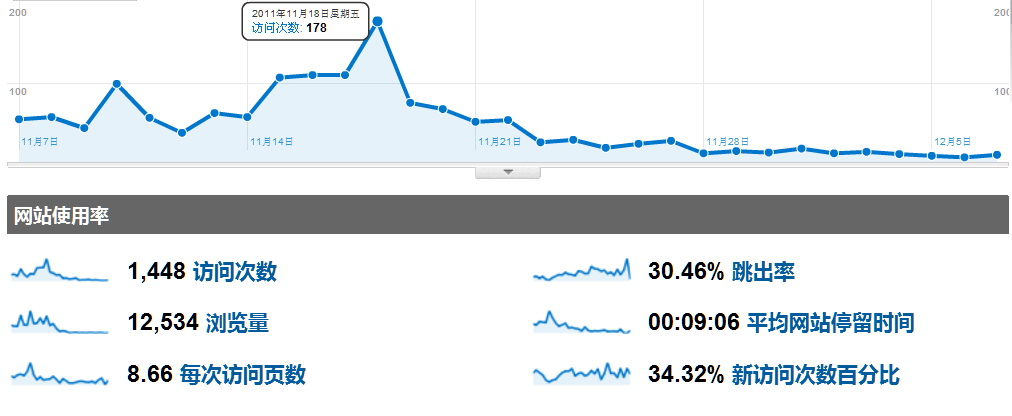
The 5 or 6 visits per day at the bottom include myself, and probably also some automatic crawlers or spam-registration bots. Unless the site is malfunctioning, it’s unlikely to truly drop to 0; this position can basically be understood as meaning the site is already dead.
I had originally been thinking about recruiting some classmates to serve as site administrators or moderators, truly developing this site from my personal property into a shared asset. But I was also holding back, because if a situation like the present one arose, then I would have to consider taking the site back and rebuilding it.
How would I rebuild it? First, I would still keep the current BBS running for a while, but at the appropriate time I would move that BBS to a subdomain such as bbs.keshizhe.net. The homepage would then be repurposed for something else.
I also considered donating this site to the Peking University Center for the History, Philosophy, and Sociology of Science and Technology, and rebuilding it as a WordPress-based portal for history, philosophy, and sociology of science and technology, replacing the current, utterly terrible hps.pku.edu.cn site. Of course, if traffic were high, the server would need an upgrade. WordPress is very easy to maintain; once set up, it can be handed over to anyone to manage. As for the domain name, it could either be hiddenly redirected from hps.pku.edu.cn or used directly as keshizhe.net. But if Professor Wu doesn’t want it, then I won’t fuss over it.
Speaking of hps.pku.edu.cn, I’m really getting angry just thinking about it, so let me say a few more words while I’m at it……
Back when Professor Wu found a classmate of Jing Qi’s to help build the site, I had only just started constructing my own blog host, so apart from suggesting that they might as well use an existing site-building program, I didn’t pay much more attention or get involved. But clearly they didn’t adopt my suggestion. I heard that because they were studying this stuff, they wanted to practice on their own, so they wrote it themselves. Now the more I think about it, the angrier I get: no matter how good your programming is, even if you’re the best in the world—so what? Those excellent site-building programs were not written by one person or a small clique; they underwent long periods of polishing and improvement in commercial companies or open-source communities, and are by no means something any individual could hope to match by writing from scratch in just over half a month. Moreover, those site-building programs have excellent room for extension, and they are also convenient for backup, migration, upgrading, and maintenance. If you want to practice programming techniques, at least you should rewrite an existing program, right? You were clearly using PHP, an open-source programming language, yet you didn’t have the slightest open-source spirit—you only cared about practicing on your own. But did you think more about the site itself?
So let’s take a look at how these genius programmers, who supposedly don’t need to stand on the shoulders of giants, wrote the site. A total mess! This new site built in 2011 feels even worse than the old site our senior classmates built in 2003. In terms of appearance, it already falls short by a fair margin—for example the strip at the top of the page, or “details…”, or the horizontal rule, or the styling of the article body…… Of course, taste in aesthetics is subjective, but at the very least the new site’s styling is crude and also looks quite outdated.
It’s also terrible in terms of SEO (search engine optimization); there isn’t even a meta description. The human reading experience is not good either. For example, all links are set to open in a new window. This design must have been Professor Wu’s idea; when I heard about it at the time, I thought it was mainly for external links and didn’t pay much attention. I didn’t expect even internal links to open in new windows. This design is also very outdated. Now all the advanced browsers (of course Firefox and Chrome both require plugins) can easily open links in new tabs by holding the link and dragging it a little bit (Internet Explorer can also do it by holding Shift and clicking). But most of the time I may not want to open a new window, in which case I should just click directly. In other words, whether to open in a new window ought to be freely chosen by the reader. But forcing everything to open in a new window like this makes the reading experience extremely poor.
The worst problem, though, is that it doesn’t support any of the new functions of the Web 2.0 era, the social features. At the very least, it doesn’t even have RSS. In fact, with the rise of the mobile internet, RSS has regained importance. I always feel that subscription functionality is indispensable for a site of news and information. Especially when updates are not very frequent—say, once every few days—rather than expecting visitors to keep refreshing our pages every day, it would be better to provide them with subscription features.
Last time Professor Wu asked me how much traffic my blog gets, whether not many people were reading it. I said the traffic wasn’t high, but it was fairly stable. What I didn’t mention then was that, in fact, direct visits are only one way a site gets read. Many more people don’t need to visit the site directly; they can keep up with updates through RSS subscriptions, Weibo follows, and Email subscriptions. Right now my blog has 16 subscribers on Google Reader for its RSS feed (Professor Wu’s blog has 37). Nearly 50 people have subscribed by Email. In addition, every time I publish an article, the message is automatically synchronized to my various Weibo accounts and a summary is displayed. Other readers can also easily share or repost information about my articles on their own Weibo accounts. According to Jiathis records alone, over the past year my articles have been shared on various social networking sites about 150 times, with Sina Weibo, Renren, and Sina Blog accounting for the most.
The difference between what is called Web 1.0 and Web 2.0 is that a Web 1.0 site is nothing more than a bulletin board: top-down, with the reader doing nothing but click—browse—close; Web 2.0, however, turns any webpage into not just that one page, but a node in a social network. And the current hps site not only fails to be a social network, it doesn’t even have an internal network of its own. Each article appears as a dead end. After reading one article, aside from “back,” there is no other path. For example, there are no components such as similar articles/related articles.
Finally, I don’t know how the backend management of hps.pku.edu.cn works, but I suspect it certainly cannot be compared with a mature program like WordPress. WordPress is easy to maintain—whether creating a new menu or adding news to a new category, it is as easy as posting a blog entry, and the published content can easily be edited in rich text format (like Word), or you can directly copy text from Word with formatting, and of course uploading images and the like is no problem either. In addition, WordPress allows for multiple permission levels, such as “administrator,” “author,” “contributor,” and “subscriber.” Administrators can change the site’s structure, while authors can only publish articles, and contributors can submit articles for an administrator’s review and publication. In this way, the site can be updated in a very self-service manner.
Since hps.pku.edu.cn ultimately cannot satisfy me, why shouldn’t I strike out on my own? keshizhe.net was originally intended to establish a public platform for the “history, philosophy, and sociology of science and technology” field. The original plan was to make it forum-centered and portal-supported (PHPwind also has portal functionality), but now that I think about it, in the absence of favorable timing, favorable circumstances, and favorable people—especially with the human element still lacking a foundation—it may be more effective to start with a portal site first. A portal site can be run initially by one or two core people, and gradually accumulate content until it becomes more and more lively. But if a forum starts out with only one or two core people, it is absolutely bound to be lifeless.
A history, philosophy, and sociology of science and technology portal site, besides providing some fresh information, may perhaps have a better breakthrough point in building a library site. Back then Professor Wu once asked me to manage the History, Philosophy, and Sociology of Science and Technology Library, and to widely collect related articles and add them to it. However, that collection effort encountered some setbacks (the details would take too long to explain), and in the end it was never accomplished, so I shelved it like that. Now perhaps I can pick up this work again. I had originally planned to use yilinhut.net to make a private repost library site, but it would also be fine to build a history, philosophy, and sociology of science and technology library site at the same time, or even as the first priority.
My general conception of the library site is as follows (as for basic functions like subscriptions and sharing, those go without saying):
First, pay attention to copyright, and do not directly cut articles from journals and magazines; instead, choose articles that have already been made public online (for example, scholars’ blogs, or electronic versions of newspapers and magazines). All reprints should indicate the original link, and try to send a pingback.
Second, allow netizens to register as contributors and submit articles themselves, which I or other administrators will review and publish.
Third, open comments and provide margin annotation functionality. This is the most difficult item, because I still haven’t found an ideal WordPress annotation plugin. The Feedback by Paragraph plugin mentioned at the time is too old and buggy, and the author has stopped updating it; the author’s new plugin, MCEngine, also has many problems, and the author has stopped maintaining it as well. A more worthwhile option is the Digress.it plugin/theme. This plugin is still updated frequently, and quite a number of academic sites (libraries, universities) are already using it. In addition, an open-source project on which Digress is based, CommentPress, has also developed to version 3.2. I tried this new development version, and it has some better features, but also quite a few problems. By studying the PHP code, I already solved the serious problem that it doesn’t support Chinese, but there is still a great deal to change before applying it here. A common problem with these two plugins is that they must be used with specific themes. There are also Open Knowledge Foundation’s Annotator and Roohit’s Highlighter plugin, both of which can achieve fairly good results (not margin annotations for each paragraph, but highlighting text to comment on), but both of them require calling third-party websites and storing data there. At the appropriate time, I may have to offer a reward to recruit WordPress or PHP experts to help me rewrite the plugin.
Translated from the Chinese original with AI assistance. The original text is authoritative.