
This article was published in the November 24, 2017 issue of the *Science and Technology Daily* on the “Chang’e Supplement.” The original title was “Edison: The Invention of Invention”; the editor’s revised title is also quite good, so I am reposting it according to the edited version.
What was Edison’s greatest invention? People usually think of the light bulb. But many people do not realize that, in fact, Edison was only an improver of the light bulb; decades before him there had already been light bulbs, and even in terms of commercial popularization, he was not the first. But Edison was still undeniably the king of invention. His contribution was not just great inventions such as the light bulb and the phonograph; more importantly, in a certain sense he reinvented “invention” itself.
Edison’s well-known aphorism happens to echo this “invention of invention”: “Genius is one percent inspiration and ninety-nine percent perspiration.” The key question is how to make inspiration and perspiration organically join together. And the invention of the light bulb is precisely a typical example: what it reveals is not merely Edison’s inspiration or diligence, but more importantly his way of coordinating inspiration and diligence.
An incandescent lamp uses the heating effect of electric current; when some materials are heated, they emit light. As early as the eighteenth century, this phenomenon was already known to electrical researchers. In the early nineteenth century, when batteries and generators had not yet developed, the British electrical scientist Davy used 2,000 Leyden jars to discharge electricity through a thin strip of platinum, demonstrating the most primitive incandescent lamp. Over the following decades, researchers kept trying to improve the design of incandescent lamps. They used carbon rods or platinum wire, iridium wire, and other materials as conductors, and also tried placing the filament in a vacuum vessel.
The person who ultimately made incandescent lamps commercially viable was Joseph Swan. In the 1870s, he made filaments from carbonized paper (and later cotton), and improved the vacuum pump, thereby enhancing the durability of the bulb and making commercial promotion possible. The world’s first residences lit by electric light, the first public building illuminated by electric light, and the first street lit by electric light were all Swan’s handiwork.
From the “evolutionary” path of the light bulb, we can see that the basic principle and technical elements of the incandescent lamp had long since been determined; what remained was only continuous improvement in the direction of greater durability, greater reliability, and lower cost, and the direction of improvement itself was also fixed: nothing more than finding a more durable and cheaper filament and making a more vacuumized bulb.
Edison worked on both of these aspects. In 1878, he began improving the filament; in 1879, he applied in the United States for a patent using cotton, paper, and other materials to make carbon filaments. This was a year later than Swan’s application in Britain. The greater breakthrough came a few months after he obtained the patent: in 1880, Edison discovered that carbonized bamboo filaments—especially those made from Japanese bamboo—worked astonishingly well, with a lifespan of up to 1,200 hours.
Why, if the light bulb was not Edison’s own invention, was his status so lofty? The key lies in the fact that his improvement of the light bulb was not the achievement of one man alone, but something produced by the research team he led. In a certain sense, Edison invented “invention” itself.
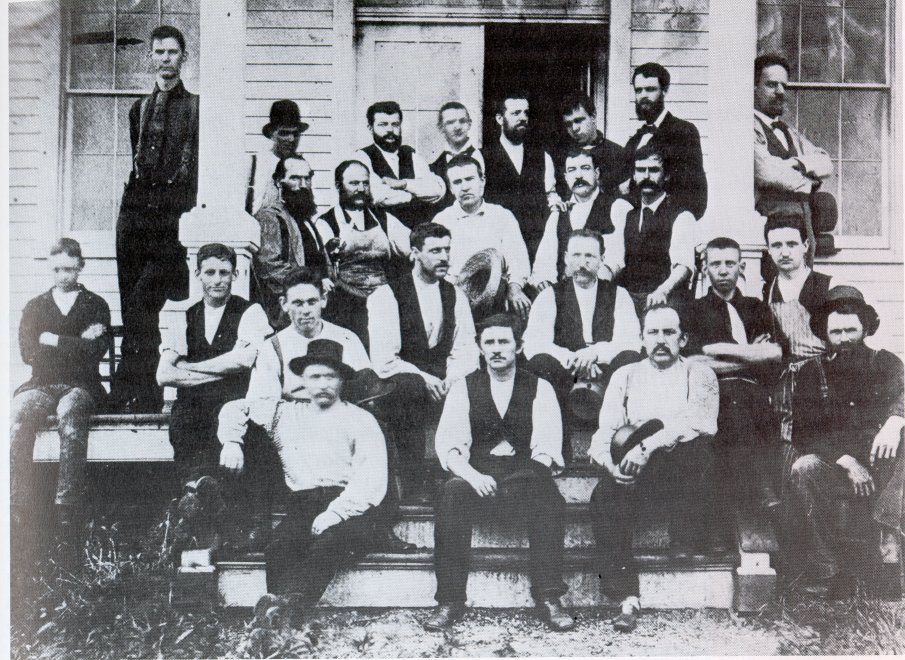
In 1876, Edison established the Menlo Park Laboratory. At first it had only a few employees; by 1878 it had grown to 25 people; around the time he obtained the light-bulb patent in 1880, it had reached 50 to 60 people. After the establishment of General Electric, the industrial laboratory was extended to every factory, and production and research became tightly integrated.
This system, in which large corporations set up specialized R&D institutions to promote the integration of “production and research,” became popular in the twentieth century. Major well-known companies all rushed to establish laboratories. Edison’s laboratory can be said to have been the forerunner and model for these later industrial labs.
Edison applied the model of industrial mass production to “invention” itself. In his laboratory, “invention” was like an industrial product: it could be broken down into separate stages, placed on an “assembly line” for experts in different fields to work on separately, and ultimately assembled into an effective patent.
Clichéd popular-science books mention that Edison tested hundreds and thousands of materials before finally finding the optimal bamboo filament, often merely to highlight the inventor’s diligence. However, testing hundreds and thousands of materials tens of thousands of times was clearly not something Edison could have done alone. Some employees were specially responsible for collecting materials from around the world; some were responsible for the carbonization process; some were responsible for test records… It was precisely because the employees completed Edison’s assigned tasks in an organized and disciplined way that invention could be advanced efficiently. The logic of industrial production was applied to “invention” itself: a division of labor in which each person does his own part was far more efficient than having everyone start from scratch and work to the end. Add to that a complete set of logistical support and attendance supervision systems, and the workshop could steadily advance research in every subfield and quickly integrate the results. That is what made Edison’s inventions so efficient and so prolific. Because all of the laboratory’s inventions were ultimately patented under Edison’s name, Edison was able to hold 1,093 U.S. patents.
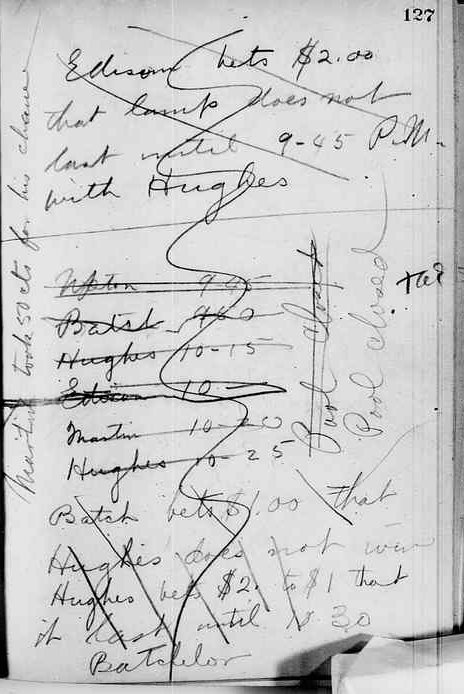
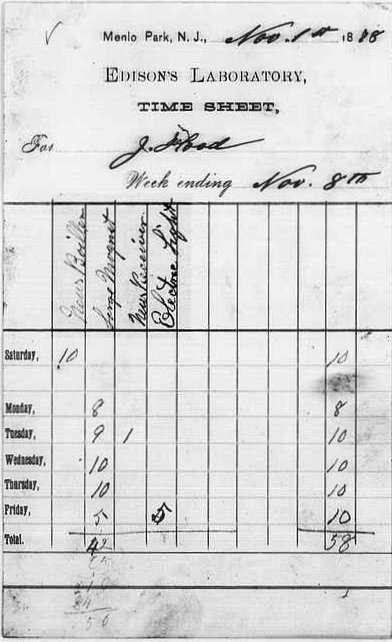
Attendance records from Edison’s laboratory: daily tasks, weekly working hours
The “ninety-nine percent perspiration” that shapes genius may very likely have been perspiration shed by ninety-nine other people. A true genius is not only someone who can endure hardship and work diligently himself, but even more someone who is adept at effectively “organizing” other people’s perspiration into a stable mechanism of cooperation. This kind of institutionalized invention industry was something the geniuses before Edison never managed to achieve.
Translated from the Chinese original with AI assistance. The original text is authoritative.