
This semester I’m teaching two courses: one is “Introduction to the Philosophy of Technology” for undergraduates, and the other is the required graduate course “Selected Readings in the Classics of Philosophy of Science.”
Introduction to the Philosophy of Technology meets every Tuesday at 15:20, in 6B113 of Building 6.
Selected Readings in the Classics of Philosophy of Science meets every Wednesday at 13:30 (adjusting to 13:00 after October), in 3203 of Building 3.
As for the reading group, the time has not yet been decided; I guess it may not officially get underway until after the National Day holiday?
Introduction to the Philosophy of Technology
Course Description
This course alternates with the spring-semester course “A General History of Technology,” but the two are positioned differently. “A General History of Technology” is a broad-facing, showcase-style course with a wider audience and slightly lower demands, whereas “Introduction to the Philosophy of Technology” is more demanding of students, and I would prefer not to have too many people enroll; those who do enroll should actively participate in the course. Reading, discussion, and writing are all required.
Course Requirements
Course paper (80%) + regular performance (20%)
Course paper requirements: more than 6,000 Chinese characters, in proper academic format (sources cited and referenced), plagiarism is strictly forbidden! (If discovered, the grade will inevitably be0; there is absolutely no room for discussion.)
There is no upper limit on length. If 6,000 characters feels too long, you may instead write two short papers of around 3,000 characters each. You may also substitute ten essays of around 600 characters each.
Submit at any point before the end of the semester; the final deadline is within one week after the exam period. Students who submit earlier can receive more comments and feedback. If you submit in the form of multiple short pieces, they should be turned in over time and not all left until the end of the term.
No roll call, but I do keep track of faces. You may ask questions, interject, or offer your thoughts at any time in class. In addition, students who are interested may apply to give a themed report, with 20–30 minutes of speaking time as the main presenter. Students with too many absences or who never speak will lose points.
Course Format and Outline
The course will still be mainly lecture-based, with some student-led segments arranged according to students’ initiative.
The lectures will follow a threefold thread: “texts + history + problems.” The tentative outline is as follows:
- Introduction: the history of technology as transcendental philosophy
- Stiegler, Plato, Kant
- The extension of the human—what is technology?
- McLuhan, Understanding Media; Heidegger, Being and Time
- Technology and the origin of humanity—did humans come first, or technology?
- Stiegler, Technics and Time I
- The discovery of nature—what are the similarities and differences between science and technology?
- Aristotle, Physics
- The logic of machines—do humans control machines, or do machines control humans?
- Marx, 1844 Manuscripts, Capital; Mumford, The Myth of the Machine
- Technology and modernity—how does the modern differ from the ancient?
- Heidegger, “The Question Concerning Technology”, “Building Dwelling Thinking”
- Loss of control—has modern technology formed an autonomous system?
- Ellul, “The Technological Order”; Winner, Autonomous Technology
- The information age—the many new problems brought by information technology
- Dreyfus, What Computers Still Can’t Do; Feenberg, “technical code”
- Close analysis
- Specific discussions of technologies (paper, clocks, gunpowder, architecture, mobile phones, …)
Note: each segment will take roughly 1–2 weeks of class time, and the final part, section 9, may be interwoven throughout the middle of the semester. The assigned readings are not required of all students; only Heidegger’s essay “The Question Concerning Technology” is one I hope everyone will read, and I may find an opportunity to explain it in class.
General Recommended Readings
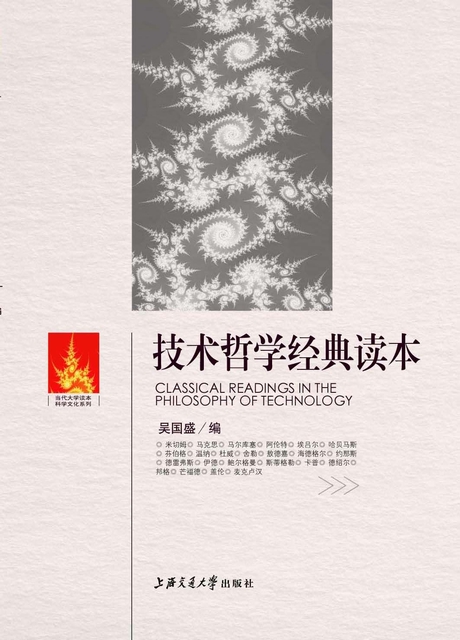
Recommended readings for each lecture will be given in class. The general recommended readings are Wu Guosheng, ed., Classical Readings in the Philosophy of Technology (excerpts from many classic texts can be found in this book; the paperback is hard to buy now, but the Kindle edition is available), Wu Guosheng, Lectures on the Philosophy of Technology, and Ihde, An Introduction to the Philosophy of Technology.
Selected Readings in the Classics of Philosophy of Science
The basic course design is the same as last year. This year there are 7 students enrolled. I had been thinking of adding a “pioneers” segment, focusing on Mach, Duhem, and Poincaré, but none of the students chose that, so instead we went with Eddington, whom I happened to have on hand (since it’s philosophy of science written by a scientist, I suppose it counts for this segment as well). In addition, I also added several books that the original STS program was quite fond of, and the one ultimately selected was Cartwright. As for report times, the students will coordinate internally on their own; the order is a bit messy, but I feel it probably doesn’t matter much.
The books tentatively chosen by the students are as follows:
Eddington: The Philosophy of Physical Science
Putnam: Reason, Truth and History
Hempel: The Philosophy of Natural Science
Latour: We Have Never Been Modern
Reichenbach: The Rise of Scientific Philosophy
Kuhn: The Structure of Scientific Revolutions
Cartwright: The Dappled World
Translated from the Chinese original with AI assistance. The original text is authoritative.