
This Spring Festival, my wife and I, as usual, went home to keep our parents company. This year was a bit special: on the one hand, we finally finished our wedding ceremony last year (we had already been legally married long ago, but the ritual was only just completed), which put our parents’ minds at ease; on the other hand, they were also, one after another, just entering retirement.
My parents had been retired in name for a long time, but in practice they had been running their own storefront all along. Last year they finally rented the shop out and let go of it to enjoy life for themselves. My father-in-law stepped back from the front line, and my mother-in-law has just retired as well; both are moving into retirement.
My parents are fairly open-minded. They said that while they were still physically able to travel, they might as well tour the whole world, and before long they had been to Europe, America, Japan, and Korea. But beyond traveling, one still needs to find things to do.
In guiding older people to enjoy retirement, the “senior university” has a very strong presence. Many people spend their whole lives busy, and one of the saddest things is that when they finally do have leisure, they have to learn entertainment from scratch. Young people like to toss around the four big characters “eat, drift, and wait for death” (混吃等死), but when they really get old, really no longer need to work, and really can only eat, drift, and wait for death, they are not satisfied at all. Older people still want ambitions; they still need to live a life with a sense of accomplishment. So institutions such as senior universities, which provide training specifically for older people, are very meaningful.
My mother is studying English and singing; my father went to study photography; my mother-in-law also signed up for senior university. Only my father-in-law can amuse himself by going online, so he didn’t want to enroll in senior university. For this, he even got a sidelong glance from my mother-in-law. She thought he was being too lazy.
So I remembered to look up what senior universities actually teach, and after a rough survey, the mainstream courses are nothing more than calligraphy and painting, literature and arts, singing and dancing, martial arts and fitness, piano, chess, photography, gardening, foreign languages, and so on. A few also offer computer courses, but only at a very elementary, introductory level.
By and large, these courses are all zither, chess, calligraphy, and painting—very elegant. And what is it that makes them so similar? They are very much like the schedules of interest classes for children and teenagers. Apart from classroom education, are not the classes parents like to enroll their children in also of these very same kinds?
It is somewhat sad to say this, but after entering the exam-oriented track in upper primary school, and then all the way through a whole life of busy work, ordinary people seem to have only these two bookends—childhood and retirement—when they have a chance to learn these cultured yet useless skills. But what, exactly, is the meaning of learning these things? In truth, we have not really figured it out. It is only because the word “elegant” is usually preceded by the word “supplementary” (附庸) that, because other children are enrolled, because other elders are enrolled, we follow along and learn them too. It can’t be wrong to do that, and that is all there is to it.
The reasons for letting children or older people take these interest classes are quite similar: nothing more than developing intelligence and cultivating temperament. For older people, it means slowing brain decline and adding a little spice to life. Very few people actually expect senior universities to produce many artists.
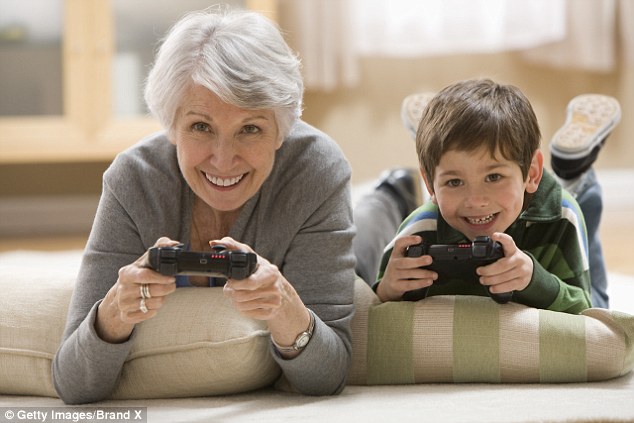
This kind of learning of useless knowledge is truly free and unrestrained. So then I thought: since it is all about learning useless things, why don’t older people learn to play games?
The interest classes for older people are similar to those for children, but there is one thing that is not quite the same: the thing that children do not need interest classes to learn, and can pick up on their own without instruction—playing games—has almost no trace in older people’s learning activities.
It is another very sad thing to say: when, exactly, can a person play games? Parents do not let toddlers play games, believing it affects development; they strictly control teenagers’ gaming because it interferes with school; once grown up, one is busy working and then has to take care of children, so there still seems to be no time to play. Then if one waits until school and work are both gone, and only after retirement, what reason remains to stop a person from playing games?
The sad thing is that there really is still one huge reason preventing older people from playing games, namely—being unable to play!
But if one cannot play, one can learn. Things like calligraphy, painting, and photography are also often newly learned only after retirement by many older people. So is learning to play games difficult? It is and it isn’t. A three-year-old child picking up a phone may very quickly find the trick to playing. If you ask a primary school student which is harder—Chinese painting, piano, or gaming—I reckon very few would think gaming is difficult. But those middle-aged and older people who studied calculus when they were young and later relearned the piano when they were old—if they really wanted to learn, would they really be worse than three- or five-year-olds?
Of course, because of the natural aging of the body, older people really do have difficulty adapting to games that demand especially high dexterity. But some games are nothing more than slowly clicking a mouse—what is so difficult about that?
So, in short: first, older people have the right to play games; even if they become addicted to games, there is nothing else that will be delayed by it. Second, older people can play games; most older people’s intelligence and physical ability have not declined to below that of three- or five-year-olds. So the question is, what else is preventing older people from gaming?
In my view, there may still be the following four major reasons: incapacity, fear, contempt, and not thinking of it.
By “incapacity,” I mean a certain lack more original than the specific inability to play, something like this: a person with all four limbs intact has been tied to a wheelchair since childhood, and only when old is the binding finally loosened. Then his walking function has long since atrophied, and if you make him learn to walk again, it really will be harder for him than for a three-year-old child to learn.
As for video games, there are millions of kinds and millions of ways to play, but in the final analysis there are some foundational abilities that need to be learned first. Just as there are countless specific ways of walking, but whatever the gait, a person must first learn some capacity for coordination and balance. For gaming, the first foundational ability, I think, is a kind of “projection” ability: the player must establish, on their own, an original correspondence between actions in real space—operating the controller or keyboard—and certain objects within the screen.
This so-called original correspondence is not, as in a matching game, the establishment of a connection between two objective objects, but rather the establishment of a connection between the subjective “I” and an object. For example, only when I regard my “foot” as “my” foot can I begin to walk. If I always merely treat my feet and anyone else’s feet the same, viewing them all as objective objects to be observed, then I will not be able to learn to walk. That is why it is difficult for people to learn swimming, cycling, and driving through objective observation alone. In philosophy, this phenomenon is called “embodiment.” I must take something external to me and treat it as part of my interior, as a component or extension of my body; only then will I become as skillful as if I were wielding an arm.
To take the little figure or symbol on the screen as part of “me,” or even to project “me” into it completely—to regard the image on the screen as me running, me jumping, me slashing… this requires learning. It is like learning to ride a bicycle or drive: once mastered, it feels like an extremely easy thing. When riding, one does not need to be constantly thinking about how to keep balance, nor constantly paying attention to how to fine-tune the force with which one grips the handlebars. But for beginners, such a skill is daunting. If one did not personally see everyone on the street riding bicycles, one might very well think that controlling this dangerous machine is an impossible task.
Playing games is even harder than activities like cycling. From chopsticks and hammers to bicycles, even to driving cars and controlling mechanical arms, no matter how large the thing being operated may be, it can basically all be seen as an extension of the body; those machines are like prostheses extending along the limbs. But video games are not so much still an “extension” of the body as a “projection,” because the “screen” creates an “interface,” instantly dividing the object before us into two “worlds”—the real world and the virtual world, the world of the body and the world of the game. From my hand to the handlebars to the wheel, it seems as though our “control” is transmitted continuously along a line, but in video games, control acts at a “distance”; our will seems to pass directly through space, through the “barrier between dimensions,” and emerge straight at a point on the screen. Rather than saying that this will that emerges in the “other world” is an extended form of “embodiment,” it is better to say that it is the arrival of an “avatar.”
Controlling a game character is less a tactile kind of control than a visual kind of control. The eyes are more important than the hands, because only vision can instantly cross an endless distance and unfold its inspection on a dimension that stands above all things. One could exaggerate and say that the player is like “God,” looking down upon everything in another world, far removed from all things yet able to exert one’s power within any thing. This “God’s-eye view” is even more apparent in strategy games, but in fact other kinds of games also more or less require this dimension. Many people are bad at games because, in truth, they simply cannot “play God” convincingly.
But compared with the omnipotent God, the god enacted by humans has limited ability: he can transmit his will at a distance, but his will does not always make things happen; very often, it runs into frustration.
In fact, whenever one practices embodiment with any technology, one often has to endure hardship. Very few people learn to ride a bicycle without falling. Learning to swim also means not being afraid of swallowing water; the learning process always has setbacks. This is unavoidable, because the body, as body, in some sense means limitation, because human beings are not God after all, nor free-floating souls; the flesh is the prison of human beings. To skillfully operate the body is nothing more than becoming familiar with its limits. The same is true in dealing with technology: while technology extends human capacities, it also limits the range and modes of human activity.
So, hesitation and timidity are the second major reason that prevents older people from learning games. I know this very well from teaching my parents to use a computer. If a warning pops up, if anything unusual happens, they stop moving at once and immediately need my guidance. When I use a computer, on the other hand, breaking things or crashing things is an everyday occurrence. The same is true when playing games: without setbacks, where would the challenge be? Even veteran players, when they encounter some new game, may be at a loss; they cannot even get out of the starting village, or they get beaten to tears by the first little boss—these are all common things. But older people may look at the beginner’s guide and immediately think it is too hard, impossible to remember, and give up. If one runs away at the first swallow of water, then naturally one will never have anything to do with the feeling, after mastering the skill, of being as fish in water.
The degree of frustration also determines the difficulty of learning. For example, for young people, falling down is routine, but older people really cannot take it, so even when learning to ride a bicycle, children find it easy, while middle-aged and older people, if they still want to learn, will inevitably become cautious and timid. Then, in situations where the setbacks are unrelated to physical strength, in terms of emotional tolerance, middle-aged and older people still differ from children. For example, the three words “you are wrong” are commonplace for a child in the process of growing up, but when said to an old person they can become extremely heavy. Chinese parents in particular are a classic case: they never admit mistakes in front of their children. There are only parents disciplining children—where in the world is there a parent who is willing to be scolded? In that case, if a computer screen suddenly pops up with the three big characters “an error occurred” with a ding, the feelings of children and older people are probably quite different. Children are very good at treating any reproach as wind in their ears and continuing to bumble along on their own, at most thinking, “Oh no, I got scolded again (sticks out tongue); next time I need to be quicker.” Older people, by contrast, may be frightened immediately. Besides a superior, who else would dare to lecture them? Especially if the elder is learning operation from their own child, then the resulting gap is probably very uncomfortable.
In addition, I mentioned before that the degree of completion in the life-worlds of children and elders is very different: a child’s entire self and world are still under construction, whereas an adult’s has long since been capped off. For a child, adding a new technology is like adding bricks and tiles to one’s world; but for an elder, the addition of new technology is bound to disrupt the existing order of one’s world. So what is an exciting new thing for a child becomes a sudden new trouble for an older person. The life-world of the elderly tends toward closure. In traditional society, this was not a problem; on the contrary, one could say that the elder’s world was the ultimate model for the child’s world. Children constantly learned, constantly perfected their world, and in the end did nothing more than build a world as complete and self-sufficient as that of their ancestors. But in the present era, the situation is completely different, because the surrounding environment changes with each passing day, and any way of life that stands still will very quickly be forced out of date. The elderly’s closed space is constantly broken open by the times, and then one has no choice but to live and learn.
These difficulties can actually still be overcome. It is nothing more than spending more time exploring and practicing, and adjusting one’s mindset a bit more. Could something that a six-year-old child can master in ten minutes really be something that a sixty-year-old cannot learn even after ten hours? The gap is not that large. The most fundamental obstacle is that they have no desire to learn.
How do many middle-aged and older people learn computers? At first they could not install any software at all, but once they needed to trade stocks, stock-trading software was installed one by one; at first they did not know how to shop online, and even after their children recommended Alipay for years they still had not learned it, but once relatives and friends started grabbing red envelopes together, they all learned it. The key issue here is not merely that the user experience of those software programs improved; the crucial point is who the person doing the recommending or teaching was.
Middle-aged and older people and young people can be said to belong to two subcultural circles. To put it mildly, there is a generation gap; to put it more bluntly, they look down on each other. Older people look down on what young people like, and young people, in turn, cannot stand the culture of older people. Especially when it comes to one’s own children, parents seem unable to escape a lifetime attitude of “finding fault” and “educating.” Even if the child is already an outstanding graduate of a top university, parents would rather believe knowledge they picked up from their WeChat Moments and use it to educate their children than admit that in many areas of knowledge they ought to be learning from their children.
The divide works both ways. Young people likewise hold an attitude of contempt toward the lives of older people. On the one hand they look down on activities like square dancing, but on the other hand they very rarely seriously imagine whether older people might be able to live a life even trendier than that of young people. Take older people playing games, for example: how many people instinctively refuse even to consider it?
Because of the cultural divide, even when middle-aged and older people have to learn new things, they would rather learn from their own peers than from their younger generation. In particular, the reason gaming is fun is not only that the game itself is interesting and exciting; even more important is its social meaning. Teenagers who play games like to compare skill; adults who play games compare grinding, luck, and spending. On the one hand, playing games together and then discussing the game together afterward is an important social activity. On the other hand, those who play well can gain extra accomplishment outside the game, such as being looked up to in real life, or receiving virtual medals or likes. These dimensions of motivation are indispensable to the popularity of games, or of any social activity. And for older people, these social incentives are almost entirely absent.
After saying all this, what I mean is nothing more than recognizing the rationality of why older people do not play games, and the difficulty of learning to play them. But this does not mean the following approach is unworthy: namely, at least to place gaming alongside photography, piano, and the like, as a subject specifically suitable for older people to study. Only by recognizing difficulties can we then do our utmost to overcome them; that is precisely the mission of “teachers.”
Because learning games is difficult, but once you learn to play, the gains are enormous! First, killing time and pleasing the mood—games need no explanation there. Second, broadening knowledge and enlivening the mind—of course that too is beyond question. Third, saving money and physical effort. For example, my parents travel all over the world, which is certainly elegant, but it is expensive and exhausting. Yet the money for a single night in a hotel would be enough for me to buy a AAA title and play for a month or two. For example, if I buy an Assassin’s Creed game for just over 200 yuan, I can “travel through time and space” and experience the style of ancient Greece; the grandeur of the scenery, the richness of the details, and the breadth of the cultural background knowledge are now things that today’s whirlwind tour groups simply cannot compare with. And there’s no jet lag, no fear of hurting your knees. Spend a little more money ordering some Western takeaway to compensate for the lack of taste experience in games—wouldn’t that be a total victory over travel? The only drawback is probably that sitting for too long is bad for health, so then just supplement it with some VR games or motion-controlled games for exercise: you can move your legs and feet, it is safe and controllable, and you avoid inhaling smog.
In short, I believe older people are perfectly suited to gaming, and not just simple games like stealing vegetables, poker, or matching games, but everything, including AAA titles. Moreover, gaming ought to become the most central and important subject in senior universities. A few years ago, I personally bought my parents a Switch (regrettably it has been left unused), and this year I gave them a VR set. By the way, the iQIYI Qiyu II + Nolo solution is excellent: the 4K Qiyu II is most suitable for watching movies, and with Nolo one can play PC games like Beat Saber. If you don’t plan on gaming, giving an older person a 4K all-in-one headset just for watching movies is also good; the iQIYI VIP membership, when bundled with JD Plus membership, only costs a bit over 100 yuan after the discount. The reactions from both families of parents after receiving them were quite good. But because of the gulf between social circles, we cannot expect older people to join the younger generation’s social circle and compete and exchange with them together; there must be scenes where older people are playing games together, and only then is it truly possible to mobilize their enthusiasm for learning. I genuinely look forward to seeing some day the scene of older people in senior universities forming teams to go online and play together.
Translated from the Chinese original with AI assistance. The original text is authoritative.